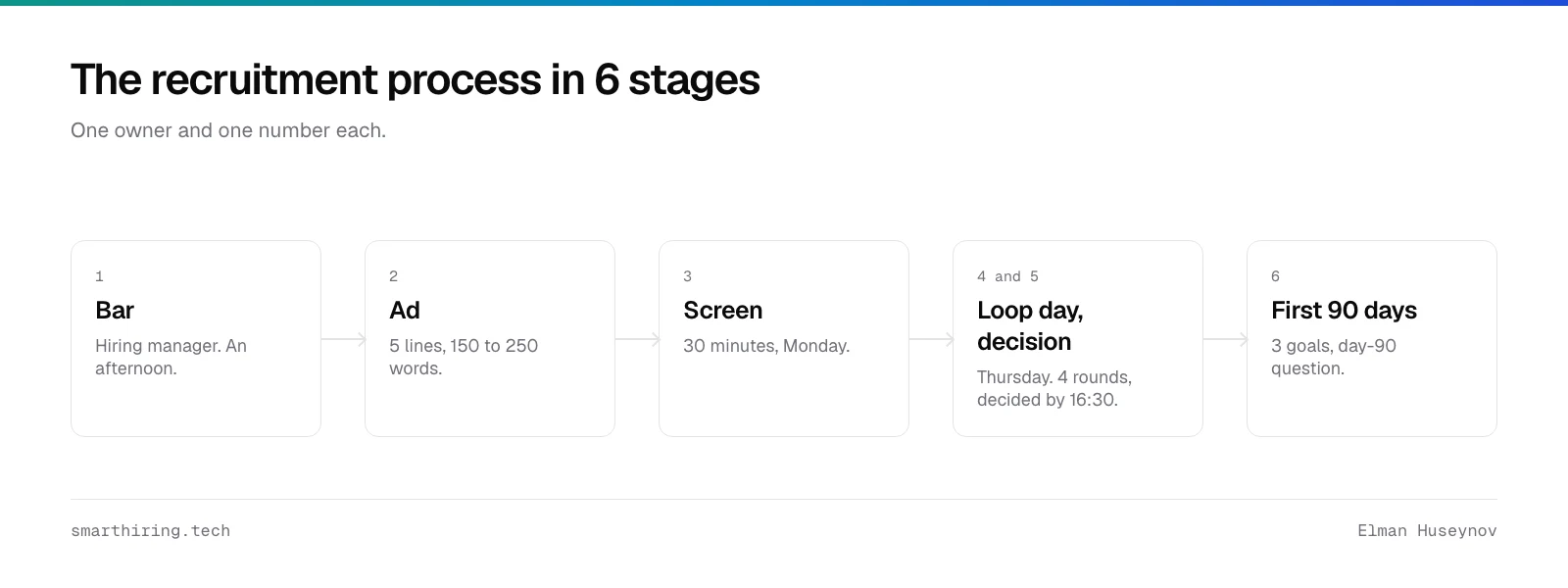
A recruitment process for a 10-engineer team is 6 stages. Bar, ad, screen, loop day, decision, first 90 days.
Each stage has one owner and one number. A small team has no recruiting department and no process to unlearn.
Most of the work is writing down what strong looks like, once per role.
On this page
What are the 6 stages of the recruitment process?
The 6 stages of the recruitment process run from the written bar to day 90. Bar, ad, screen, loop day, decision, first 90 days.
In a 10-engineer team, one wrong hire is 10% of the team.
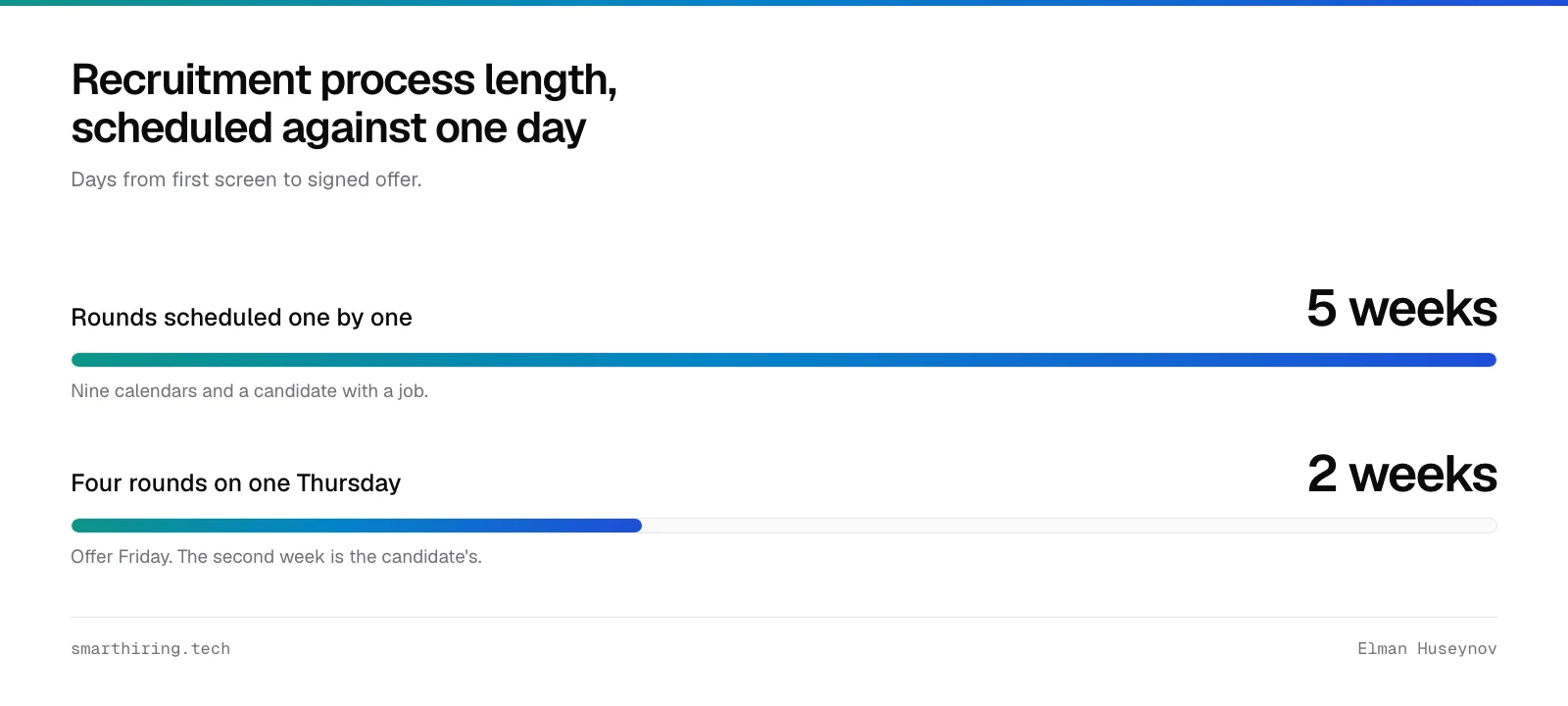
The 6 stages take 2 weeks from first screen to signed offer. The sixth runs for a quarter after that.
How to hire software engineers covers the rounds and sourcing for one engineering role.
Stage 1 of the recruitment process is the only one that costs real time. Everything after it is faster because of it.
Stage 1 and 2: who writes the bar and the ad?
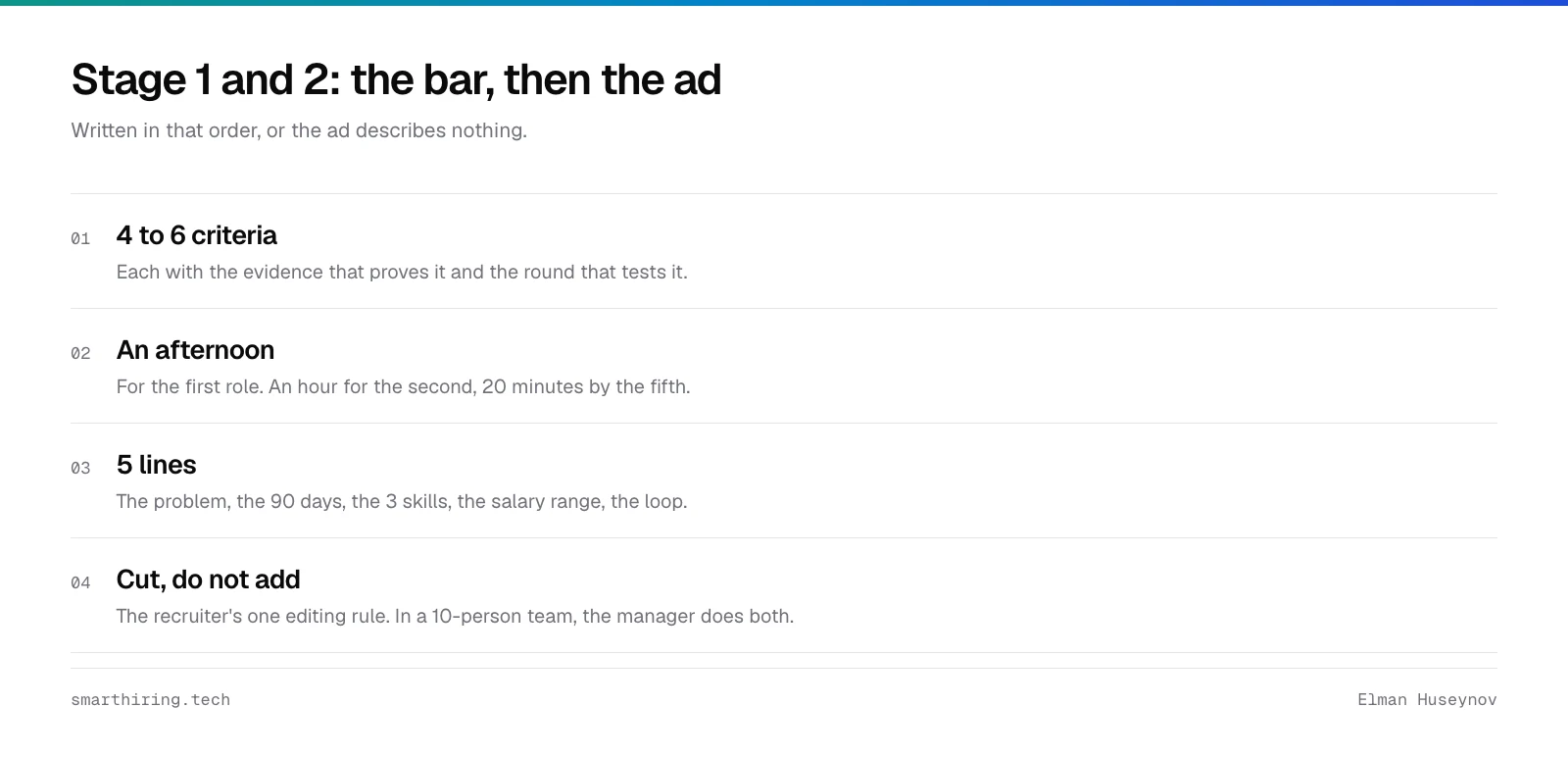
The hiring manager writes the bar, then the ad from it. Four to 6 criteria, evidence for each, one round per criterion.
The scorecard is the slow part. The first role takes an afternoon. The next takes an hour, because most criteria carry over.
The ad is 5 lines, 150 to 250 words, each one lifted from the scorecard.
The recruiter, if there is one, edits with 1 rule: cut, do not add. In a 10-person team the manager does both.
Stage 3: what does the screen do?
The screen is 30 minutes on Monday. In a small team the manager runs it, not an agency.
The screen keeps the loop day for people who can do the work.
The screen is the only round before that day.
A 5-line ad with a salary range does half the screening before anyone calls.
Candidates who need more than the band rule themselves out before the screen.
The manager reads the 20 CVs that pass the ad in one sitting. Each gets a yes or a no.
Stage 4 and 5: the loop day and the decision
The loop day is Thursday: 4 rounds, then the debrief the same afternoon.
The decision is made that evening, in writing.
Practical coding from your own codebase. Design or depth with clear constraints. The hiring manager conversation.
Interviewers score alone before the debrief starts. A founder on every loop still owns one round and one score.
Friday brings an offer or feedback the candidate can use. The 4-round loop covers a senior hire.
Stage 6: what happens after the offer?
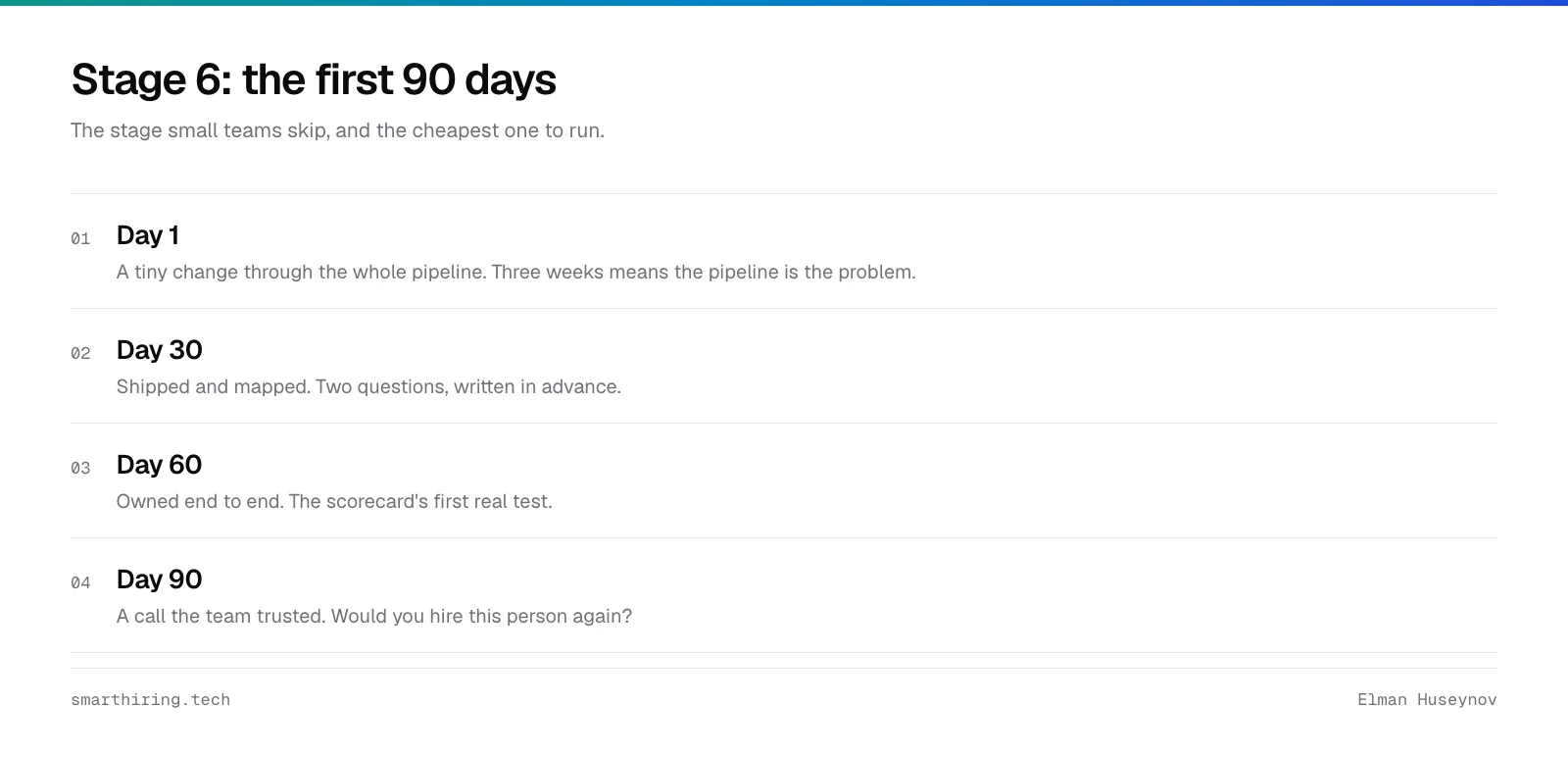
Stage 6 is the 30 60 90 day plan. The manager writes it the week before the start date.
Day 1 tests your setup as much as the hire. One tiny change goes through the whole pipeline.
Each month closes with a 30-minute conversation, booked before the start date.
Day 90 is the question most small teams never ask out loud. Knowing what you know now, would the team hire this person again?
When the hire is a manager, read their first 90 days beside the plan.
Common questions
How long does the recruitment process take for a small team?
Two weeks from first screen to signed offer, per hire. Screen Monday, loop Thursday, offer Friday, the second week for the candidate to decide. Two or 3 roles run in parallel, so 10 hires land in about a quarter. Five weeks is what happens when rounds are scheduled one by one.
Does a 10-person team need a recruiter?
Not for the loop, and maybe not for the funnel. A 5-line ad with a salary range brings the right 20 people. The wrong 200 stay away. The manager reads 20 CVs in a sitting. A recruiter earns their place when 3 or more roles are open at once.
Which stage of the recruitment process do small teams skip?
Stage 1, the written bar, and stage 6, the day-90 question. Both feel optional when the founder runs every interview. Both are where a wrong hire is prevented or caught early. The bar costs an afternoon; the day-90 question costs 30 minutes.
What is the one metric for the recruitment process?
Days from first screen to signed offer, per hire, posted where the team sees it. A small team hires too rarely for averages, so read each hire on its own. Put the number beside that hire’s day-90 answer. A fast loop that hired the wrong person saved nothing.
The short version
Six stages: bar, ad, screen, loop day, decision, first 90 days. One owner and one number each.
Write the bar first. Two weeks from screen to offer. The day-90 question asked out loud.
A 10-person team has no process to unlearn. An afternoon on the scorecard is most of the work.
An audit of your loop, with the 6 stages mapped to your team and named. Book a free 30-minute call.
PDF, 2 pages
6-stage recruitment process, one page
Each stage with its owner, day, output and number, a column for yours, the 2 weeks on a calendar, the one metric, and the 2 stages small teams skip.
Leave a work email: the file opens right here, and one hiring stage, taken apart, follows every week. One click to leave.
Read next
Recruitment Agencies, a Consultant or In-House: 10 Hires After a Round
An agency fee for one engineer is 12,000 to 20,000 euro. Ten hires after a seed round is 120,000 or more, and the loop is still yours. Here is the comparison.
The Behavioral Interview for Engineers, With 3 Questions That Cannot Be Rehearsed
Every candidate has a rehearsed answer to "tell me about a time you disagreed". Here are the 3 questions that survive rehearsal, and the follow-ups that separate a true story from a prepared one.
Want this fixed in your loop?
SmartHiring trains engineering interview panels on their own open roles. Elman Huseynov, a Technical Interview & Calibration Trainer in Berlin, runs every engagement. One workshop writes the scorecards for your roles, then calibration runs until the panel agrees. It starts with a free 30-minute call.
No pitch if the loop is already fine. See an example audit report.