← All posts
The Behavioral Interview for Engineers, With 3 Questions That Cannot Be Rehearsed
4 min read Elman Huseynov
4 min read Elman Huseynov
A behavioral interview for engineers is 3 questions, the same for every candidate. Each is scored against a scorecard line.
Two written follow-ups end a rehearsed story.
Most behavioral rounds measure whether the candidate read the same list the interviewer did.
The 3 questions below produce evidence when the strong answer is written first.
A behavioral interview measures how the candidate has acted. Past behaviour is the evidence for future behaviour.
The round feeds the scorecard lines no coding round can.
Can disagree without stalling. Makes decisions the team follows. Reasons about their own failures.
The 3 lines carry a hiring decision as often as the coding round does. Most panels score them on feeling.
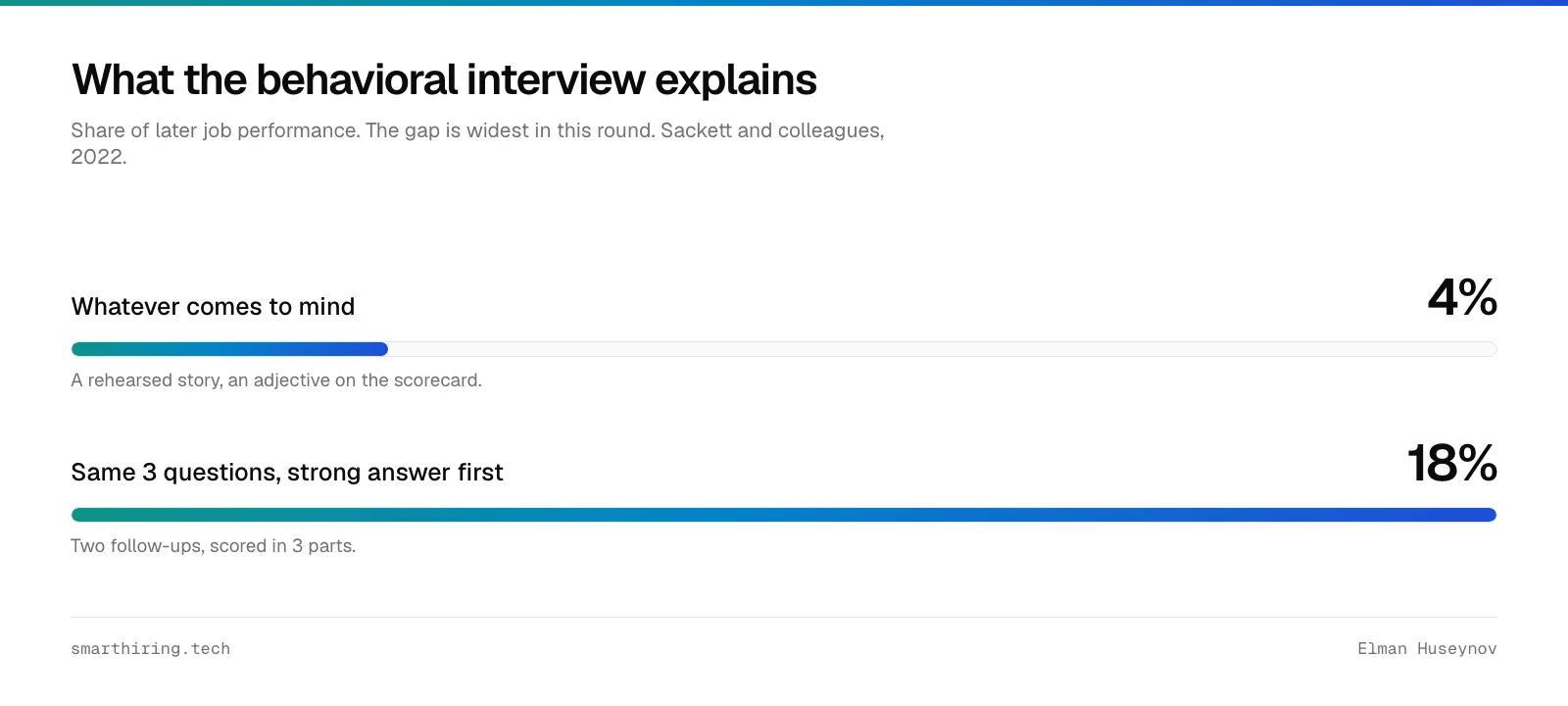
Unstructured interviews explain about 4% of later performance. Structured ones explain about 18% (Sackett and colleagues, 2022).
A behavioral round without a written strong answer is an unstructured interview.
Most behavioral interview questions fail because every candidate has a rehearsed answer.
“Tell me about a time you disagreed with a decision” is on every list.
The interviewer hears a tidy story with a happy ending. The scorecard says “good communicator”. Nothing in it can be checked.
The fix is 2 written follow-ups that a rehearsed story cannot survive.
Anyone telling a prepared story runs out inside 2 follow-ups. Anyone telling a true one gets more specific.
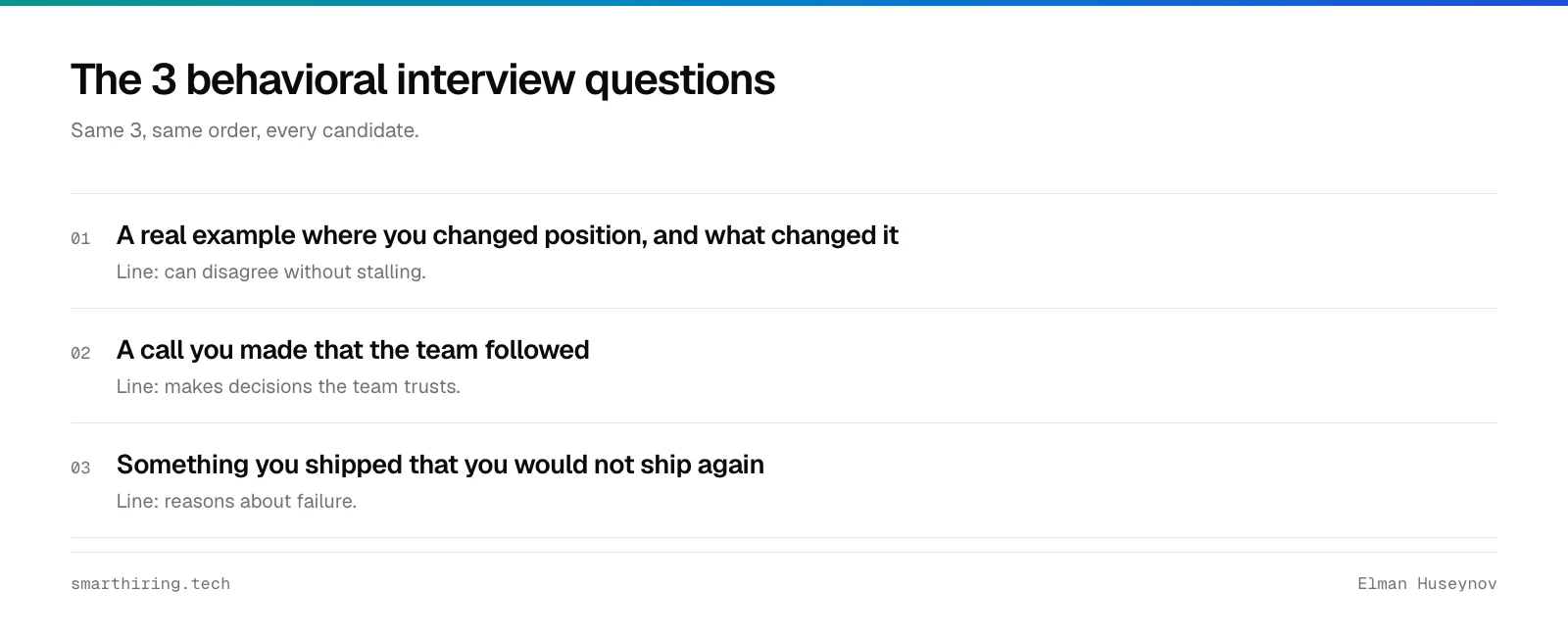
The 3 behavioral interview questions map to 3 scorecard lines.
A changed position. A call the team followed. A thing they would not ship again.
Question 1: “Give me a real example where you changed position, and what changed it.” Line: can disagree without stalling.
Question 2: “Tell me about a call you made that the team followed.” Line: makes decisions the team trusts.
Question 3: “What did you ship that you would not ship again?” Then: “What do you know now?” Line: reasons about failure.
The same 3, in the same order, for every candidate for the role. The scorecard supplies the lines.
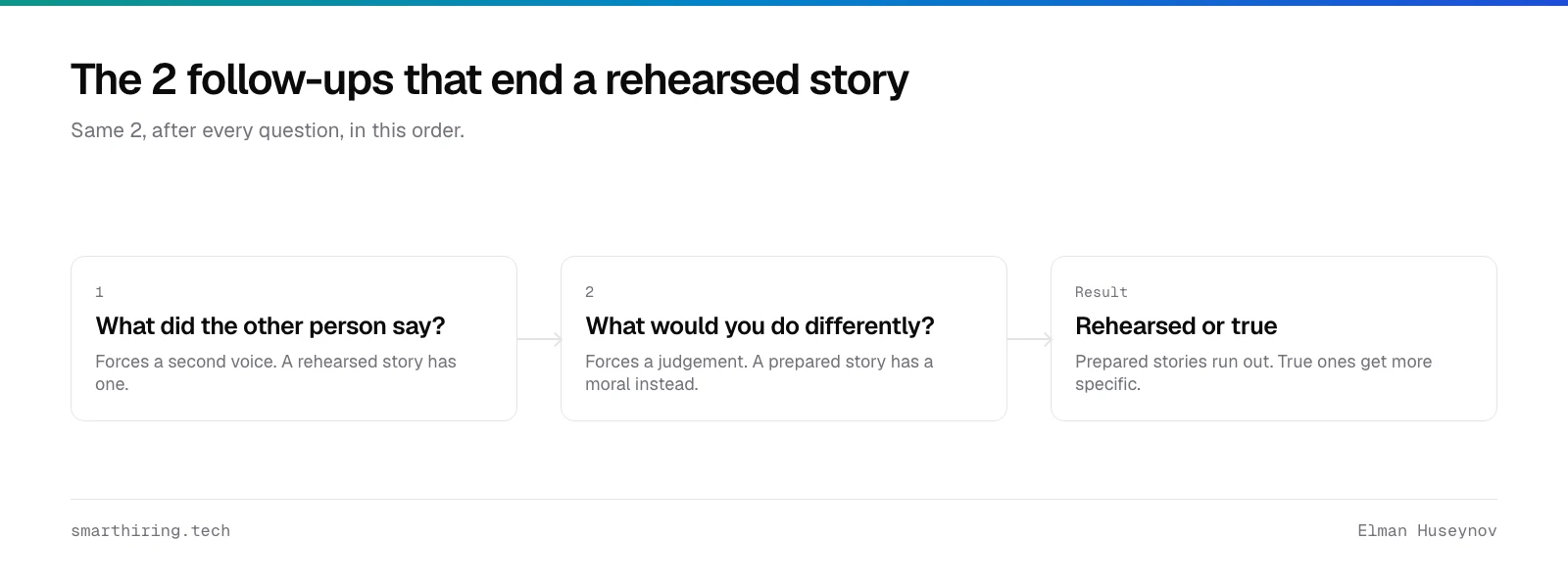
The 2 follow-ups are the same for every question. What did the other person say? What would you do differently?
The first one forces a second voice into the story. A rehearsed story has one voice.
The second one forces a judgement. A true story has one; a prepared story has a moral instead.
Ask both, every time, in that order. Write them on the interviewer’s sheet so nobody improvises a third.
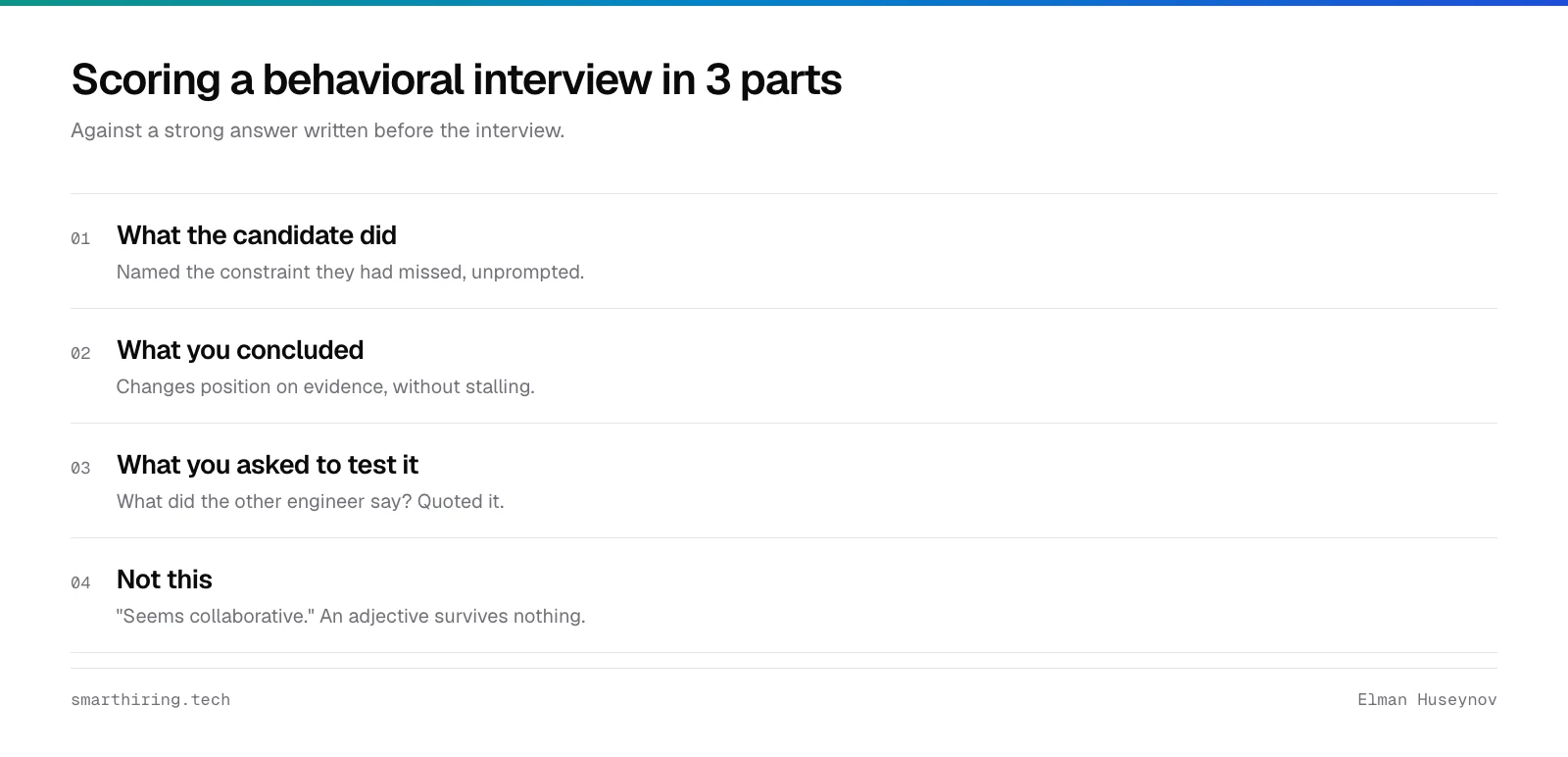
A behavioral interview is scored in 3 parts per question. The strong answer was written first.
What the candidate did. What you concluded. What you asked to test it.
“Named the constraint they had missed, without being prompted. Asked what the other engineer said: quoted it.” That is evidence.
“Seems collaborative” is an adjective. It survives neither the debrief nor calibration.
Write the strong answer before the interview. If you cannot describe one, the question measures taste.
Forty-five minutes. Three questions at 12 minutes each, 2 follow-ups inside each. The rest is for the candidate’s questions. It is the hiring manager’s round in a 4-round loop. The manager runs no other. Longer rounds add a fourth story and no new evidence.
The candidate may use it; the interviewer should not need it. STAR produces a rehearsed shape, which is exactly what the 2 follow-ups exist to break. Score the answer against the strong answer on your sheet. Whether it had a Situation, Task, Action and Result is irrelevant.
Yes, and the structured version is the only one worth running. Same 3 questions, same order, same 2 follow-ups. A strong answer written first. Scores in writing before the debrief. Structured interviews explain about 18% of later performance, against 4% for unstructured ones.
“I do not have one” is a valid answer. A junior candidate may not have one for question 2. Score the line as untested rather than weak, and note it. A candidate who invents an example under pressure is telling you something. The other 2 questions will confirm it.
Three questions, the same for every candidate. A changed position, a call the team followed, a thing they would not ship again.
Two follow-ups, every time. What did the other person say? What would you do differently?
Score in 3 parts against a strong answer written first.
A workshop sprint: the 3 questions and their strong answers written with your panel. Book a free 30-minute call.
PDF, 2 pages
One sheet per candidate: the 3 questions with their scorecard lines, the 2 follow-ups in order, space for the strong answer and the 3-part score, and how to read the answer that is not there.
Leave a work email: the file opens right here, and one hiring stage, taken apart, follows every week. One click to leave.
A 10-engineer team has no recruiting department and no process to unlearn. Here is the recruitment process in 6 stages, from the written bar to the day-90 question.
An agency fee for one engineer is 12,000 to 20,000 euro. Ten hires after a seed round is 120,000 or more, and the loop is still yours. Here is the comparison.
SmartHiring trains engineering interview panels on their own open roles. Elman Huseynov, a Technical Interview & Calibration Trainer in Berlin, runs every engagement. One workshop writes the scorecards for your roles, then calibration runs until the panel agrees. It starts with a free 30-minute call.
No pitch if the loop is already fine. See an example audit report.