The hiring debrief meeting is where the decision gets made. It is also the one meeting nobody designed.
On this page
Lock written scorecards before submission. Show all ratings at once.
Restate the bar before discussing the candidate. Let the lowest rating speak first. Never take a vote.
Thirty minutes is the constraint. Google calls the same meeting a hiring committee.
The default interview debrief: the manager opens with an impression, everyone adjusts, hands go up.
Why does the default debrief meeting fail?
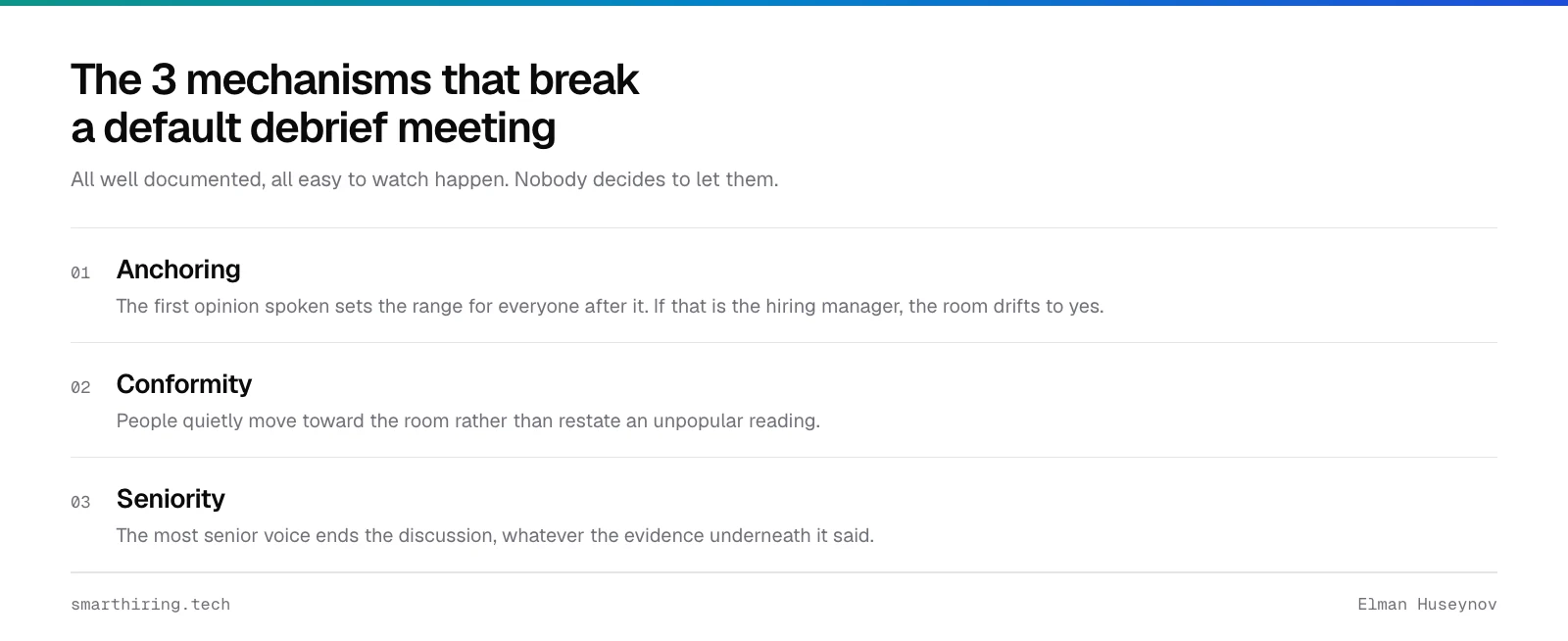
The default debrief meeting fails through 3 mechanisms, all well documented.
Anchoring, where the first opinion spoken sets the range for everyone after it.
Conformity, where people quietly move toward the room. Seniority, where the most senior voice ends the discussion.
Anchoring. If the hiring manager speaks first, the room drifts towards yes. A hiring manager has a seat to fill.
Conformity. A junior interviewer who saw something real softens it to “I could be wrong”. The room hears a yes.
Seniority. Five scores get averaged, and the principal engineer’s weight wins. The finding that mattered is buried.
What is the debrief meeting agenda?
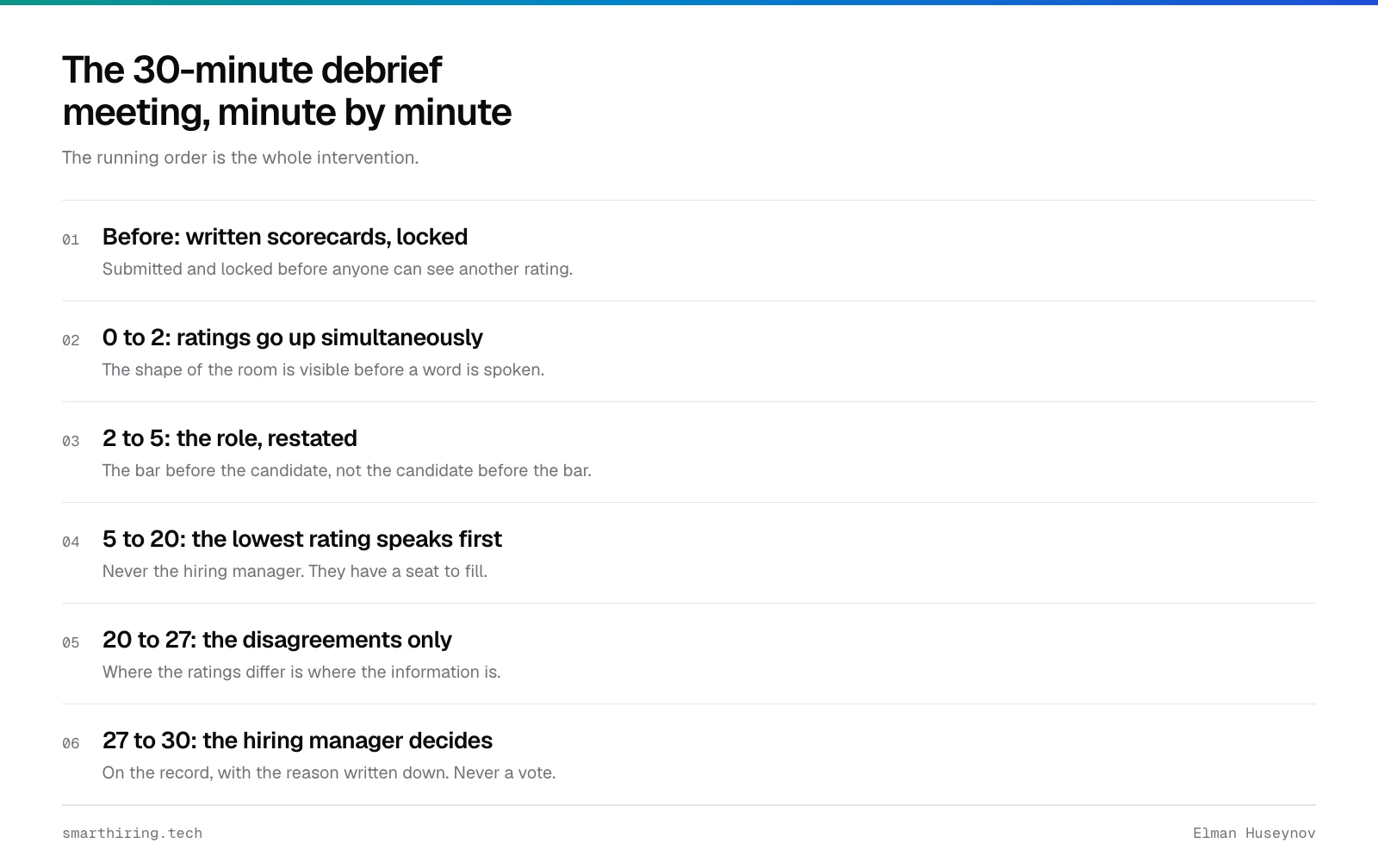
The debrief meeting agenda is 30 minutes in 5 blocks. Scorecards are locked before it starts.
Ratings go up at once. The bar is restated. The lowest rating speaks first. The hiring manager decides.
Before the meeting. Scorecards submitted and locked. Nobody sees another’s until their own is in.
Minute 0 to 2. All ratings on a screen at once. The room sees the shape of the disagreement before anyone speaks.
Minute 2 to 5. The hiring manager reads the bar written before the role opened. The question becomes “does this candidate clear it”.
Minute 5 to 20. The lowest rating presents its evidence first. The strongest advocate goes last.
Minute 20 to 27. Only the disagreements. Did 2 interviewers see different evidence, or apply different standards?
Minute 27 to 30. The hiring manager decides out loud, with a reason, in writing. A vote is a hire nobody owns.
Which 4 debrief questions do the work?
Four interview debrief questions unstick a room. Most disagreements dissolve on the first.
What specifically did they say or do. What would have changed your rating.
Would you want them on your own team next quarter. What is the risk if we are wrong.
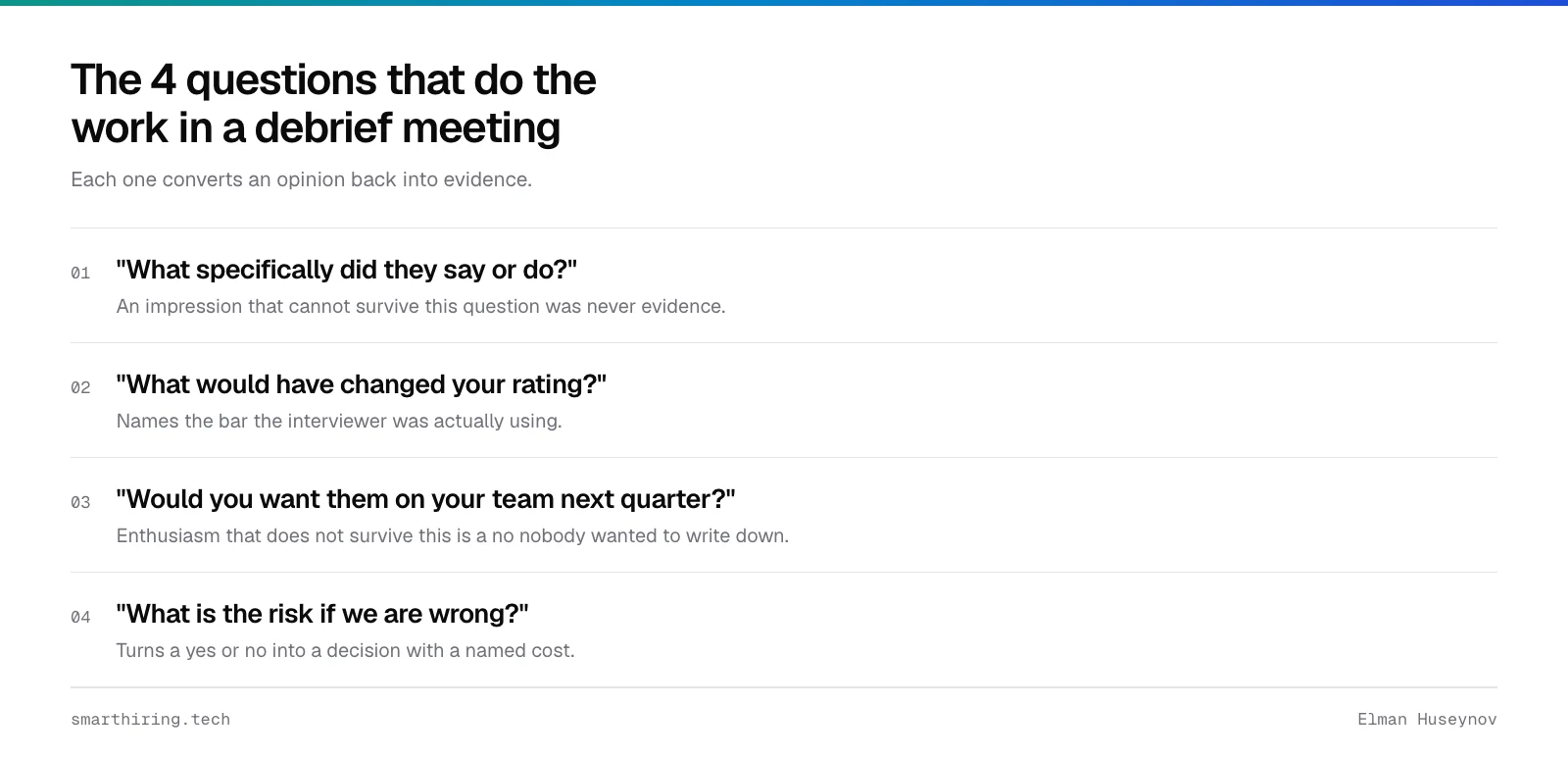
“What specifically did they say or do?” One person is describing an observation and the other an impression.
“What would have changed your rating?” Forces the standard into the open. No answer means the rating was a feeling.
“Would you want them on your team next quarter?” People answer this more honestly than “are they good”.
“What is the risk if we are wrong?” A false positive and a false negative cost different amounts. Say which.
How do you handle the common debrief meeting shapes?
Four debrief meeting shapes recur, and each one means something specific.
Everyone says yes and nobody is enthusiastic. One strong no against 4 yes.
A split on level rather than on hire. And a room where nobody has real evidence, only adjectives.
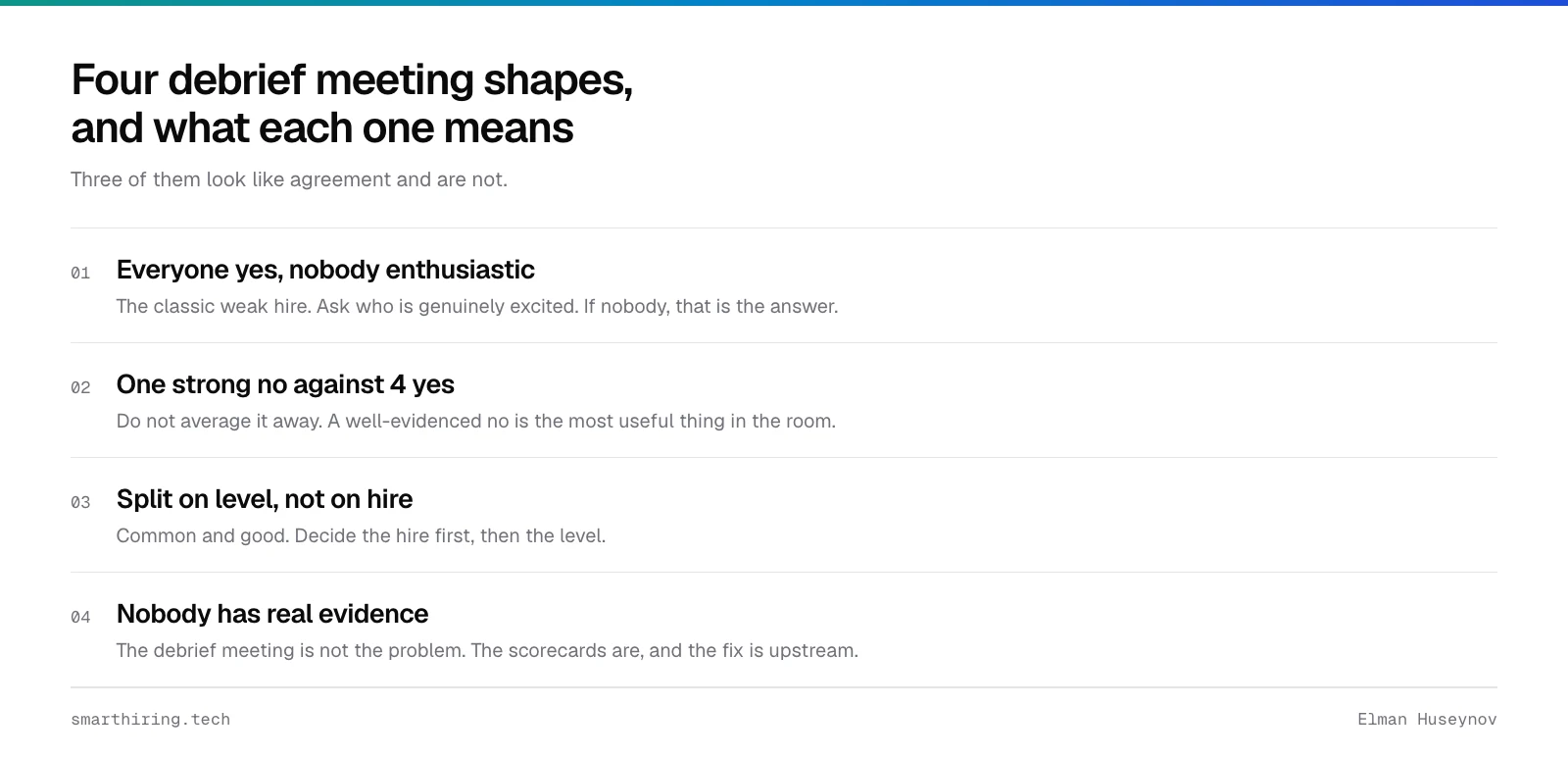
Everyone yes, nobody enthusiastic. The classic weak hire. Ask directly: “who is genuinely excited?” Silence is a no.
One strong no against 4 yes. Ask for the evidence. Ask whether it is about this role or any role. A well-evidenced no is the most useful thing in the room.
Split on level. Decide the hire first, then the level from the ladder. The candidate’s side is in engineering levelling.
Nobody has real evidence. Run another round with a specific question. If it recurs, the fix is interviewer calibration.
What do you write down after an interview debrief?
Write down the decision and its reason, whatever the outcome. One paragraph, in the ATS, the same day.
For a rejection, the record gives the recruiter something to say to the candidate.
For a hire, the new manager reads it in month 2. The panel’s worries are there.
In 9 months, compare the record with the hire. Almost nobody does, which is why almost no loop improves.
A debrief meeting that runs an hour is re-litigating. If 30 minutes is short, the scorecards were the problem.
Common questions
Should a debrief meeting take a vote?
Never. A vote converts evidence into a headcount. It lets the room average away a strong objection. Ratings go up simultaneously so the shape is visible. Then the discussion works through the gaps. The hiring manager decides at the end, on the record, with the reason written down.
Who should speak first in a debrief meeting?
The lowest rating, and never the hiring manager. The first opinion spoken sets the range for everyone after it. The hiring manager has a seat to fill. Starting with the lowest rating makes the objection cheap to state. That is exactly what anchoring normally suppresses.
How long should a debrief meeting be?
Thirty minutes. A debrief meeting that runs an hour is re-litigating. Re-litigating favours the most persistent voice rather than the best evidence. If 30 minutes is not enough, the scorecards were not good enough. The fix is upstream, in how interviewers record what they saw.
What if everyone says yes but nobody is keen?
Unanimous but unenthusiastic is the classic weak hire. The room routinely mistakes absence of objection for agreement. Ask each person whether they would want this candidate on their own team. Next quarter, specifically. Enthusiasm that does not survive that question is a no. It is a no that nobody wanted to write down.
What is an interview debrief?
An interview debrief is the meeting where the panel compares written scorecards. The hiring manager then decides. Thirty minutes is enough. Ratings go up at once, the lowest speaks first, and the disagreements get the middle. A debrief that ends in a show of hands was never designed.
The short version
Lock scorecards before submission. Show all ratings at once. Restate the bar before discussing the candidate.
Lowest rating speaks first. Resolve disagreements on evidence, not by averaging. The hiring manager decides in writing.
Never take a vote.
Ask who is genuinely excited.
Treat a well-evidenced no as the most useful thing in the room.
Rebuilding a loop like this is the work I do here.
Audit from 500 euro, workshop sprint at 2,500.
Shadowing and calibration from 5,000.
The first call is 20 minutes and free.
PDF, 2 pages
Debrief agenda: 30 minutes in 5 blocks
The agenda minute by minute, the 4 questions that unstick a room, the 4 shapes a debrief takes and what each one means, and the one paragraph to write afterwards.
Leave a work email: the file opens right here, and one hiring stage, taken apart, follows every week. One click to leave.
Read next
The Job Description That Gets the Right Engineers to Apply
Most job descriptions are a wish list nobody reads. Here is the 5-line version that changes who applies, and the template behind it.
Interviewer Calibration, Explained
Two interviewers watch the same candidate and reach opposite conclusions. Here is how to run the session that fixes it.
Want this fixed in your loop?
Interview training for hiring managers and their panels: one workshop on your open roles, scorecards written for them, and calibration until the panel agrees. It starts with a free 20-minute call.
No pitch if the loop is already fine.