← All posts
The 30 60 90 Day Plan the Manager Writes for a New Engineer
Updated 5 min read Elman Huseynov
Updated 5 min read Elman Huseynov
A 30 60 90 day plan is 3 goals, 1 per month. The manager writes it before the engineer starts.
Day 30: shipped and mapped. Day 60: owned something end to end. Day 90: made a call the team trusted.
Each goal has evidence and a conversation attached.
Candidates write a 30 60 90 day plan to get the job. Michael Watkins’ book The First 90 Days made that a habit.
The candidate’s plan is theatre.
The version that decides whether the hire works out is the one the manager writes. Most managers never write it.
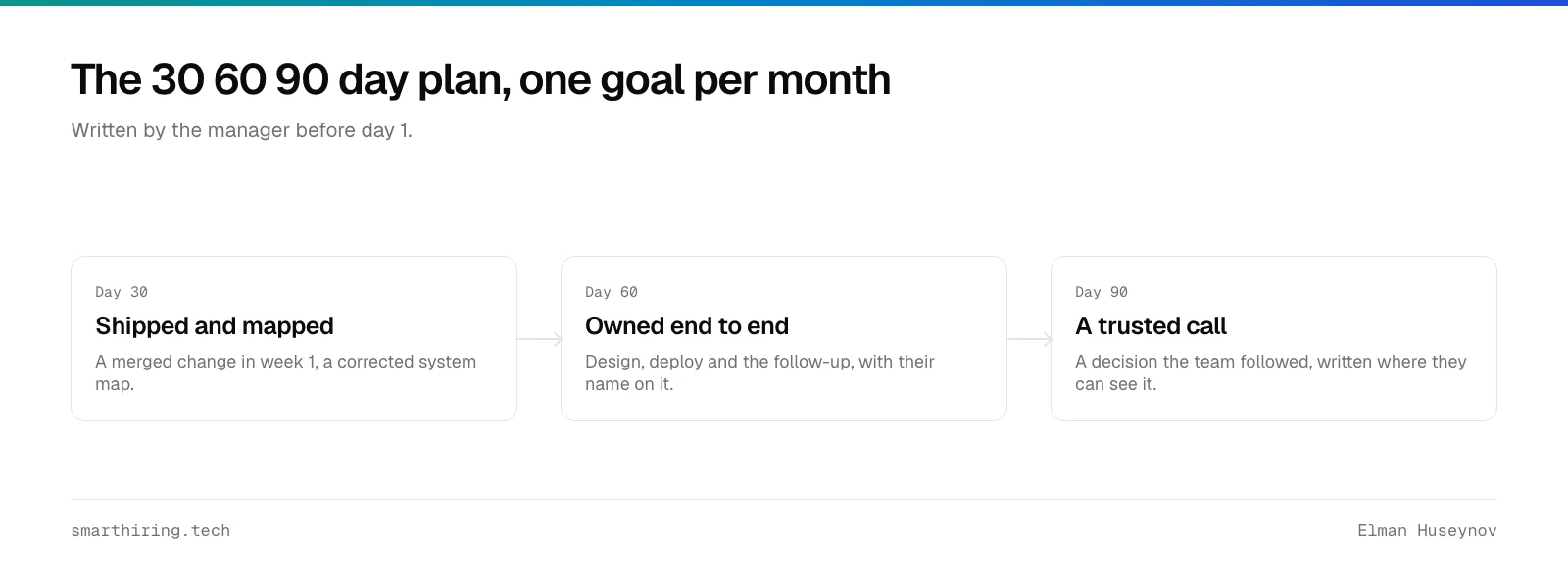
A 30 60 90 day plan is 3 written goals for a hire’s first quarter.
The plan names what the person will have done by each mark. And how you will know.
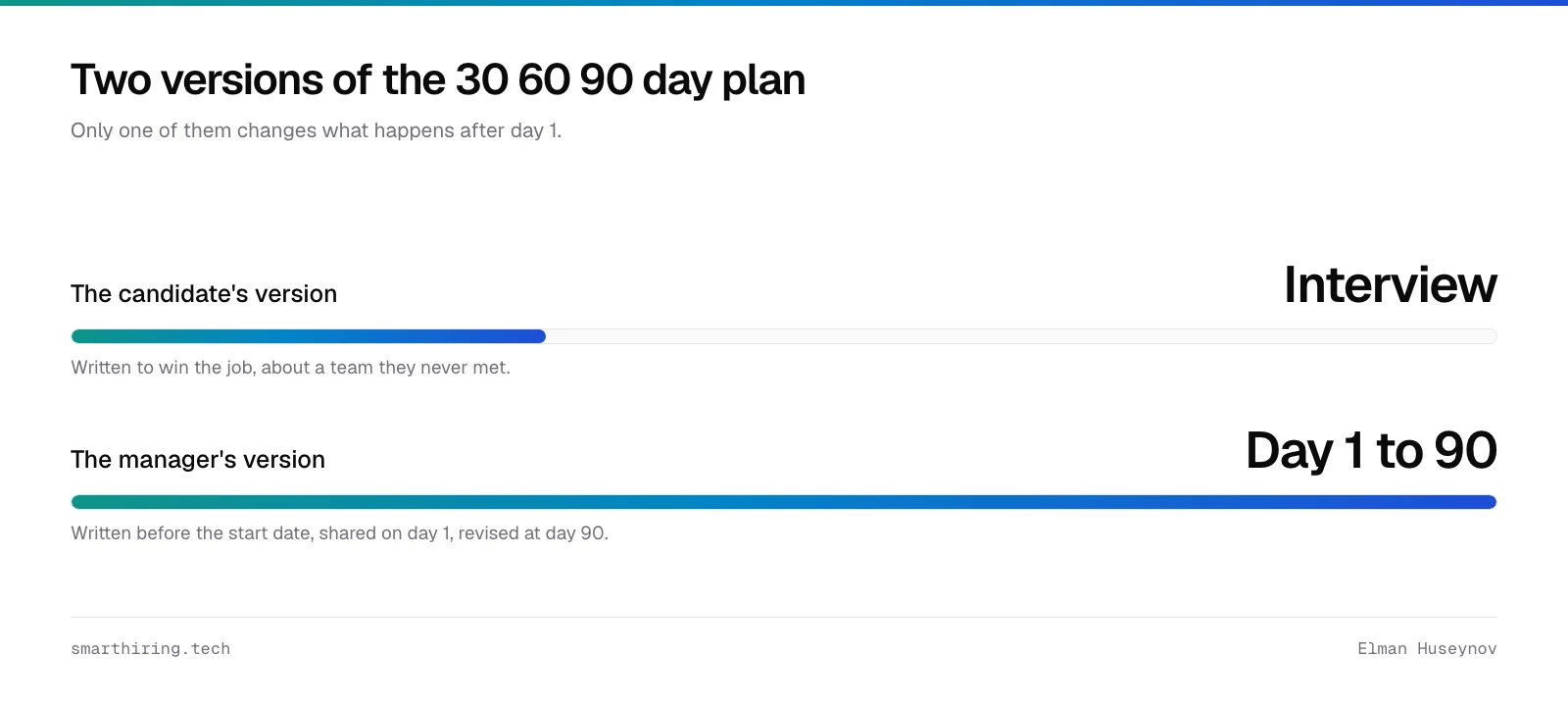
The candidate’s version is written to win an interview. The manager’s version is written to make the hire succeed.
Written before day 1, it is a plan. Written at day 45, it is a performance file.
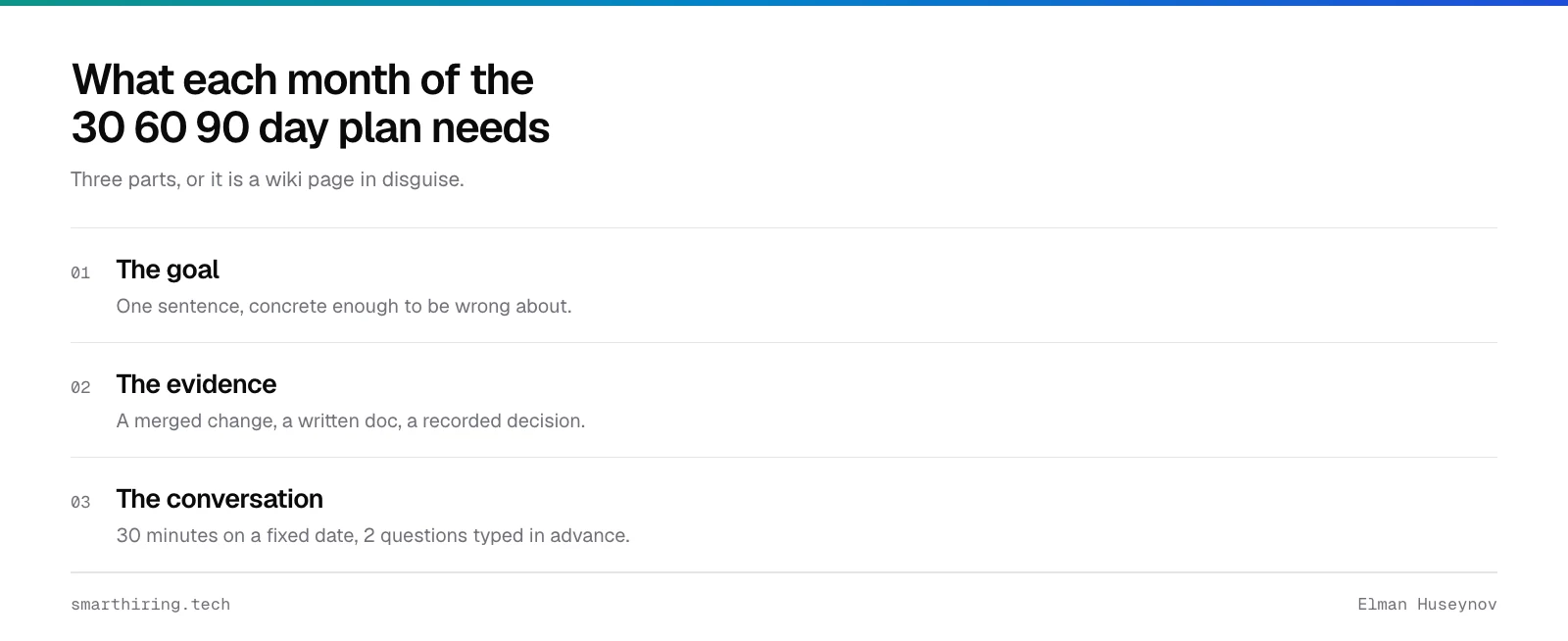
A 30 60 90 day plan needs 3 things per month. The goal, the evidence, the conversation.
The goal is 1 sentence. The evidence is what you can point at. The conversation is 30 minutes on a fixed date.
Anything else in the document is a wiki page wearing a plan’s clothes.
The goal. Concrete enough to be wrong about. “Understand the codebase” fails the test.
The evidence. A merged change, a written doc, a recorded decision. Something a third person can see.
The conversation. 2 questions, written in advance, on a date already in the calendar.
Day 30 is a merged change and a drawn system map. Both come out of the onboarding checklist.
Day 60 is a piece of work owned end to end. Design, deploy, and the fix when something breaks.
Day 90 is a decision the team followed. A review that changed a design. A call in an incident. A no to scope.
A hire without a merged change at day 30 is a pipeline problem. Fix the pipeline before you judge the person.
Day 60 is where the interview scorecard gets its first real test. A gap goes back into the scorecard.
Day 90 closes the loop. The answer to “what should the next hire’s plan say?” rewrites it for the next person.
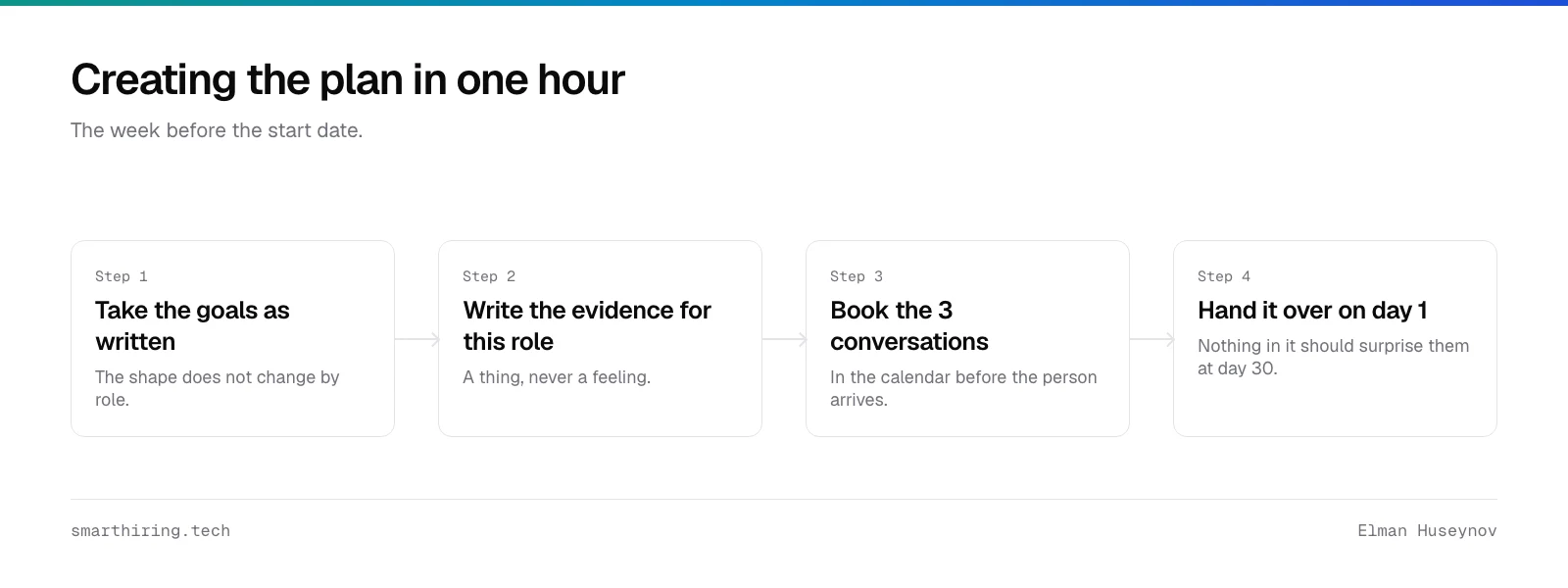
Create the plan in 1 hour, the week before the start date. The scorecard and the first task are the inputs.
Copy the 3 goals. Write the evidence for this role. Book the 3 conversations with the questions typed in.
Share the plan with the new hire on day 1. A plan the person has never seen is a test they cannot study for.
The evidence names a thing, never a feeling. A backend hire ships a change to a service. A frontend hire ships a visible one.
Conversations booked on the day get moved. Conversations booked in advance happen.
The 30 60 90 day plan template is 1 page with 3 rows. A mark, a goal, the evidence, and the 2 questions.
Copy the goals as they stand. Rewrite the evidence column for the role in front of you.
The questions stay. They are the part managers skip. The next hire’s plan is built from the answers.
| Mark | Goal | Evidence | The 2 questions |
|---|---|---|---|
| Day 30 | Shipped and mapped | A merged change in week 1, a corrected system map | What have you stopped asking about? What do you see that we cannot? |
| Day 60 | Owned end to end | A design, a deploy, the follow-up, all with their name on it | Where did you need a hand? Which habit would you change first? |
| Day 90 | A trusted call | A decision the team followed, written where they can see it | What would you do differently? What should the next plan say? |
The manager writes the 30 60 90 day plan the week before the start date. It is shared on day 1. A plan the new hire writes alone is a guess about strangers. A plan the manager writes alone and hides is a test. Written by the manager, read together, it is a contract.
A senior engineer’s plan keeps the same 3 goals, with heavier evidence. Day 30 stays a merged change and a map. Day 60 becomes a design the team adopted. Day 90 becomes a decision with a cost, a scope cut or an architecture call. A senior hire with no trusted call by day 90 was scored wrong.
The onboarding checklist is what the team prepares before the hire arrives. It fills week 1. The 30 60 90 day plan is what the hire achieves across 3 months. The checklist is a list of things; the plan is 3 goals with evidence. One feeds the other, and the checklist comes first.
A missed day 30 goal is a pipeline problem first. Access, environment, a review queue nobody watches. Fix those before judging the person. A missed day 60 goal is information about the loop. A skill you scored did not show up. A missed day 90 goal is the first real conversation about fit.
Use the plan in the final round. Ask what the candidate wants from their first 90 days. Compare it with your plan. The gap tells you about the candidate and about your ad. Do not ask for a written plan as homework. A candidate’s plan for a team they never met is fiction. The good ones know it.
3 goals, 1 per month, written by the manager before day 1.
Day 30: shipped and mapped. Day 60: owned end to end. Day 90: a call the team trusted.
Each goal has evidence a third person can see. Each has a 30-minute conversation on a fixed date.
Share the plan on day 1. Rewrite it at day 90 for the next hire.
A missed goal is information about the pipeline first, the loop second, the person last.
An audit of your loop, with the plan written for your next hire. Book a free 30-minute call.
Excel, 2 sheets
The 3 rows with goal, evidence and the 2 questions, evidence columns for backend, frontend and platform hires, and the 3 conversation dates to book before day 1.
Leave a work email: the file opens right here, and one hiring stage, taken apart, follows every week. One click to leave.
A job description needs 5 lines. The problem, the first 90 days, 3 skills, the range and the loop. A template to copy.
A take-home costs the candidate 6 hours and you 45 minutes of marking. A 60-minute pair costs 1 hour each side and tells you more. Here is the comparison.
SmartHiring trains engineering interview panels on their own open roles. Elman Huseynov, a Tech Hiring Expert in Berlin, runs every engagement. One workshop writes the scorecards for your roles, then calibration runs until the panel agrees. It starts with a free 30-minute call.
No pitch if the loop is already fine. See an example audit report.