← All posts
Recruitment Agencies, a Consultant or In-House: 10 Hires After a Round
4 min read Elman Huseynov
4 min read Elman Huseynov
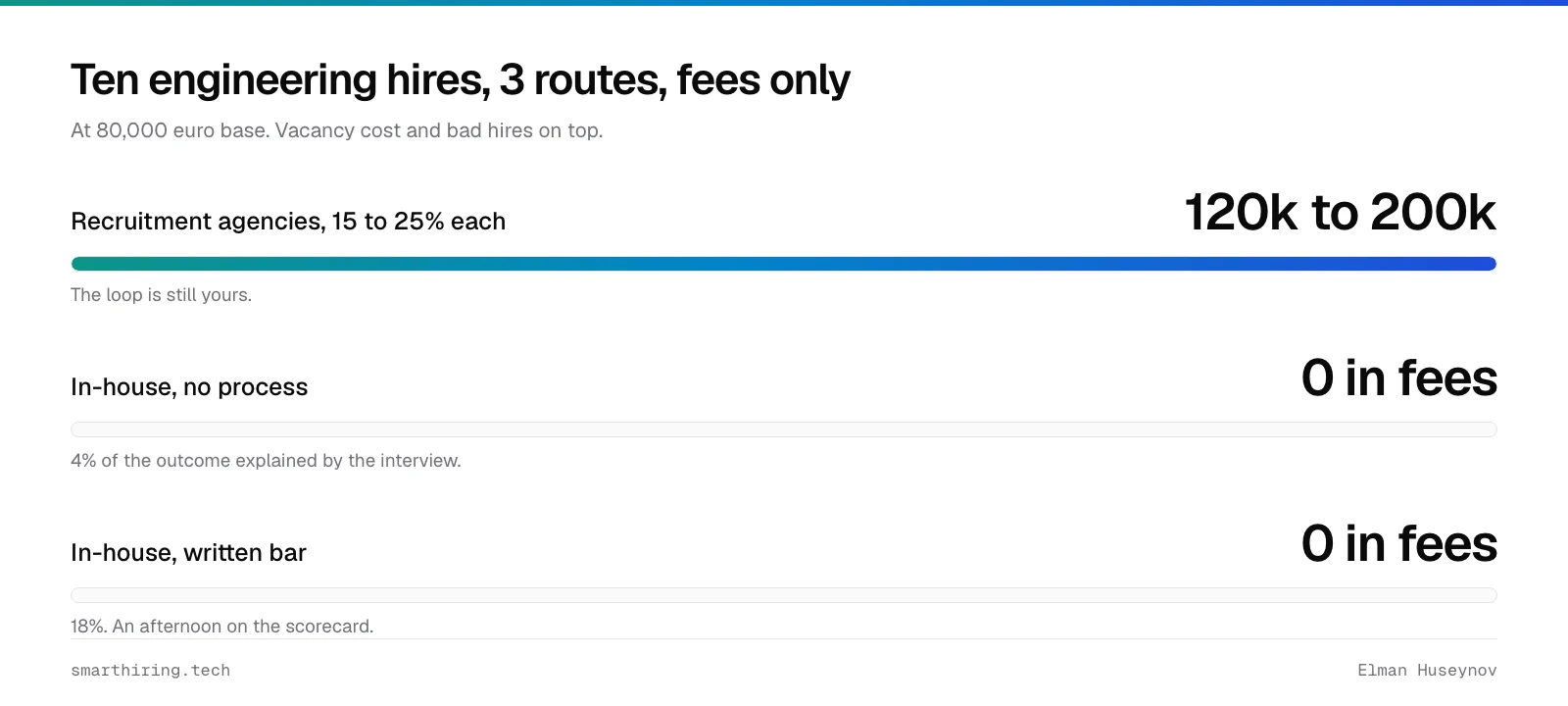
Recruitment agencies charge 15 to 25% of first-year base per engineer. At 80,000 euro that is 12,000 to 20,000 for one hire.
A seed round means 10 hires. Through an agency that is 120,000 euro or more. The interview loop is still yours.
The 3 routes below are costed on the same 10 hires.
| Route | Who finds the candidates | Who owns the bar | What you pay for |
|---|---|---|---|
| Recruitment agency | The agency | Nobody, unless you write it | A fee per hire, every hire |
| In-house, no process | Your recruiter | Nobody | A salary, plus every bad hire |
| In-house, written bar | Your recruiter | The hiring manager and the panel | An afternoon, then 2 hours a quarter |
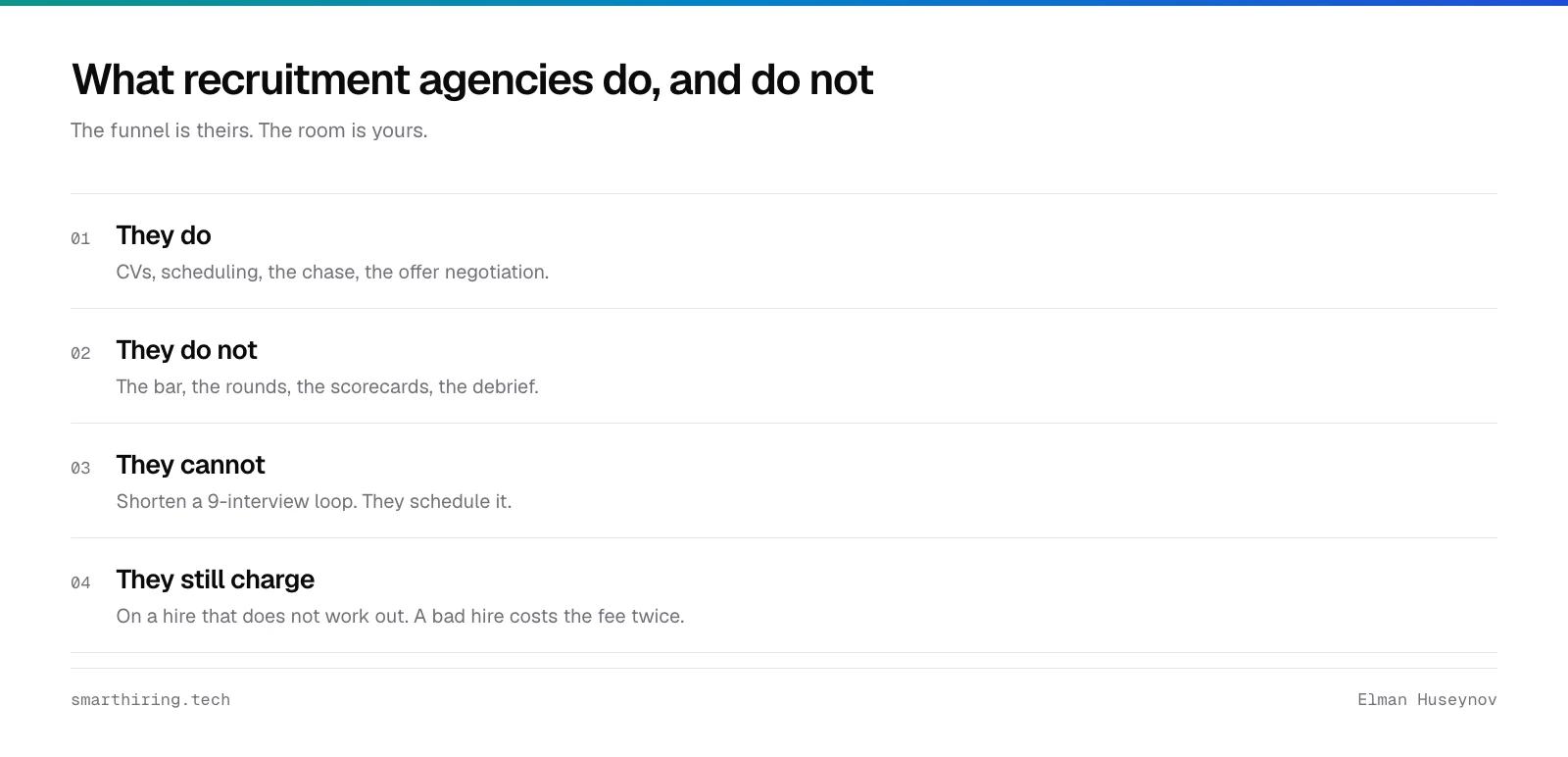
Recruitment agencies fill the top of the funnel. CVs, scheduling, the chase, the offer negotiation.
Nobody sells you the room where the decision happens. The bar, the rounds, the scorecards and the debrief stay yours.
Forty agency CVs into a loop with no written bar is 40 coin flips.
The agency never sees the debrief, so it cannot fix the bar.
Recruitment agencies are paid on the hire, whether it works out or not. A bad hire costs the fee twice.
The agency route costs 120,000 to 200,000 euro in fees for 10 hires. The loop time is on top.
An open 80,000 euro role loses at least 300 euro of work a day. Ten roles open 5 weeks each is about 77,000 euro.
Recruitment agencies do not shorten the loop. The 9 interviews over a month are yours, and the agency schedules them.
The 2 strongest agency profiles can still die in a CV filter nobody checked.
In-house with no process costs 1 recruiter’s salary plus every bad hire.
The fee disappears. The coin flip stays.
Your recruiter now fills the funnel the agency filled. The panel still interviews with no written bar.
Robert Walters research found 40% of hiring managers never had formal interview training. The in-house panel is built from them.
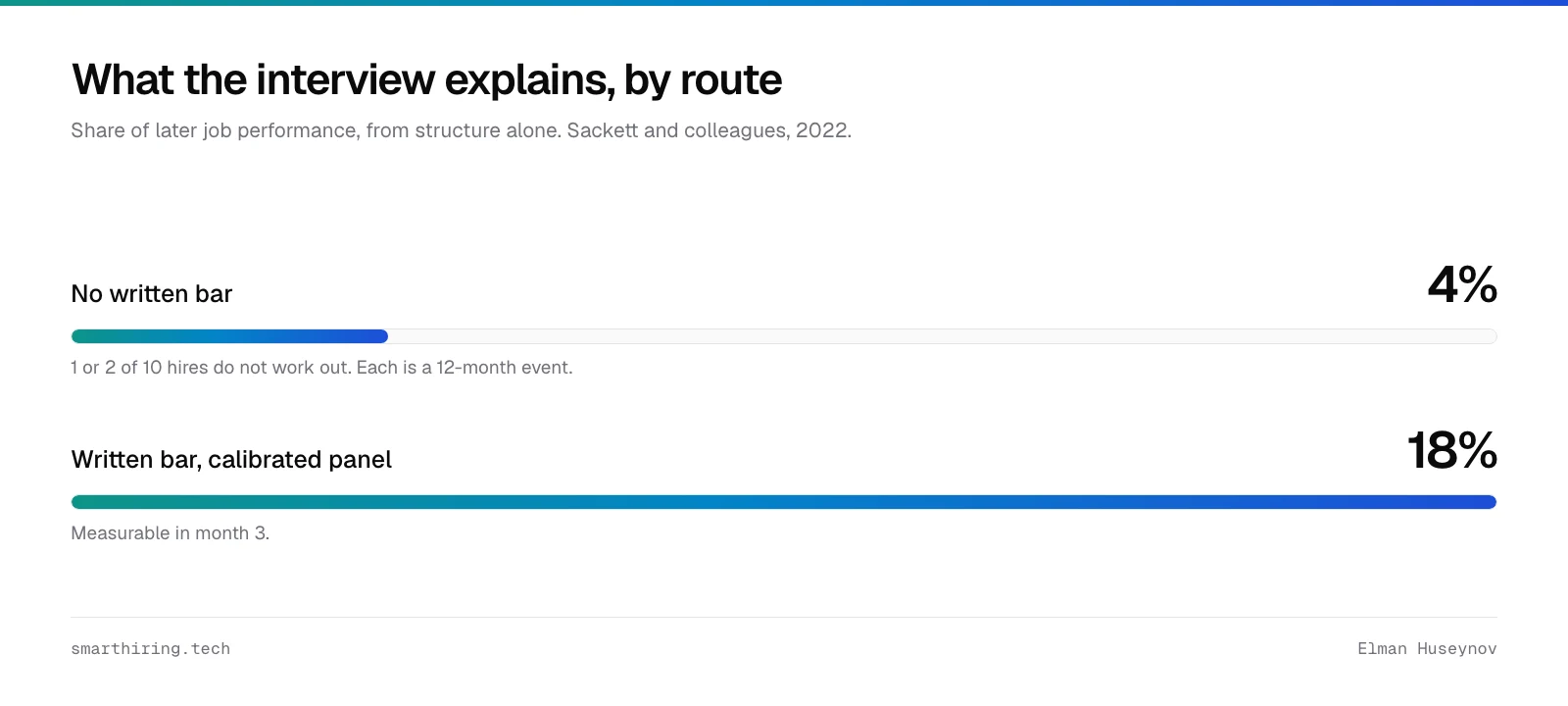
Unstructured interviews explain about 4% of later job performance (Sackett and colleagues, 2022).
A bad hire that gets through is a 12-month event. Salary is the smallest of its 7 lines.
In-house with a written bar costs an afternoon on the scorecard. Then 2 hours of calibration a quarter.
Four rounds in 1 day per candidate. Everything else is free.
The scorecard takes an afternoon for the first role, and less for each role after.
Structured interviews explain about 18% of later performance, against 4% (Sackett and colleagues, 2022).
The recruiter still does the funnel, or recruitment agencies do. The panel now agrees within 1 level on the same candidate.
Agency CVs then meet a bar that is written down.
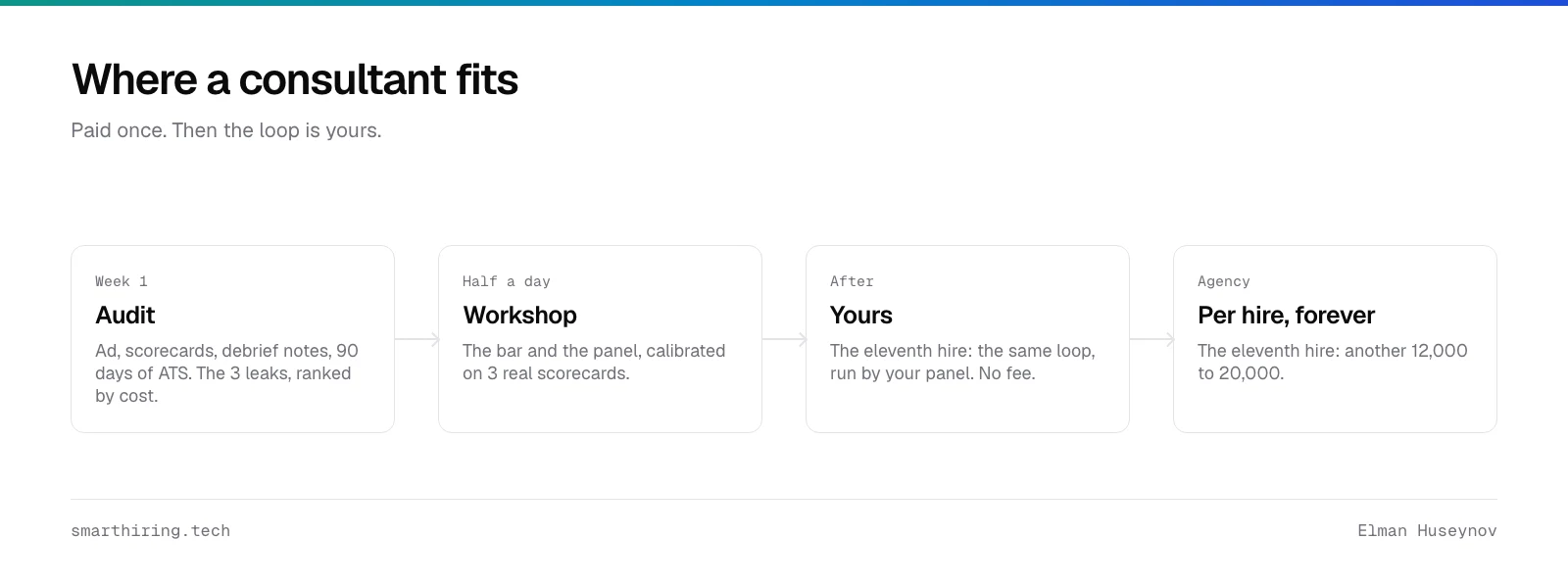
A consultant fits between route 2 and route 3. The audit finds the 3 leaks in a week.
The workshop writes the bar with the panel in half a day. The scorecards come from your own open roles.
The loop is then yours, and it hires without the consultant. An agency is paid per hire, forever.
The process audit reads your ad, scorecards, debrief notes and 90 days of ATS export. The report ranks the leaks by cost.
A consultant who runs your interviews for you is an agency with a different invoice.
When the funnel is the problem and the loop is not. A written bar, 4 rounds in 1 day, a calibrated panel, and too few CVs. An agency then adds candidates to a loop that can decide. Without the bar it adds candidates to a coin flip, at 20% each.
Yes, and the lever is exclusivity and volume. Ten hires on one contract is worth a lower percentage than 10 separate searches. The better lever is the loop. A company that decides in 2 weeks gets the agency’s best candidates first. The agency gets paid sooner.
Four rounds in 1 day, a screen on Monday: 2 weeks per loop. Ten hires run in parallel across 2 or 3 open roles. The 10 land in about a quarter. The bottleneck is interviewer hours. A 4-round loop uses 5 to 10 fewer per candidate than 9 interviews do.
No. An agency is paid per hire and owns the funnel. A consultant is paid once and fixes the loop, then leaves. The test is what happens on the eleventh hire: with an agency, another fee. With a consultant, the same loop, run by your panel.
Recruitment agencies: 12,000 to 20,000 euro per engineer, the loop still yours. Ten hires: 120,000 or more.
In-house with no bar: no fee, and 4% of the outcome explained by the interview.
In-house with a written bar: an afternoon, 2 hours a quarter, about 18%.
An audit of your loop, before the agency call. Book a free 30-minute call.
Excel, 2 sheets
Type your base salary, fee, vacancy cost and weeks per loop; agency, in-house and in-house with a written bar calculate side by side, next to what each route includes.
Leave a work email: the file opens right here, and one hiring stage, taken apart, follows every week. One click to leave.
A 10-engineer team has no recruiting department and no process to unlearn. Here is the recruitment process in 6 stages, from the written bar to the day-90 question.
Every candidate has a rehearsed answer to "tell me about a time you disagreed". Here are the 3 questions that survive rehearsal, and the follow-ups that separate a true story from a prepared one.
SmartHiring trains engineering interview panels on their own open roles. Elman Huseynov, a Technical Interview & Calibration Trainer in Berlin, runs every engagement. One workshop writes the scorecards for your roles, then calibration runs until the panel agrees. It starts with a free 30-minute call.
No pitch if the loop is already fine. See an example audit report.