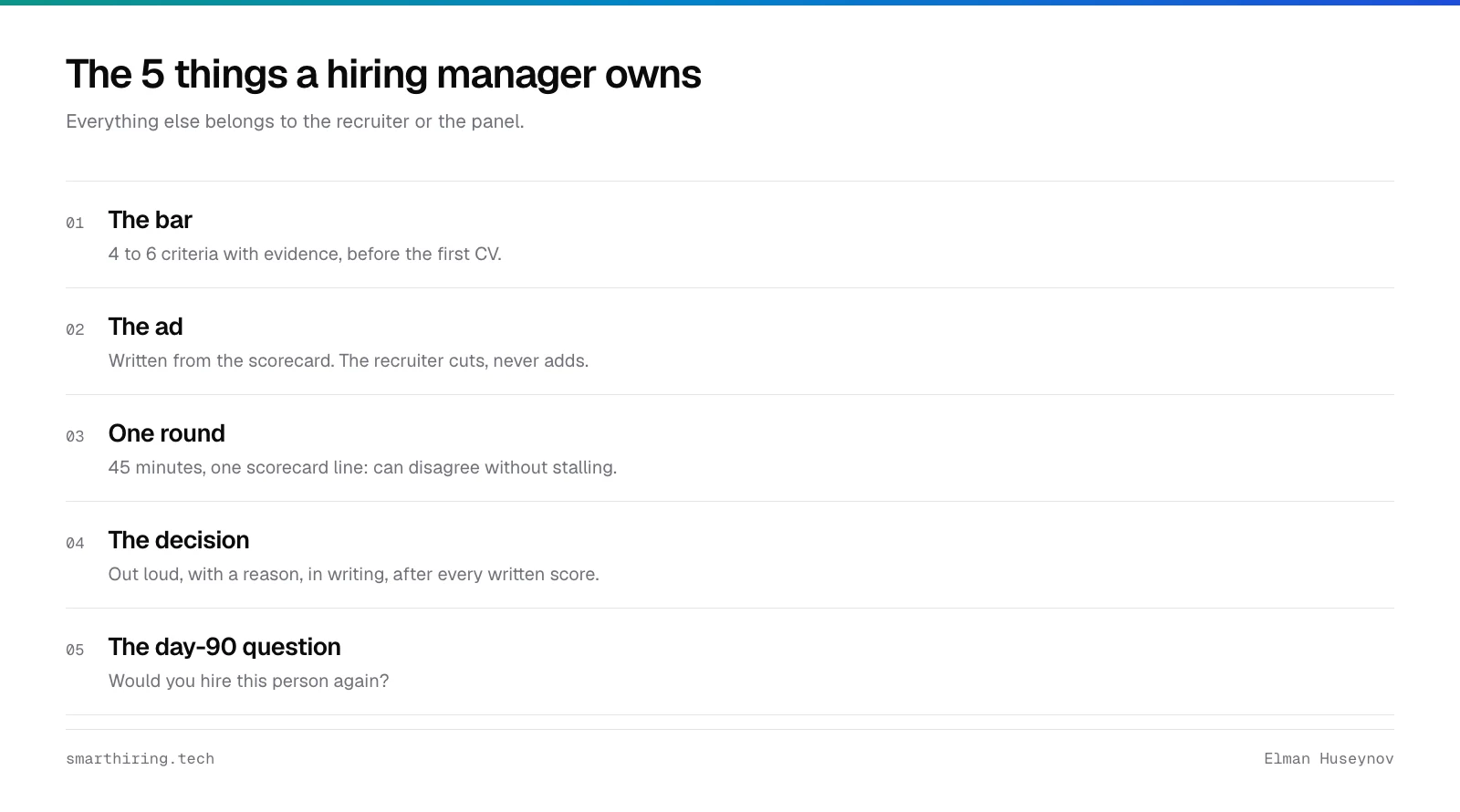
A hiring manager owns 5 things in an engineering loop. The bar, the ad, one round, the decision, and the day-90 question.
The recruiter owns the funnel. The panel owns the other rounds. Everything else on that list is the hiring manager’s, or nobody’s.
On this page
The 5 duties below decide whether a loop hires or loses the candidate.
What does a hiring manager own before the role opens?
The manager owns the bar. Four to 6 criteria, with the evidence for each, written before the first CV arrives.
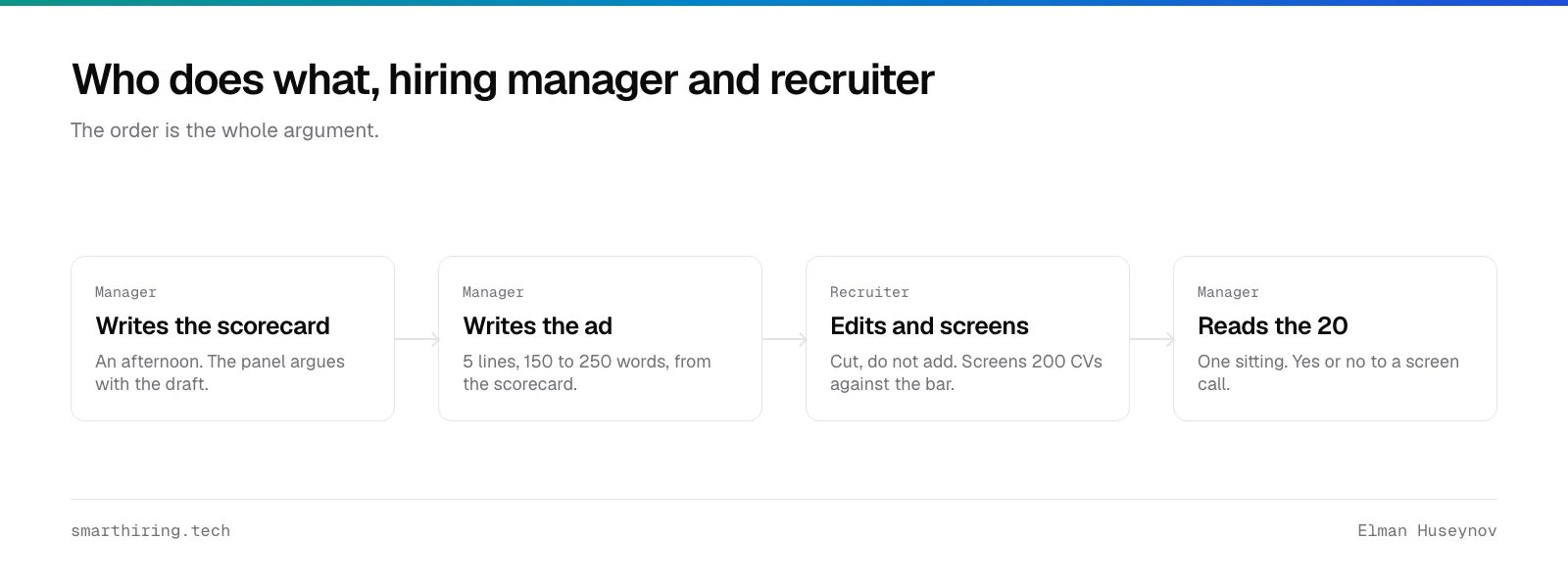
The scorecard takes an afternoon for the first role. An hour for the second, 20 minutes by the fifth.
A scorecard written by the recruiter describes a job nobody has defined.
A scorecard written by nobody lives in people’s heads.
The manager drafts it. The panel argues with the draft until each line has an owner.
Who writes the job ad, the hiring manager or the recruiter?
The manager writes the job ad, from the scorecard. The recruiter edits it, with 1 rule: cut, do not add.
The manager knows what the hire must ship by day 90. The recruiter knows where candidates stop reading.
The hiring manager signs off the final draft before it goes live.
When the recruiter writes first, the manager ends up defending lines they never chose.
The 5-line job ad is 150 to 250 words. Every line past the 5 is one the right candidate skims.
Which round does the hiring manager run?
The manager runs 1 round, 45 minutes, and owns 1 scorecard line. Usually: can disagree without stalling.
How they work with people, how they handle disagreement, what they need from a manager.
The manager does not sit in every round. Sitting in every round anchors the panel on the manager’s view.
Two interviewers per round, with separate assignments, beat the manager in all 4.
How does the hiring manager make the decision?
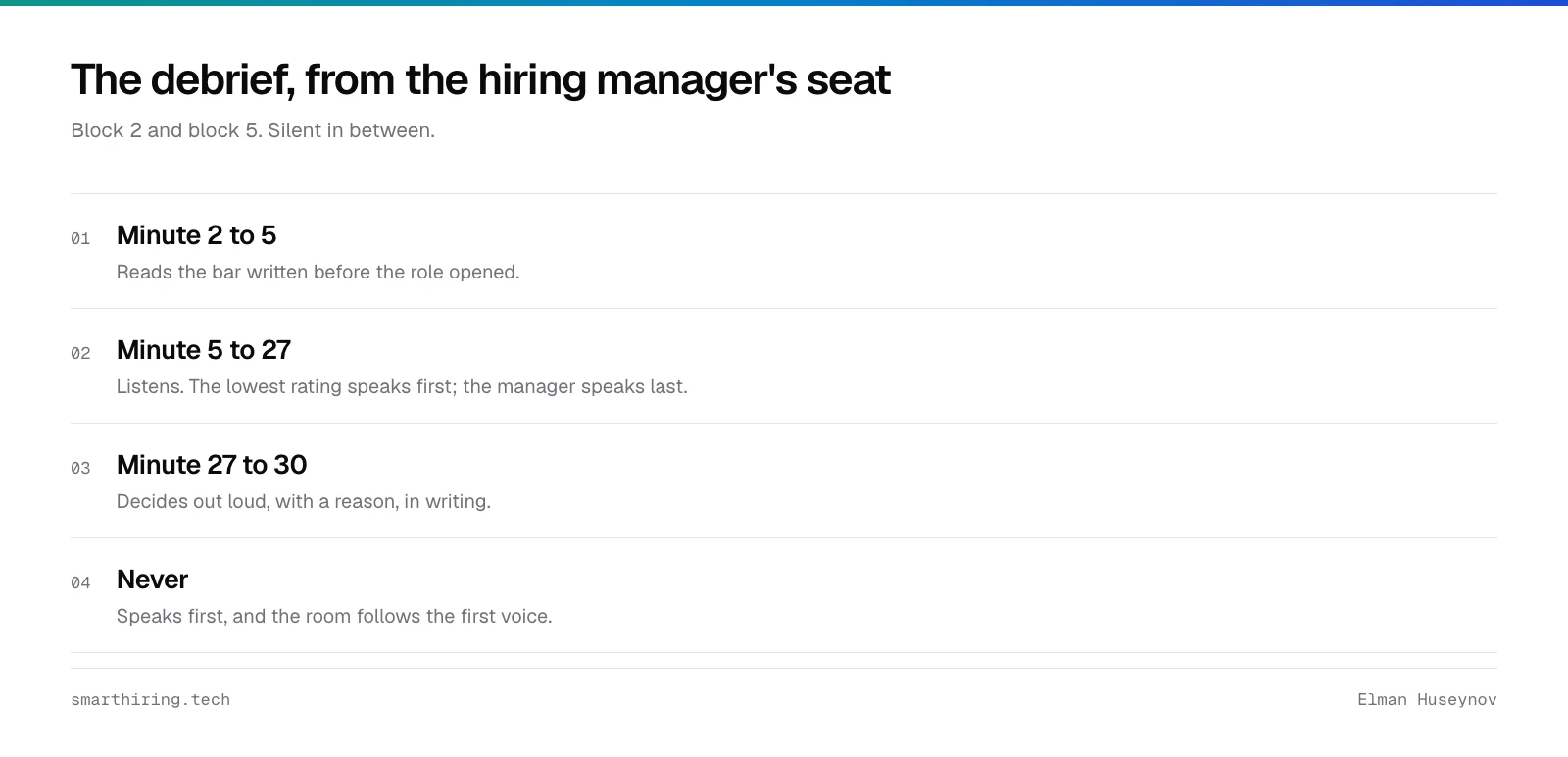
The manager decides out loud, with a reason, in writing. Minute 27 of a 30-minute debrief.
The decision comes after every written score and the lowest rating first.
A show of hands leaves nobody accountable. A decision with a reason can be checked in 9 months.
When the manager speaks first, the room anchors on that opinion.
The manager speaks last.
The debrief runs 5 blocks. The manager owns block 2, the bar, and block 5, the decision.
What does the hiring manager own after the offer?
The manager owns the 30 60 90 day plan and the day-90 question. Would you hire this person again?
The plan is written the week before the start date and shared on day 1. Three goals, one per month, evidence for each.
Each month ends in a 30-minute conversation. The manager books all 3 before day 1.
The day-90 decision belongs to the manager. It goes in the calendar with the other 3.
A no at day 90 is evidence about the loop. It shows which scorecard line missed the problem.
The hiring manager rewrites that line before the next role opens.
Common questions
Should the manager screen CVs?
No. The recruiter screens against the scorecard the manager wrote. The manager reads the 20 that pass, in one sitting. Yes or no to a screen call, each. A manager reading 200 CVs did not write the ad that filters.
What if the manager and the panel disagree?
The written scores go on the screen first, and the lowest rating presents its evidence. If the panel’s evidence is stronger, the manager says so and decides with it. A manager who overrides written evidence with a feeling owns the bad hire alone.
How many hours a week should a hiring manager spend on hiring?
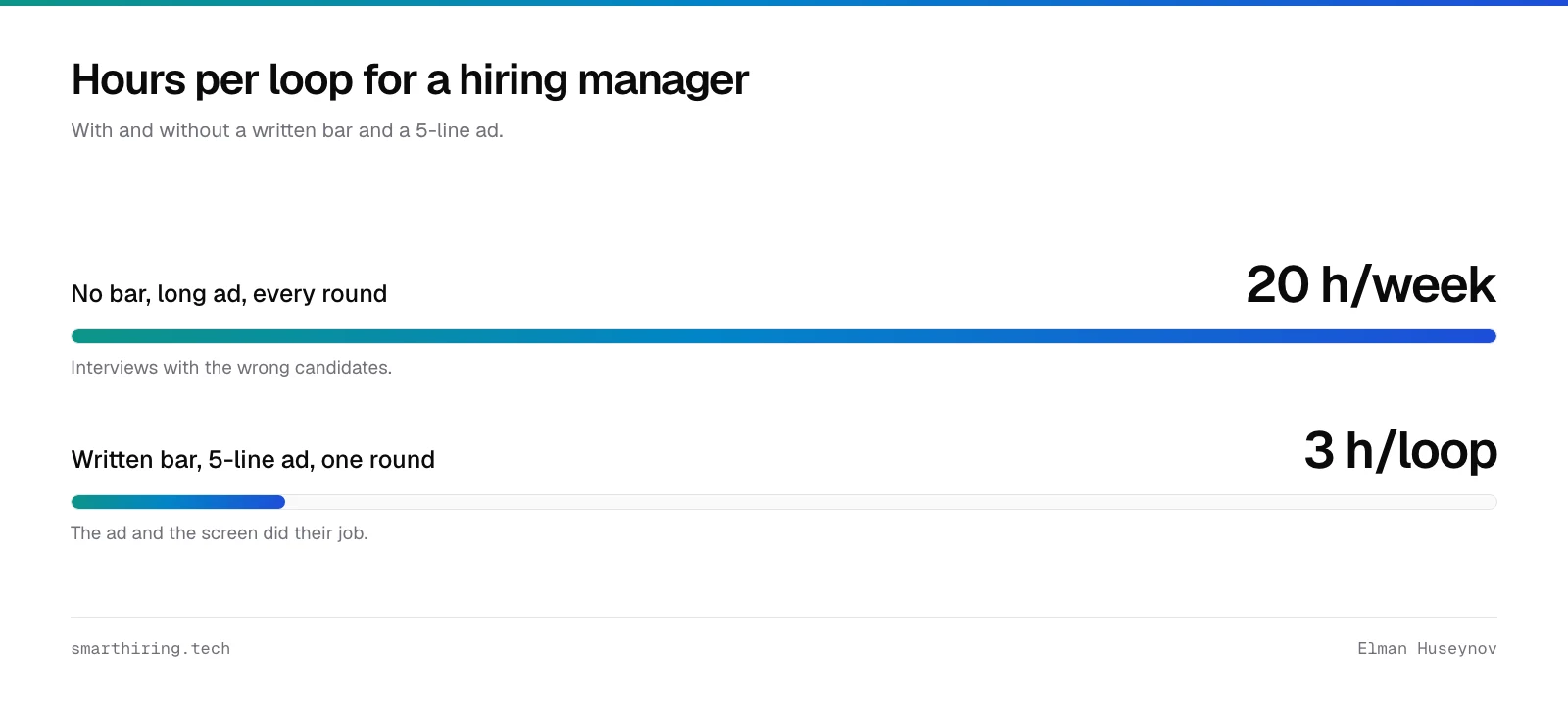
Managers lose 20 hours a week to interviews with the wrong candidates. With a written bar and a 5-line ad, it is about 3 hours per loop. The difference is whether the ad and the screen worked. Both happen before the manager sees a CV.
Does the manager need interview training?
Yes, and calibrating with the panel counts. Two hours a quarter, scoring the same 3 real scorecards alone, then comparing. Robert Walters research found 40% of hiring managers never had formal interview training. The manager’s standard is the one the panel drifts toward, so it needs checking most.
The short version
The manager owns 5 things. The bar, the ad, 1 round, the decision, the day-90 question.
Write the scorecard first. Write the ad from it. Speak last in the debrief.
Share the 30 60 90 plan on day 1. Ask the day-90 question out loud.
An audit of your loop, with the 5 mapped to your loop and named. Book a free 30-minute call.
PDF, 2 pages
The hiring manager's 5, per loop
The 5 things you own with when, what done looks like and the time each takes, the 3 that are not yours, your 2 blocks of the debrief, and the 3 dates to book before day 1.
Leave a work email: the file opens right here, and one hiring stage, taken apart, follows every week. One click to leave.
Read next
The Recruitment Process for a 10-Engineer Team, End to End
A 10-engineer team has no recruiting department and no process to unlearn. Here is the recruitment process in 6 stages, from the written bar to the day-90 question.
Recruitment Agencies, a Consultant or In-House: 10 Hires After a Round
An agency fee for one engineer is 12,000 to 20,000 euro. Ten hires after a seed round is 120,000 or more, and the loop is still yours. Here is the comparison.
Want this fixed in your loop?
SmartHiring trains engineering interview panels on their own open roles. Elman Huseynov, a Technical Interview & Calibration Trainer in Berlin, runs every engagement. One workshop writes the scorecards for your roles, then calibration runs until the panel agrees. It starts with a free 30-minute call.
No pitch if the loop is already fine. See an example audit report.