To hire software engineers well, write the bar before the job ad goes out.
Run 4 rounds after that, and give each round one criterion to measure.
Every interviewer scores alone before the debrief. The decision goes out within 2 days of the last round.
On this page
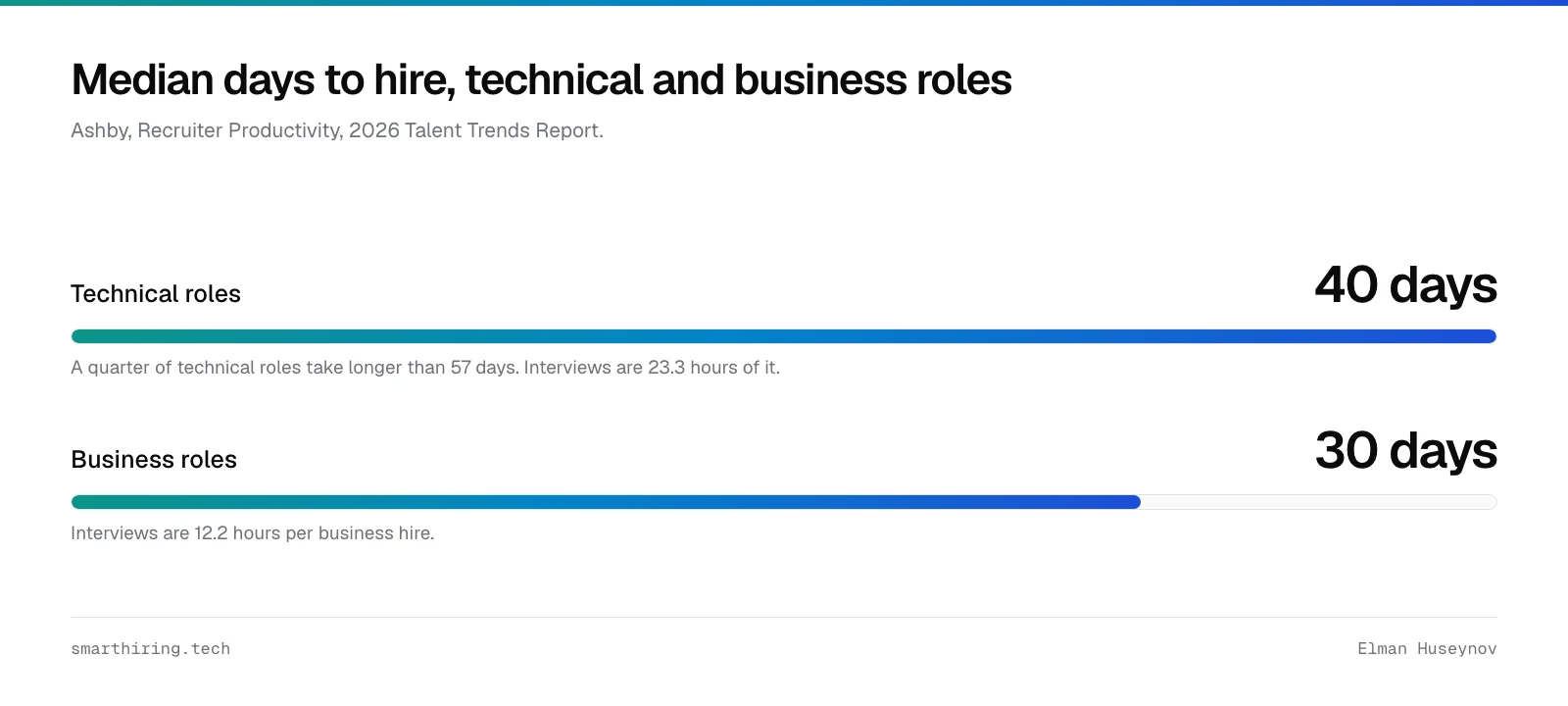
Ashby’s 2026 hiring data puts the median technical hire at 40 days. Interviews take 23.3 hours of that.
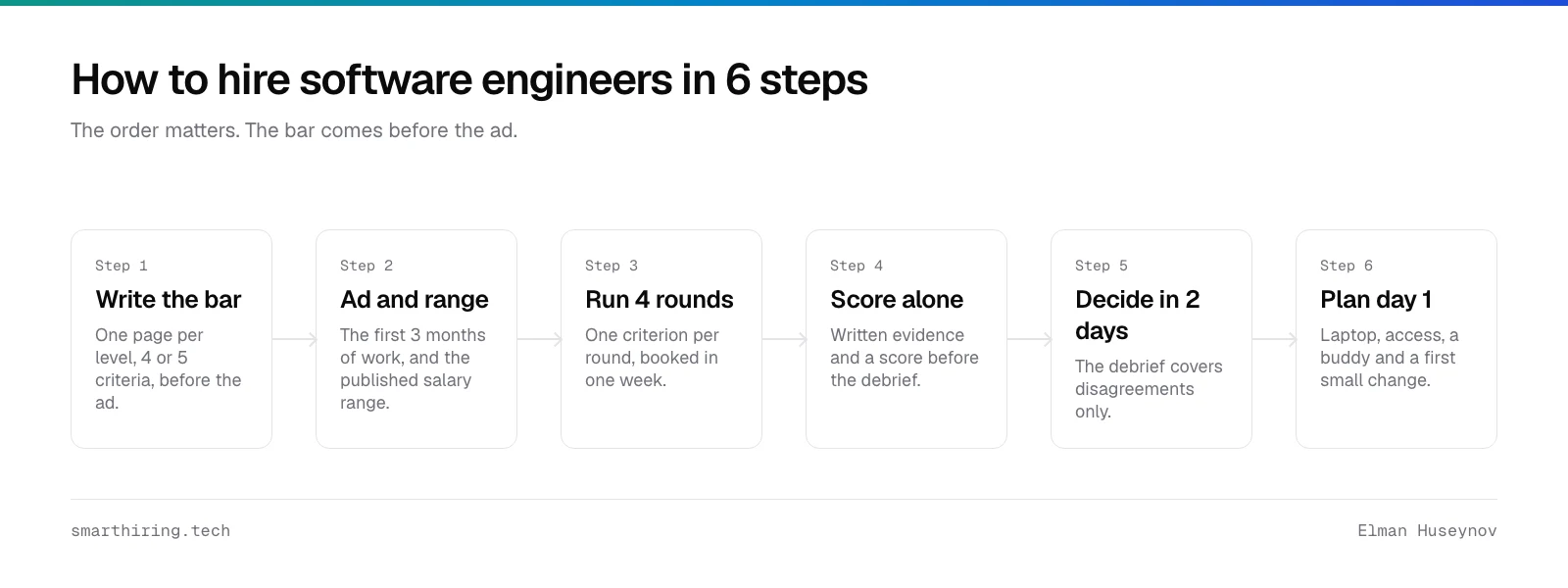
Here are the 6 steps, in the order a small team runs them.
What do you need before you hire software engineers?
Before you hire software engineers, you need a written bar for the level.
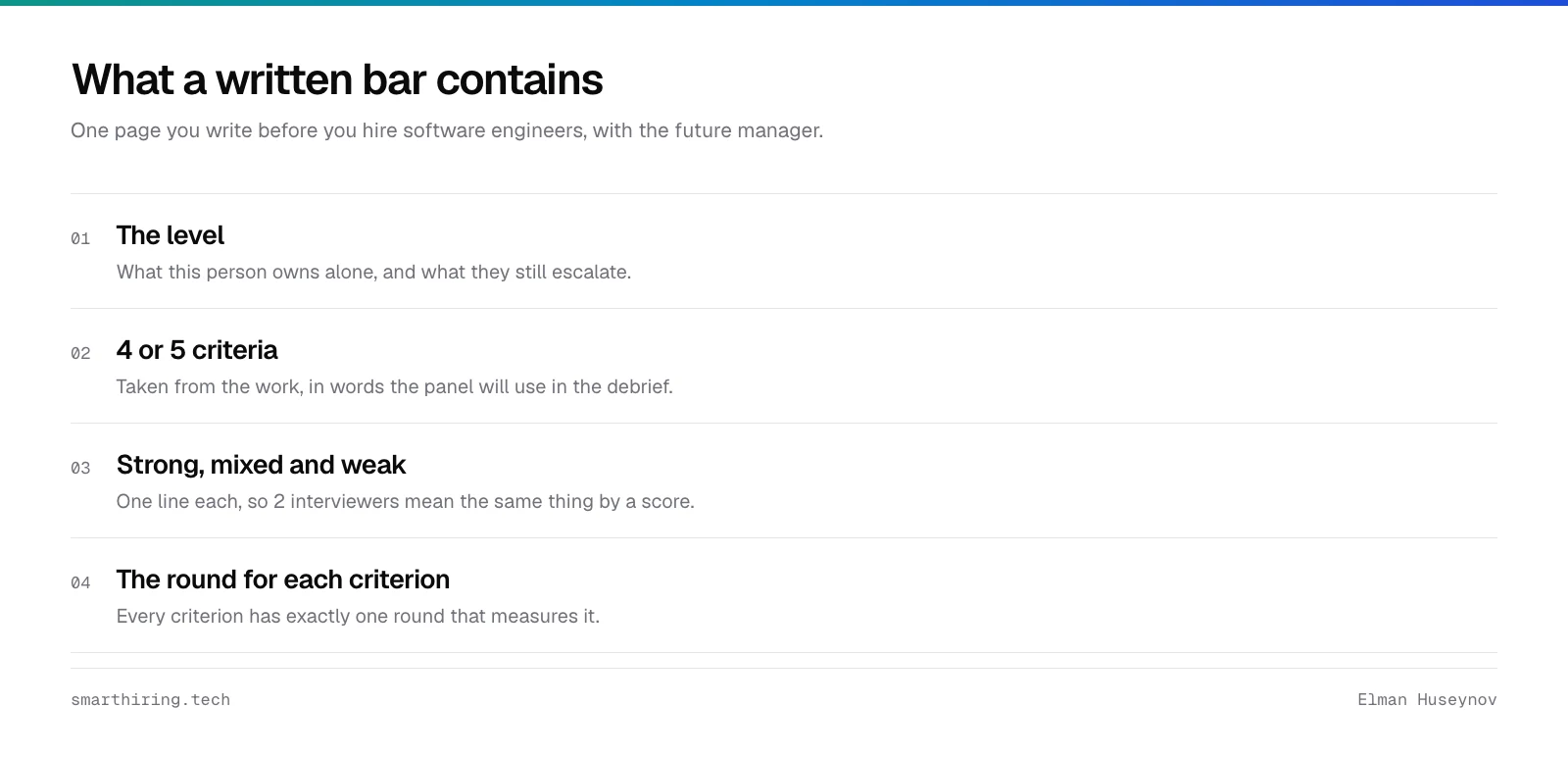
A bar is one page with 4 or 5 criteria. Each criterion says what strong, mixed and weak look like.
The bar exists before the ad, the first CV and the first call.
Without a bar, every interviewer measures their own idea of good. The debrief turns into a vote on taste.
With a bar, each round knows its criterion and each score has evidence behind it.
The scorecard template is the version I use. Write it with the person who will manage the hire.
Where do the right candidates come from?
The right candidates come from 2 places. One is an ad that describes the work. The other is people your engineers already know.
An ad listing 14 technologies attracts keyword matches. An ad describing the first 3 months attracts people who want that work.
The ad. Name the problem, the team and the first project. The job description post has the 5 lines that matter.
The range. Publish the salary range. A published range answers the first question candidates ask.
Referrals. Ask each engineer for 2 names. Referred candidates go through the same loop as everyone else.
The 4 rounds
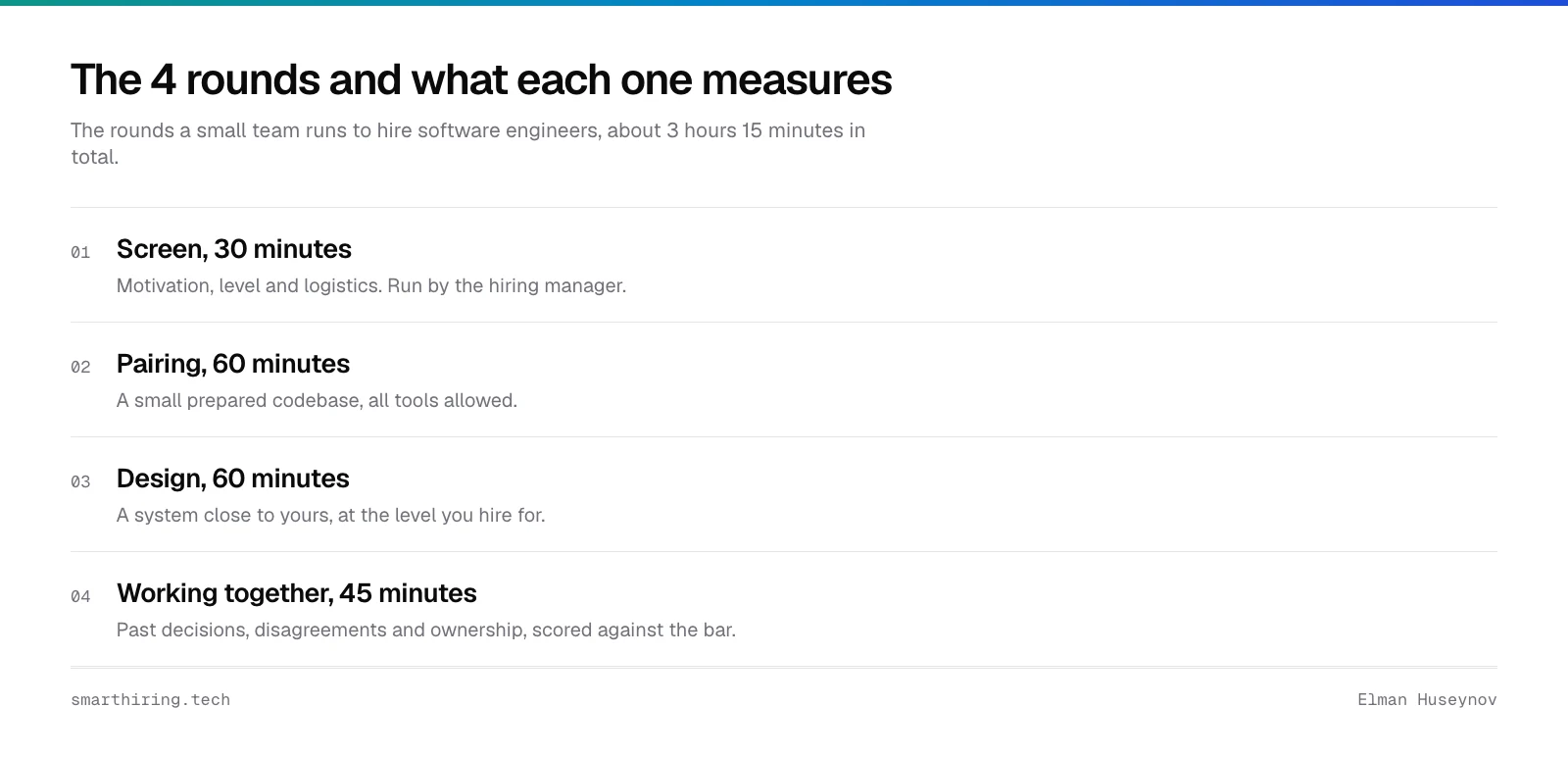
Four rounds are enough to hire software engineers at most levels. Each round owns one criterion from the bar.
1. Screen, 30 minutes. Motivation, level and logistics. The hiring manager runs it.
2. Pairing, 60 minutes. A small prepared codebase, all tools allowed. A pair costs a sixth of a take-home.
3. Design, 60 minutes. A system close to yours, at the level you hire for.
4. Working together, 45 minutes. Past decisions, disagreements, ownership. Scored against the bar.
Ashby counts 5 interview events per technical hire. Four rounds cover the same ground when none repeats another.
How do you decide who to hire?
You decide who to hire by collecting written scores before anyone speaks.
Each interviewer submits evidence and a score for their own criterion. Nobody reads the other scores first.
The debrief then covers disagreements only, and 30 minutes is usually enough.
The debrief meeting post has the 4 questions and the agenda.
How long should it take to hire a software engineer?
Hiring a software engineer takes a median of 40 days on Ashby’s 2026 data. A quarter of technical roles take longer than 57 days.
Interviewing itself is 23.3 hours per technical hire. The rest of the 40 days is calendar.
Book all rounds at once. When a candidate passes the screen, schedule the other 3 in the same week.
Decide in 2 days. Send the decision within 2 working days of the last round.
What happens after the offer?
After the offer, the first 4 weeks show whether the loop picked well.
Plan day 1 before the contract is signed. Laptop, access, a buddy and a first small change.
Write down what the new engineer should own by week 4. Then check it in week 4.
The engineering onboarding checklist covers the 4 weeks in detail.
Common questions
Should a startup use a recruiter to hire software engineers?
A startup can use a recruiter for reach and scheduling. The bar, the rounds and the decision stay with your team. Bring a recruiter in once the bar is written. Then they screen against your criteria instead of guessing. Before that, a recruiter fills your calendar with candidates nobody has defined.
How many interview rounds should a software engineer go through?
Four rounds after the application are enough for most roles. A screen, a pairing session, a design round, and working together. Each round measures one criterion. Adding a fifth round helps only when it measures something the first 4 do not.
Do you need a coding test to hire software engineers?
You need to see code, and a coding test is one way. A 60-minute pairing session on a prepared codebase shows how someone reads and changes code. It costs the candidate 1 hour instead of a weekend. Keep a take-home only where long unwatched writing is the job.
How do you hire software engineers without a technical background?
A founder without a technical background can own the bar, the screen and the decision. Borrow a senior engineer for the pairing and design rounds. Give them the written criteria. Ask for evidence in their notes, not a verdict. Calibrate with them on 2 or 3 candidates before trusting one score.
The short version
To hire software engineers, write the bar for the level before the ad.
Publish the range and describe the first 3 months in the ad.
Run 4 rounds, one criterion each. Score alone, before the debrief.
Book the rounds in one week and decide within 2 days.
Plan day 1 before the contract is signed.
Setting up this loop for your open role is what a workshop sprint does. Book a free 30-minute call.
PDF, 2 pages
The hiring plan for one engineering role
The bar for the level, the ad and the range, the 4 rounds with dates, the scoring rule, the decision date and the day 1 checklist, ready to fill in.
Leave a work email: the file opens right here, and one hiring stage, taken apart, follows every week. One click to leave.
Read next
The Technical Assessment That Tests the Job
A take-home costs the candidate 6 hours and you 45 minutes of marking. A 60-minute pair costs 1 hour each side and tells you more. Here is the comparison.
Structured Interview Questions, With the Strong Answer Written First
Unstructured interviews explain 4% of later performance. Structured ones explain about 18%. The difference is 3 questions per round and a strong answer written first.
Want this fixed in your loop?
SmartHiring trains engineering interview panels on their own open roles. Elman Huseynov, a Tech Hiring Expert in Berlin, runs every engagement. One workshop writes the scorecards for your roles, then calibration runs until the panel agrees. It starts with a free 30-minute call.
No pitch if the loop is already fine. See an example audit report.