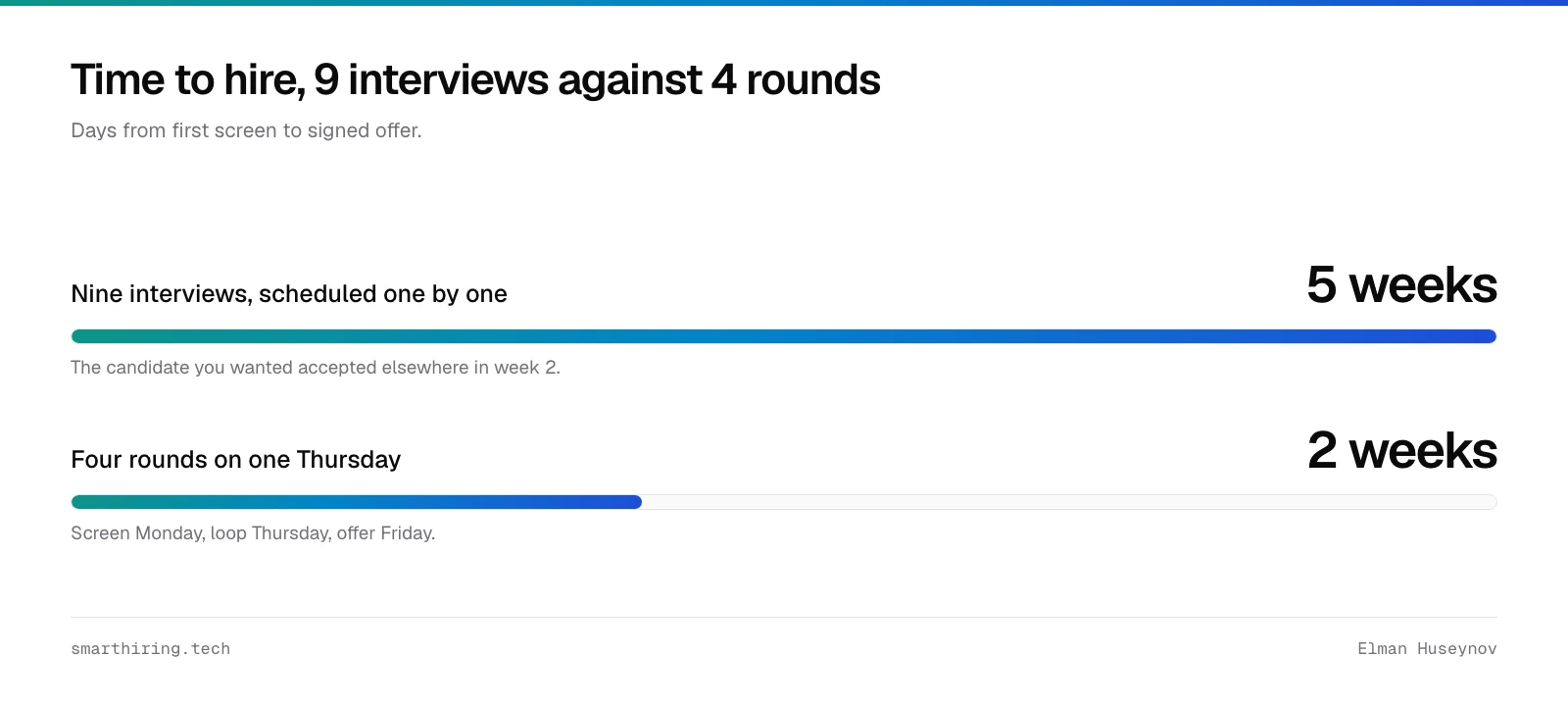
Time to hire for an engineering role runs about 5 weeks. The loop has 7 to 9 interviews and each one waits on a calendar.
Two weeks is enough. Screen on Monday, 4 rounds on Thursday, decision that evening, offer by Friday.
On this page
The calendar below lays out those 2 weeks day by day.
Why does time to hire run 5 weeks?
Time to hire runs 5 weeks because every round is scheduled separately. Nine interviewers, 9 calendars, and a candidate with a job.
Rounds 4 to 6 re-measure what rounds 1 to 3 told you. Each one adds days, and no evidence.
The candidate is weeks in by then, and talking to other companies.
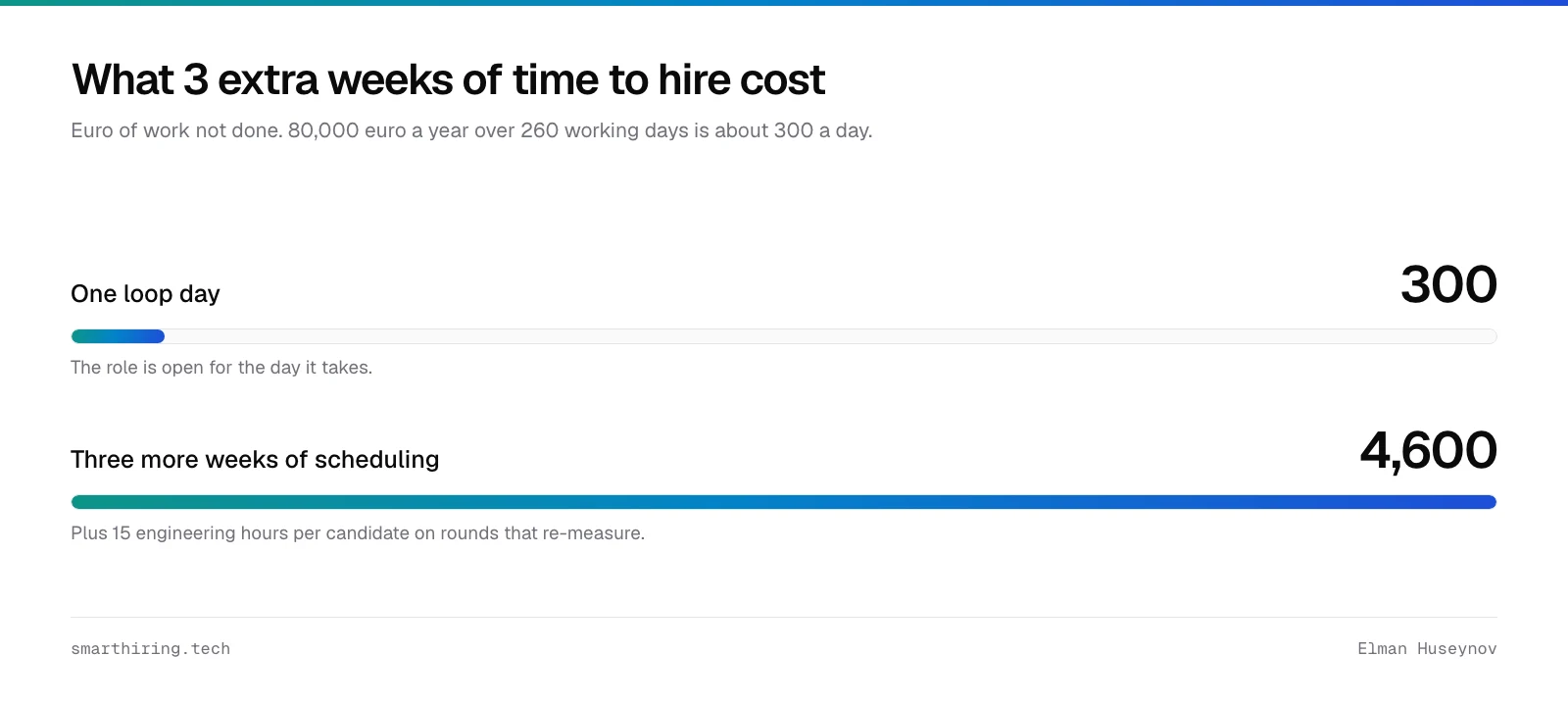
Each week of waiting has a price. Take an engineer paid 80,000 euro a year. Over 260 working days, that is about 300 euro a day.
Three extra weeks is 15 working days. That is about 4,600 euro of work not done.
What is the 2-week time to hire calendar?
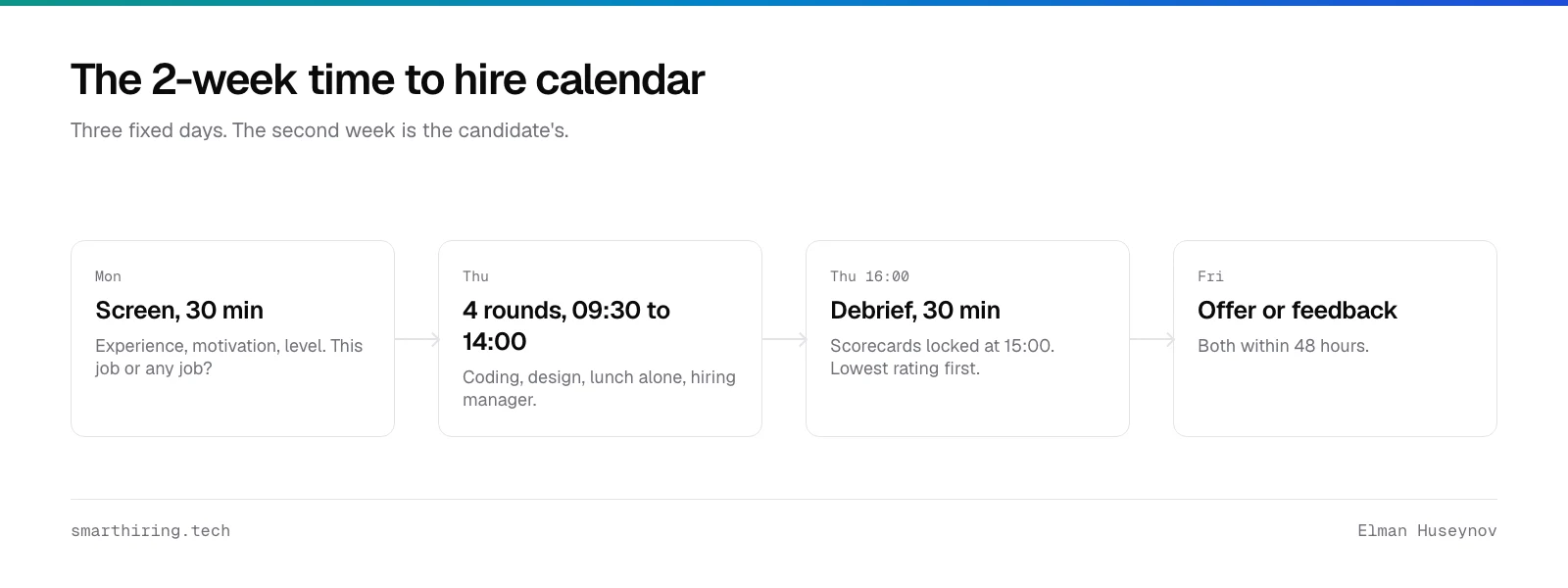
The 2-week calendar has 3 fixed days. Monday screen, Thursday loop, Friday answer.
The second week is for the candidate to decide and sign.
Monday, a 30-minute screen on level and motivation. A pass gets the Thursday invite the same day.
Thursday, 4 rounds in 1 day. The panel meets that afternoon, with every answer still in memory.
Friday. An offer, or feedback the candidate can use. Both within 48 hours.
What happens on the loop day?
The loop day is 4 rounds between 09:30 and 14:00. Then a 30-minute debrief at 16:00.
The candidate goes home before the panel writes.
09:30, practical coding, 60 minutes, from your own codebase. 10:45, design or depth, 60 minutes.
12:00, lunch without an interviewer. 13:00, hiring manager and team, 45 minutes.
14:00, each interviewer submits their scorecard alone, within the hour. 16:00, the debrief, lowest rating first.
Four rounds in one day covers a senior hire. Staff level changes what each round looks for, and adds no round.
What does a short time to hire do to quality?
A short time to hire raises quality. The rounds that go are the ones that measured nothing.
Sackett and colleagues (2022) put structured interviews at a validity of about 0.42. Unstructured ones come in at about 0.19.
Nine unstructured conversations do not add up to one structured loop.
Each of the 5 dropped rounds took 2 interviewers for 90 minutes. That is 15 engineering hours back per finalist.
Four finalists for one role is 60 hours. That is a week and a half of one engineer.
How do you measure time to hire?
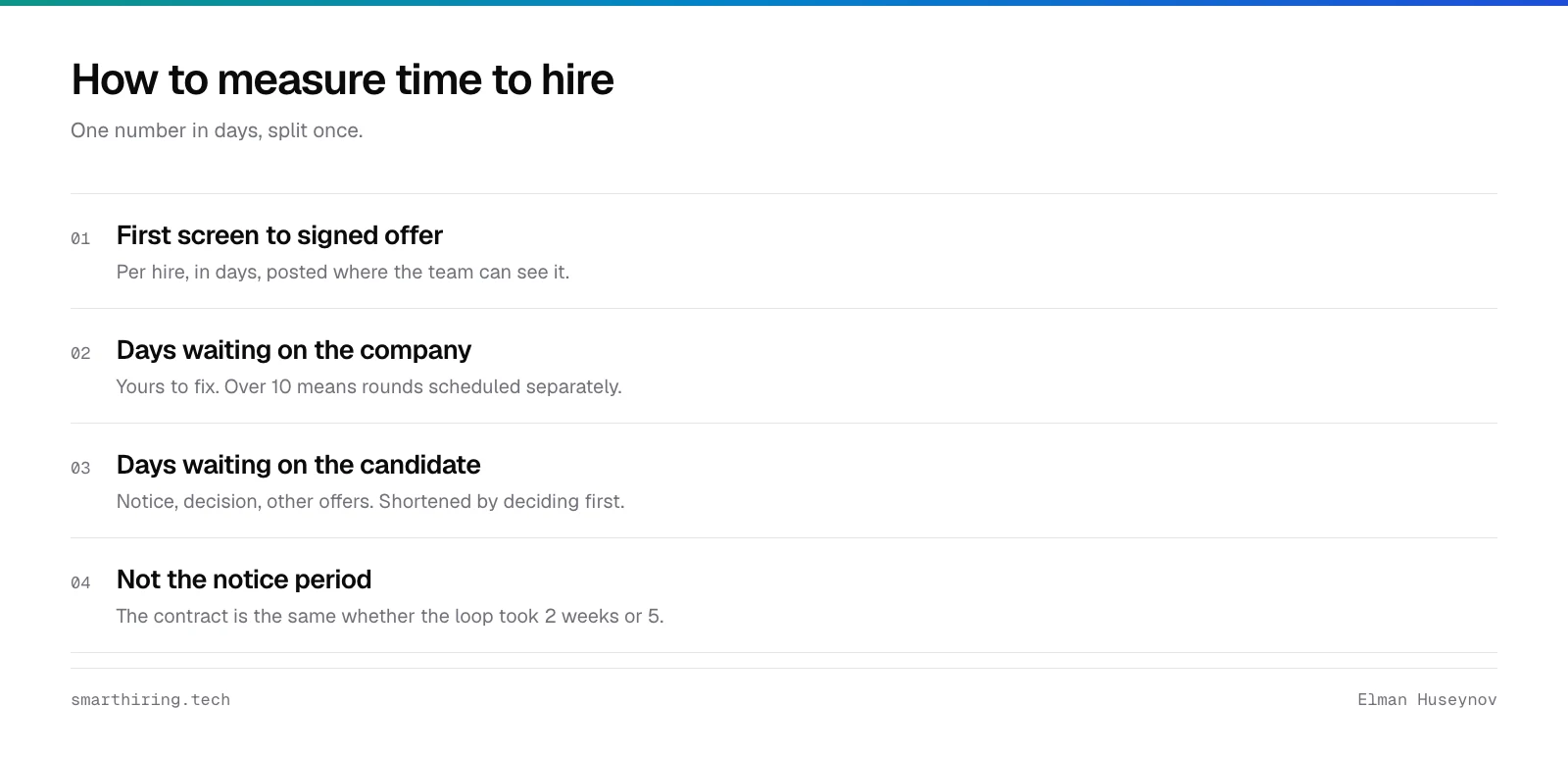
Measure time to hire from first screen to signed offer, per hire. Post it where the team can see it. One number, in days.
Split it once: days waiting on the company, days waiting on the candidate. The first is yours to fix.
Review the number after every hire, next to that hire’s debrief notes.
If the company side is over 10 days, the rounds are scheduled separately. Put them on one day.
The salary range in the ad removes 4-round conversations with candidates the band excluded.
Common questions
Does a 1-day loop work for a remote candidate?
Yes. Run the 4 rounds on video, inside the candidate’s working hours. Keep the breaks, and keep lunch away from the screen. Send the links and what each round tests a week ahead. The debrief stays the same afternoon, in your time zone. Only the room changes.
What if an interviewer is unavailable on the loop day?
Swap the interviewer, never the day. Every scorecard line has a named owner and a named backup. Both are agreed when the role opened, so the swap takes one message. A loop that moves for one calendar moves for every calendar. Five weeks is how that ends.
Does time to hire include the notice period?
No. Time to hire ends at the signed offer. The notice period is the candidate’s contract. It is the same whether the loop took 2 weeks or 5. What the loop controls is the 3 weeks of waiting before the offer exists.
Can a small company run a 1-day loop?
More easily than a large one. Four interviewers, one room, one afternoon. A 20-person company has no scheduling committee to wait for. The constraint is writing the scorecard first. The scorecard takes one afternoon whether the company has 20 people or 2,000. The small company gets it done sooner.
The short version
Screen Monday. Four rounds Thursday. Decision Thursday evening. Offer Friday.
Rounds 5 to 9 re-measure rounds 1 to 4. Delete them.
Measure first screen to signed offer, in days, and post it.
An audit of your loop, with your loop laid out on one calendar. Book a free 30-minute call.
Excel, 2 sheets
The 2-week hiring calendar and tracker
Monday to Friday by the hour with an owner and output per slot, and a tracker that calculates days per hire, split into company days and candidate days.
Leave a work email: the file opens right here, and one hiring stage, taken apart, follows every week. One click to leave.
Read next
The Recruitment Process for a 10-Engineer Team, End to End
A 10-engineer team has no recruiting department and no process to unlearn. Here is the recruitment process in 6 stages, from the written bar to the day-90 question.
Recruitment Agencies, a Consultant or In-House: 10 Hires After a Round
An agency fee for one engineer is 12,000 to 20,000 euro. Ten hires after a seed round is 120,000 or more, and the loop is still yours. Here is the comparison.
Want this fixed in your loop?
SmartHiring trains engineering interview panels on their own open roles. Elman Huseynov, a Technical Interview & Calibration Trainer in Berlin, runs every engagement. One workshop writes the scorecards for your roles, then calibration runs until the panel agrees. It starts with a free 30-minute call.
No pitch if the loop is already fine. See an example audit report.