A technical assessment for engineers comes in 3 shapes. The algorithm test, the take-home, and the pair on a broken service.
Only the third one tests the job. The other 2 test memory and free time.
Here is what each costs and what each returns.
On this page
What is a technical assessment supposed to measure?
A technical assessment measures whether the candidate can do the work this team does. Nothing else.
The work is a retry that duplicates writes. A cache that lies under load. A deploy nobody trusts.
A balanced tree on a whiteboard is none of those. The algorithm round measures a job you do not have.
Every scorecard line the assessment feeds should describe something the hire does in month 2.
An assessment scored against written criteria is a structured interview in practice.
Sackett and colleagues (2022) put that format at a validity of about 0.42. Unstructured interviews reach about 0.19.
What does a take-home technical assessment cost?
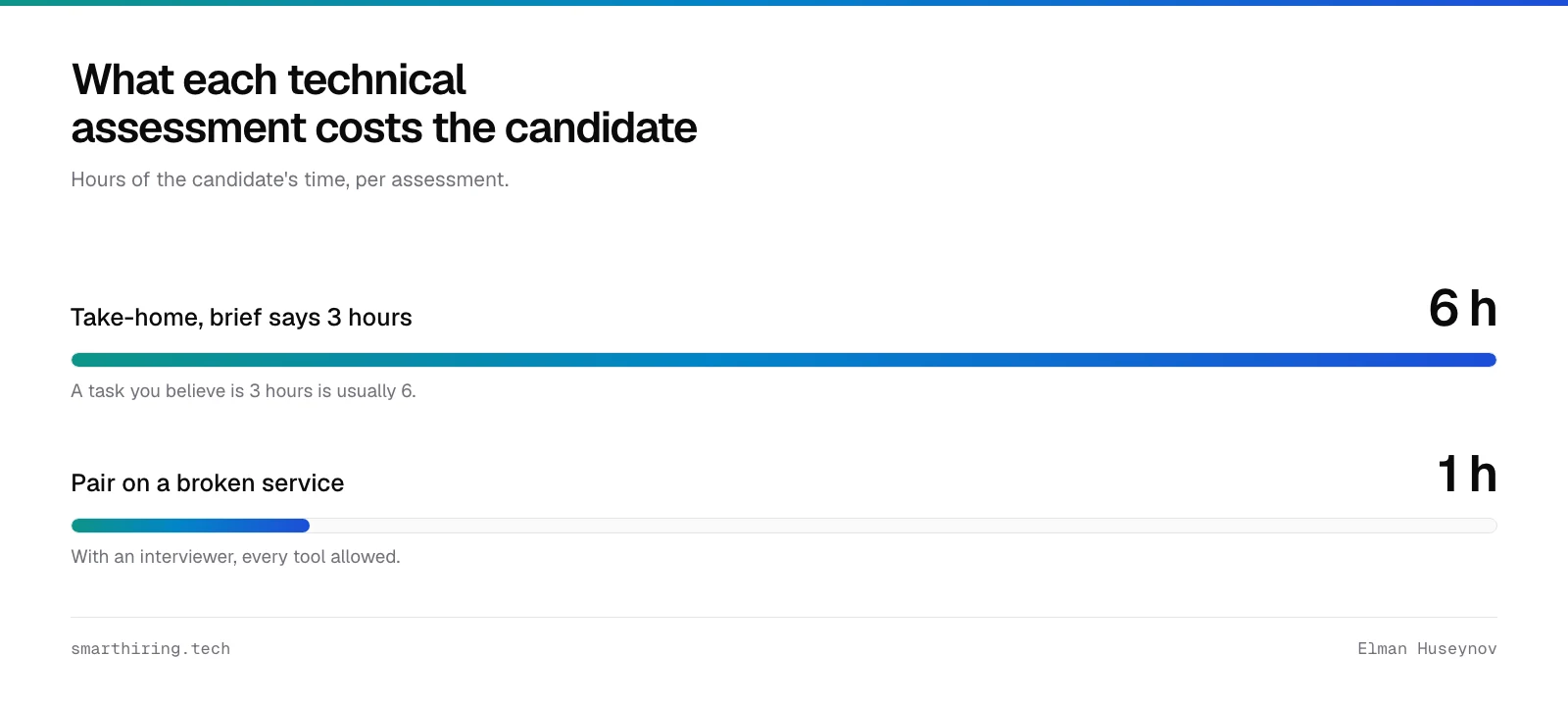
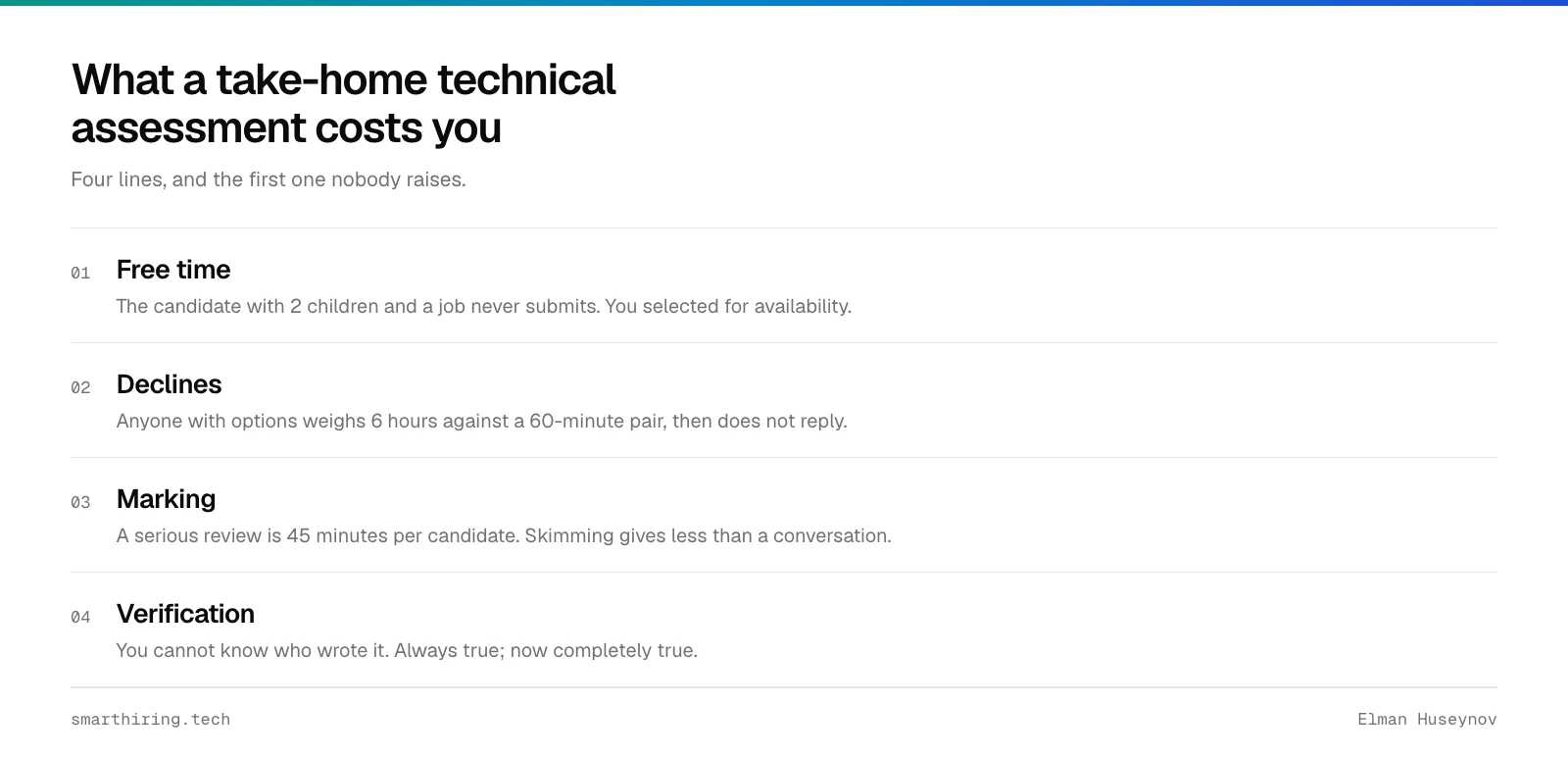
A take-home costs the candidate 6 hours and you 45 minutes of marking. Then it costs you the candidates who never start it.
A 3-hour brief turns into 6 for someone new to your conventions.
Anyone with options compares that with a 60-minute pair. Then they do not reply.
The candidate with 2 children and a current job never submits. You selected for free time.
A take-home works in 1 case: when writing alone, over hours, is the job. Cap it at 3 hours and follow it with a conversation.
What is the pair on a broken service?
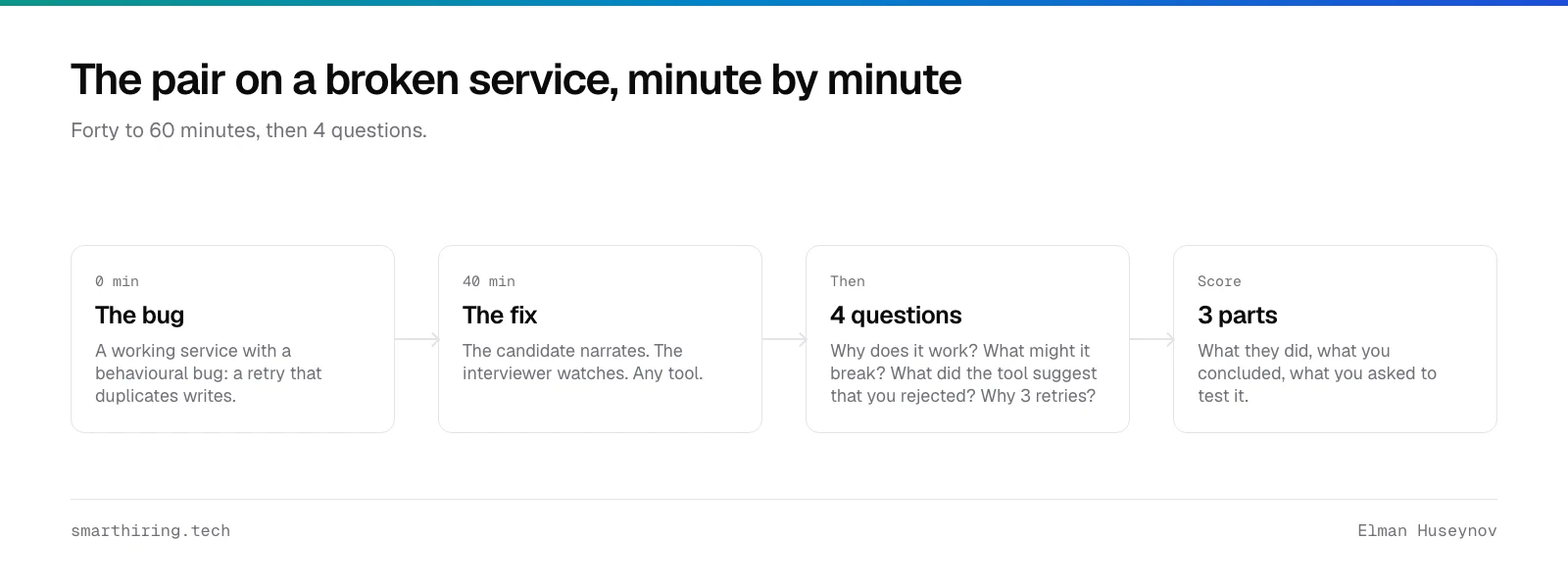
The pair is a small working service with a subtle bug. Forty to 60 minutes, every tool allowed.
The candidate narrates and the interviewer watches.
Make the bug behavioural. An off-by-one under concurrency. A retry that duplicates writes.
The pair costs the candidate 1 hour instead of 6. Your side is the same hour, scored in the room.
After the fix, 4 questions. Why does it work? What might it break? What did the tool suggest that you rejected? Why 3 retries?
A candidate who understands the fix answers each in a few sentences. A pasted fix tends to stall at “what might it break?”
Does the technical assessment survive candidates using AI?
The pair survives candidates using AI because AI is allowed in it.
The scoring lives in the 4 questions. A pasted answer cannot pass them.
Detection tools fail for stakes that end a candidacy. The ban tests obedience, and the candidates use the tools anyway.
Build 2 or 3 versions of the exercise and rotate them. One week of building covers a year of loops.
If an exercise leaks, the questions still work on someone who read the answer.
How do you know the technical assessment works?
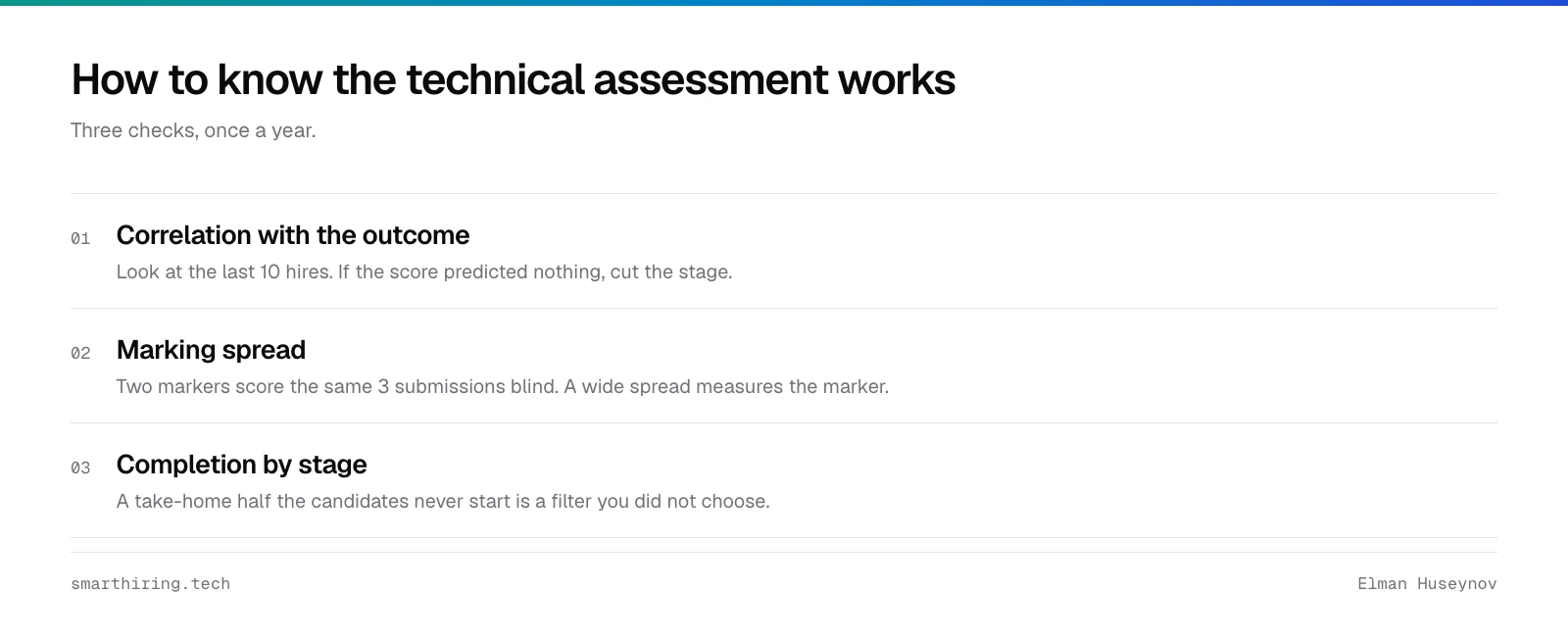
A technical assessment works if its score predicted something about the last 10 hires. Check that once a year.
Two markers score the same 3 submissions blind. A wide spread means you are measuring the marker.
Track completion rate by stage. A take-home that half the candidates never start is a filter you did not choose.
A stage whose score predicted nothing goes this quarter. The pair takes its slot.
Common questions
How long should a technical assessment take?
Sixty minutes, in the loop, with an interviewer present. A take-home is capped at 3 hours in writing, and checked against what people submit. If the strongest submissions took a weekend, the cap is fiction. The assessment scores free time.
Should the technical assessment come before or after a human conversation?
After. A stranger sent a link will not spend 3 hours on it. Put the 30-minute screen first. The assessment is then spent on people who want this job. Then the pair, then the design round, on the same day.
Can a technical assessment be used for senior and staff engineers?
The same broken service with a heavier strong answer. A senior candidate names the second bug the fix exposes. A staff candidate says what they would not fix and why. The exercise stays; the written bar moves with the level.
What should the technical assessment never do?
Never use the candidate’s output in production. Never send the task as the first step. Candidates post about tasks that look like unpaid work. A task that resembles your roadmap reads as exactly that. The candidate tells the next one. Change the task before it goes out. Say in the brief that nothing submitted is used.
The short version
A 60-minute pair on a broken service, every tool allowed, then 4 questions.
A take-home only when writing alone is the job. Three hours, capped and checked, followed by a conversation.
Check once a year whether the score predicted anything about the last 10 hires.
A workshop sprint: the exercise built from your codebase, with the 4 questions. Book a free 30-minute call.
PDF, 2 pages
Technical assessment: 3 shapes costed
The algorithm test, the take-home and the pair on one hire, the pair in 5 lines, the 4 take-home rules, and the yearly check with 3 numbers to fill in.
Leave a work email: the file opens right here, and one hiring stage, taken apart, follows every week. One click to leave.
Read next
Structured Interview Questions, With the Strong Answer Written First
Unstructured interviews explain 4% of later performance. Structured ones explain about 18%. The difference is 3 questions per round and a strong answer written first.
How to Be a Good Interviewer
Robert Walters found 40% of hiring managers never had formal interview training. These 5 habits make an interviewer worth listening to in the debrief.
Want this fixed in your loop?
SmartHiring trains engineering interview panels on their own open roles. Elman Huseynov, a Tech Hiring Expert in Berlin, runs every engagement. One workshop writes the scorecards for your roles, then calibration runs until the panel agrees. It starts with a free 30-minute call.
No pitch if the loop is already fine. See an example audit report.