A software engineer job description does 1 job. It makes the right 20 people apply and keeps the wrong 200 away.
On this page
Most job descriptions do the opposite.
14 required technologies for a role that uses 4. A salary the ad hides. A team described in adjectives.
Here is the version that comes out of the scorecard instead. It is shorter, it names the work, and it says the number.
I have hired 10+ engineers and written the ad for roles in 27 markets. The 5 lines below changed who applied.
What should be in a job description?
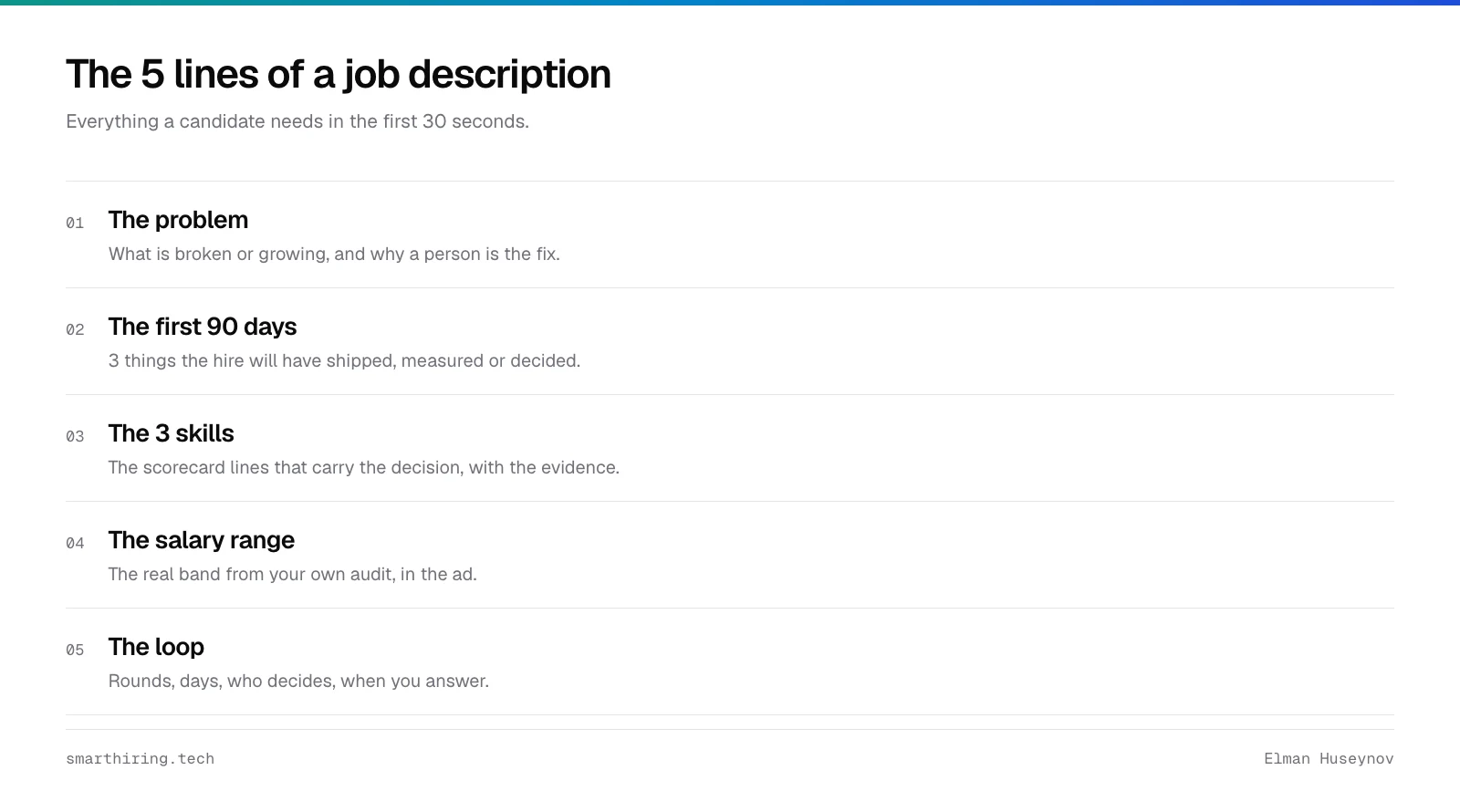
A job description needs 5 lines. The problem, the first 90 days, the 3 skills, the salary range, the loop.
Everything else is decoration.
A candidate reads for 30 seconds and decides whether the role is real. The 5 lines answer that in 30 seconds.
The problem. What is broken or growing, and why a person is the fix.
The first 90 days. 3 things the hire will have shipped. Concrete enough to be wrong about.
The 3 skills. The scorecard lines that carry the decision, with the evidence you look for.
The salary range. The real band, from your own audit. Publishing it changes who applies.
The loop. How many rounds, how long, and who decides.
How specific should a job description be?
The ad should be specific enough that a wrong candidate can see it. That is the whole test.
“Strong communicator” excludes nobody.
“You will write the design doc for the payments split” excludes half the pool. The half that stays is the half you wanted.
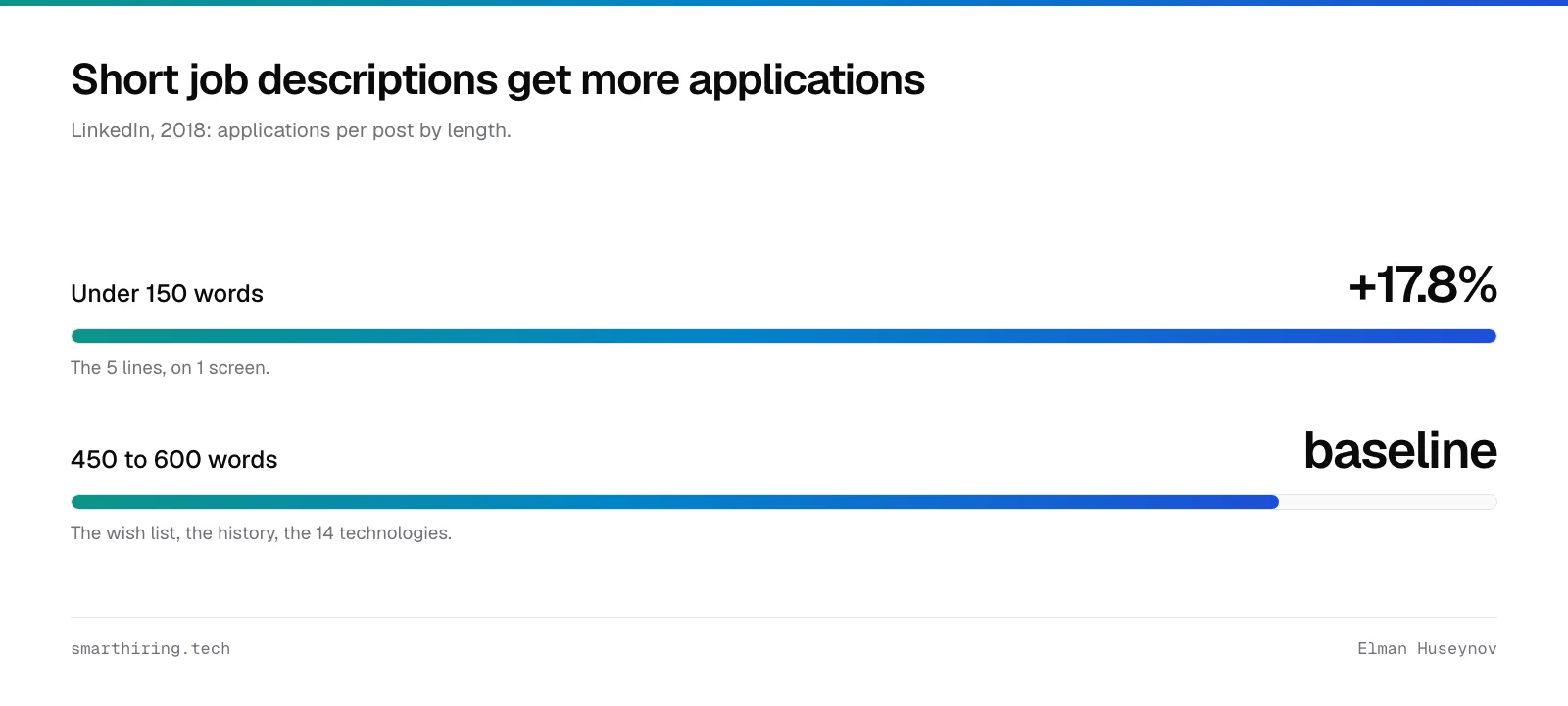
LinkedIn’s 2018 analysis found posts under 150 words drew 17.8% more applications than long ones.
The requirements list is where specificity goes wrong the other way. 14 technologies in a list is a filter you did not intend.
An HP report in Harvard Business Review found women applied at 100% of the list. Men applied at 60%.
Every line you add removes candidates who read it as a rule.
How do you write a job description from the scorecard?
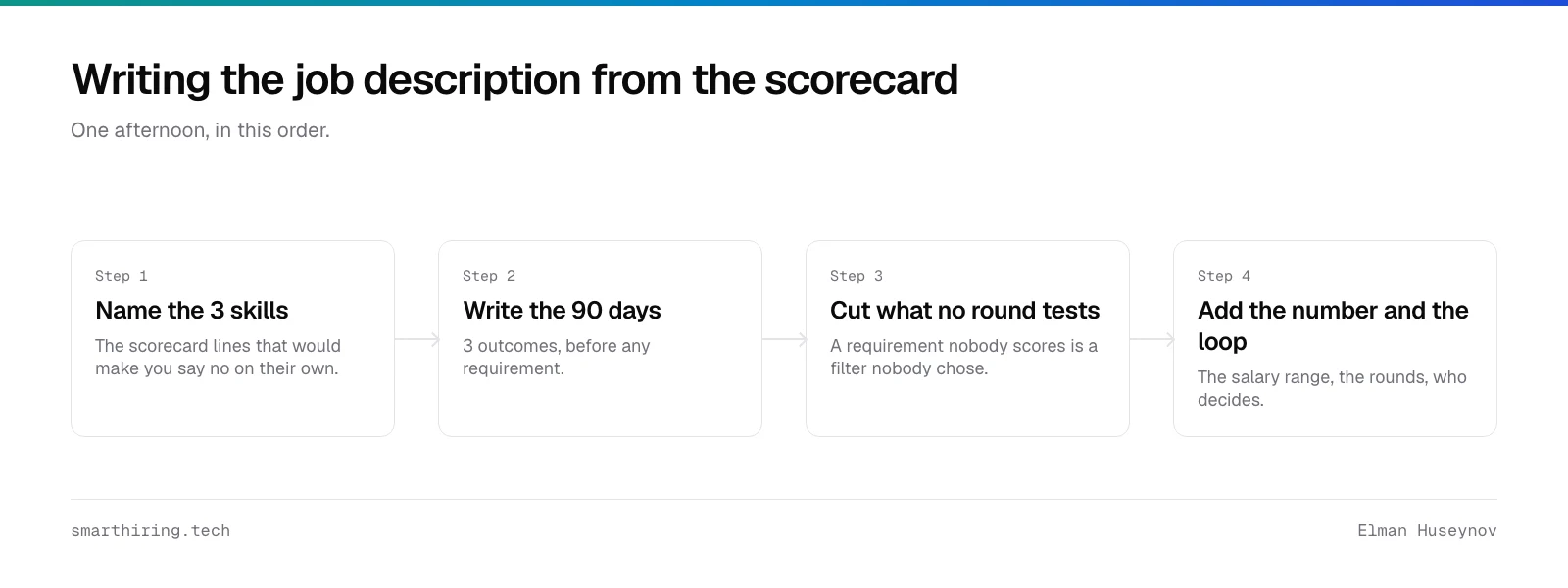
Write the scorecard first, then the ad. Never the other way round.
The scorecard names the 3 to 5 things you will score in the loop.
The ad is those things, rewritten for the person on the other side.
An ad written before the scorecard describes a job nobody has defined yet.
Pick the 3 scorecard lines that would make you say no on their own. One sentence each on what evidence looks like.
Write the 90 days before any requirement. 3 outcomes: shipped, measured, or decided.
Cut every requirement no round will test. A requirement nobody tests is a filter nobody chose.
Add the salary range and the shape of the loop. Both are things candidates ask each other about.
Does a job description include salary?
The ad should include the salary range. In a growing number of places it must.
The EU Pay Transparency Directive reaches national law by June 2026.
California, Colorado, New York, Washington and Illinois already require a range in the posting.
The range in the ad changes 3 things. The salary range post walks all 3.
Fewer people apply. The ones who do are better matched. And someone on your own team does the arithmetic.
An ad without a number reads as a company with something to hide. The candidate assumes the low end.
Who should write a job description?
The hiring manager writes it, from the scorecard. The recruiter edits it.
The reverse produces a recruiter’s guess at a job the manager has not defined.
The manager knows the 90 days, the 3 skills and the team. The recruiter knows what candidates read and stop reading.
The recruiter’s edit has 1 rule: cut, do not add. Every added line is a requirement nobody tested.
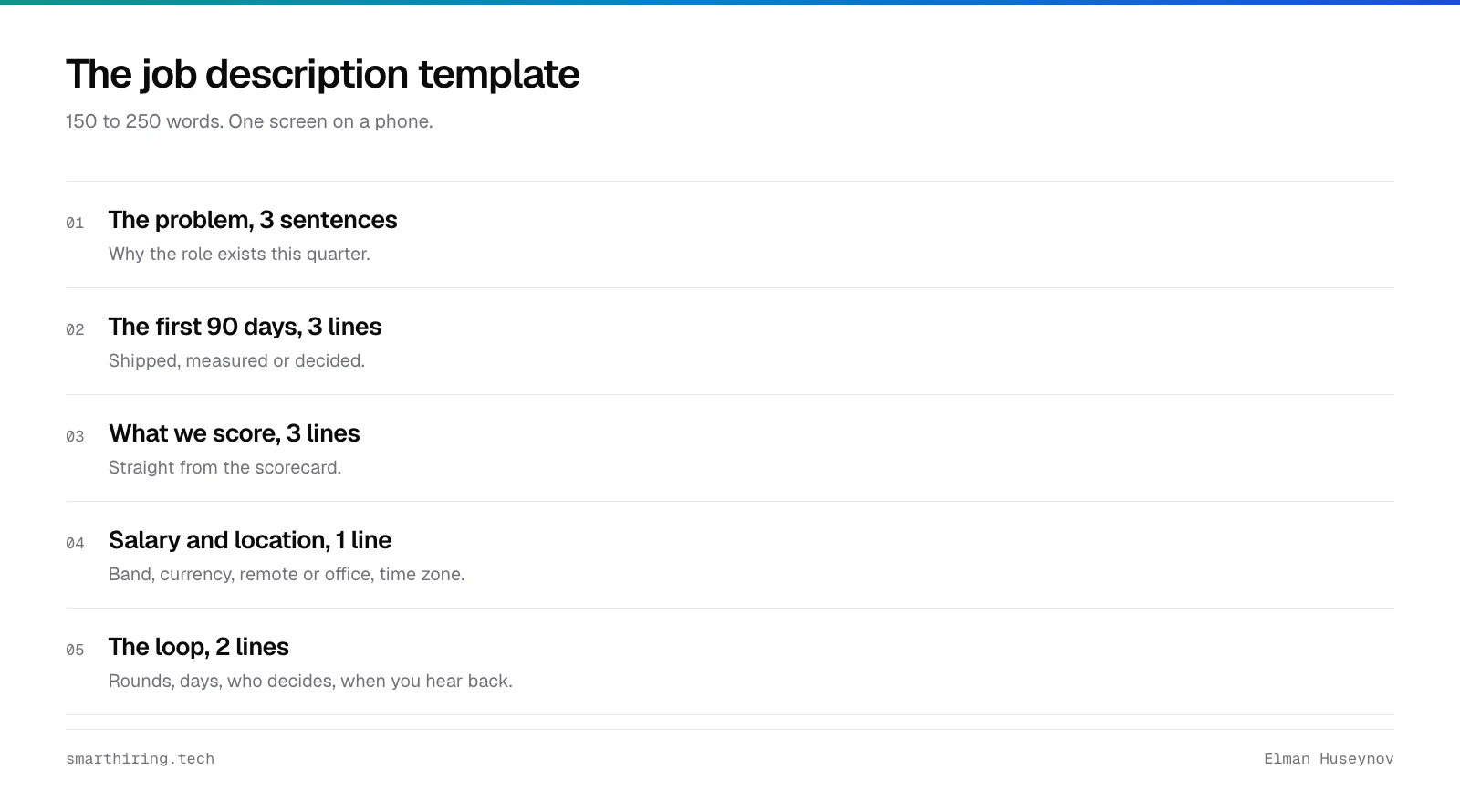
Here is what the 5 lines look like in a template you can copy.
The job description template
| Section | What goes there | Length |
|---|---|---|
| The problem | What is broken or growing, and why a person is the fix | 3 sentences |
| The first 90 days | 3 outcomes: shipped, measured or decided | 3 lines |
| What we score | The 3 scorecard lines, with the evidence you look for | 3 lines |
| Salary and location | The real band, the currency, remote or office, the time zone | 1 line |
| The loop | Rounds, days, who decides, when you answer | 2 lines |
The whole thing fits on 1 screen. 150 to 250 words.
Common questions
How long should a software engineer job description be?
A software engineer job description runs 150 to 250 words. One screen on a phone. LinkedIn’s analysis found posts under 150 words drew 17.8% more applications than long ones. Every paragraph past the 5 lines is one the right candidate skims. The wrong candidate uses it to self-select in.
Should a job description list every technology in the stack?
List only the technologies the loop will score. Usually 3 or 4. The full stack belongs on the careers page. A list of 14 reads as a rule to half the candidates. It removes them before you ever saw them. Name the 3 that carry the decision and call the rest learnable.
What is the difference between a job description and a job ad?
A job description is the internal definition of the role: scorecard, level, outcomes. A job ad is the public version written for the candidate. Most companies post the internal document and wonder why it reads like a policy. Write the scorecard, then the description, then cut it into an ad.
What makes a good job description?
A good job description lets a wrong candidate see they are wrong in 30 seconds. It names the problem, the 90 days, the 3 skills, the salary range, the loop. It fits on 1 screen. The requirements list stays short because every line in it is tested in a round.
Should the job description mention the interview process?
Say how many rounds, how long the loop runs, and who decides. Candidates trade this information anyway. A loop of 4 rounds in 1 day is a reason to apply. 9 rounds over 6 weeks is a reason to apply elsewhere first.
The short version
Write the scorecard first, then the ad from it.
5 lines: the problem, the 90 days, the 3 skills, the salary range, the loop.
150 to 250 words. A wrong candidate should know they are wrong in 30 seconds.
Cut every requirement no round will test.
The manager writes, the recruiter cuts.
Audit from 500 euro, with your ad rewritten from the scorecard. The first call is 20 minutes and free.
PDF, 2 pages
Job description template, 5 lines
The 5-line template with a filled example for a senior backend role, the cut list for the recruiter's edit, and the 30-second test.
Leave a work email: the file opens right here, and one hiring stage, taken apart, follows every week. One click to leave.
Read next
How to Run a Debrief Meeting
Most debriefs anchor on whoever speaks first and end in a vote. Here is the order that surfaces disagreement.
Interviewer Calibration, Explained
Two interviewers watch the same candidate and reach opposite conclusions. Here is how to run the session that fixes it.
Want this fixed in your loop?
Interview training for hiring managers and their panels: one workshop on your open roles, scorecards written for them, and calibration until the panel agrees. It starts with a free 20-minute call.
No pitch if the loop is already fine.