An engineering onboarding checklist has 1 metric behind it. Time to first production change.
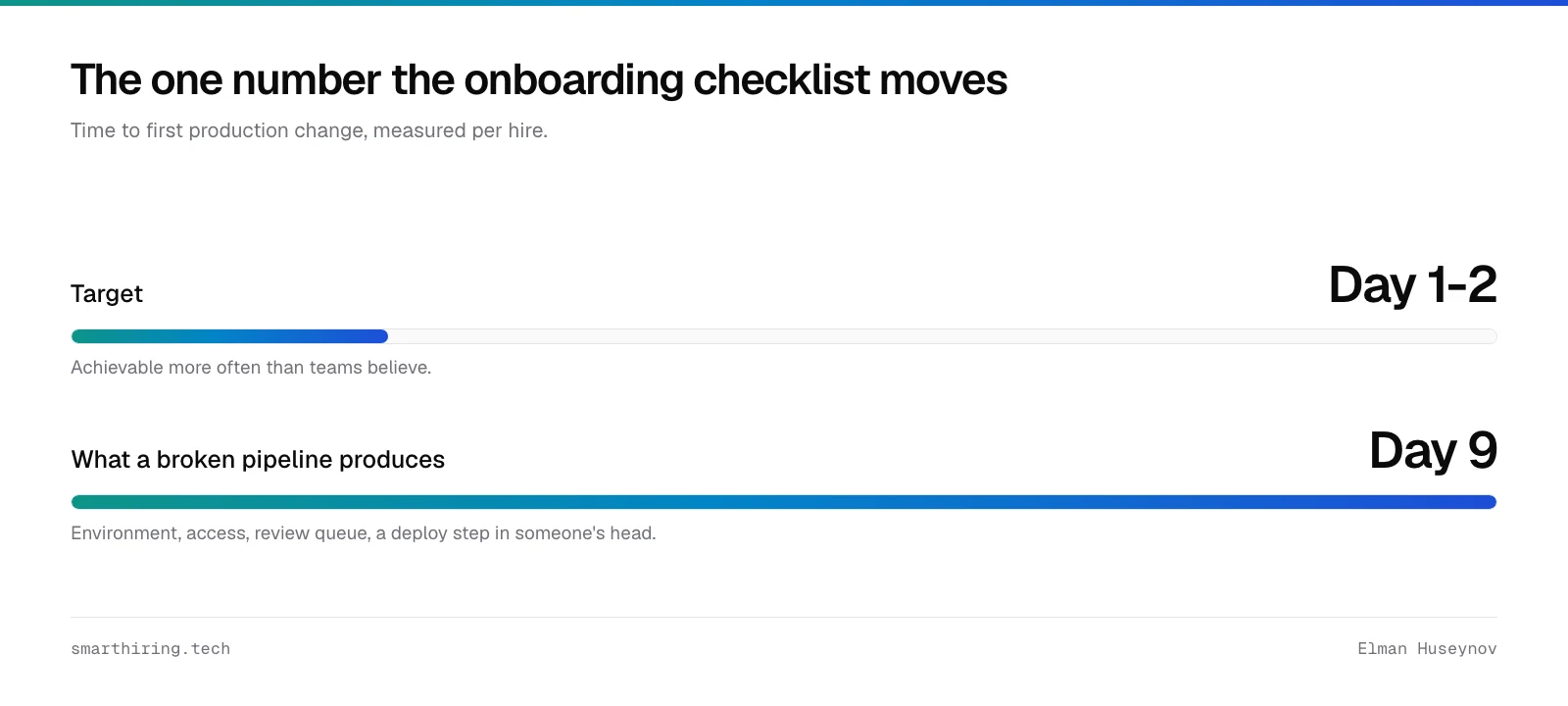
Target day 1 or 2.
Get accounts approved a week early, and choose the first task before they arrive.
Give the new hire a buddy with reduced load, and fill week 1’s calendar.
On this page
You spent 6 weeks and 5 rounds choosing this person. Then a wiki page last edited 2 years ago.
An onboarding checklist is the cheapest fix a team has. It is also what a bad hire makes expensive.
Here is the new hire onboarding checklist that costs a few hours to set up.
What is the engineering onboarding metric?
The onboarding metric is time to first production change. Measure it per hire, post it where the team sees it.
Target day 1 or 2. Shipping on day 2 does not matter in itself.
The number is a proxy for everything else being broken. Environment setup, access requests, a review queue nobody watches.
If your last 3 hires took 9 days, the problem is your pipeline. Every existing engineer pays for it too.
The new person just has no workaround yet.
What is on the onboarding checklist before day 1?
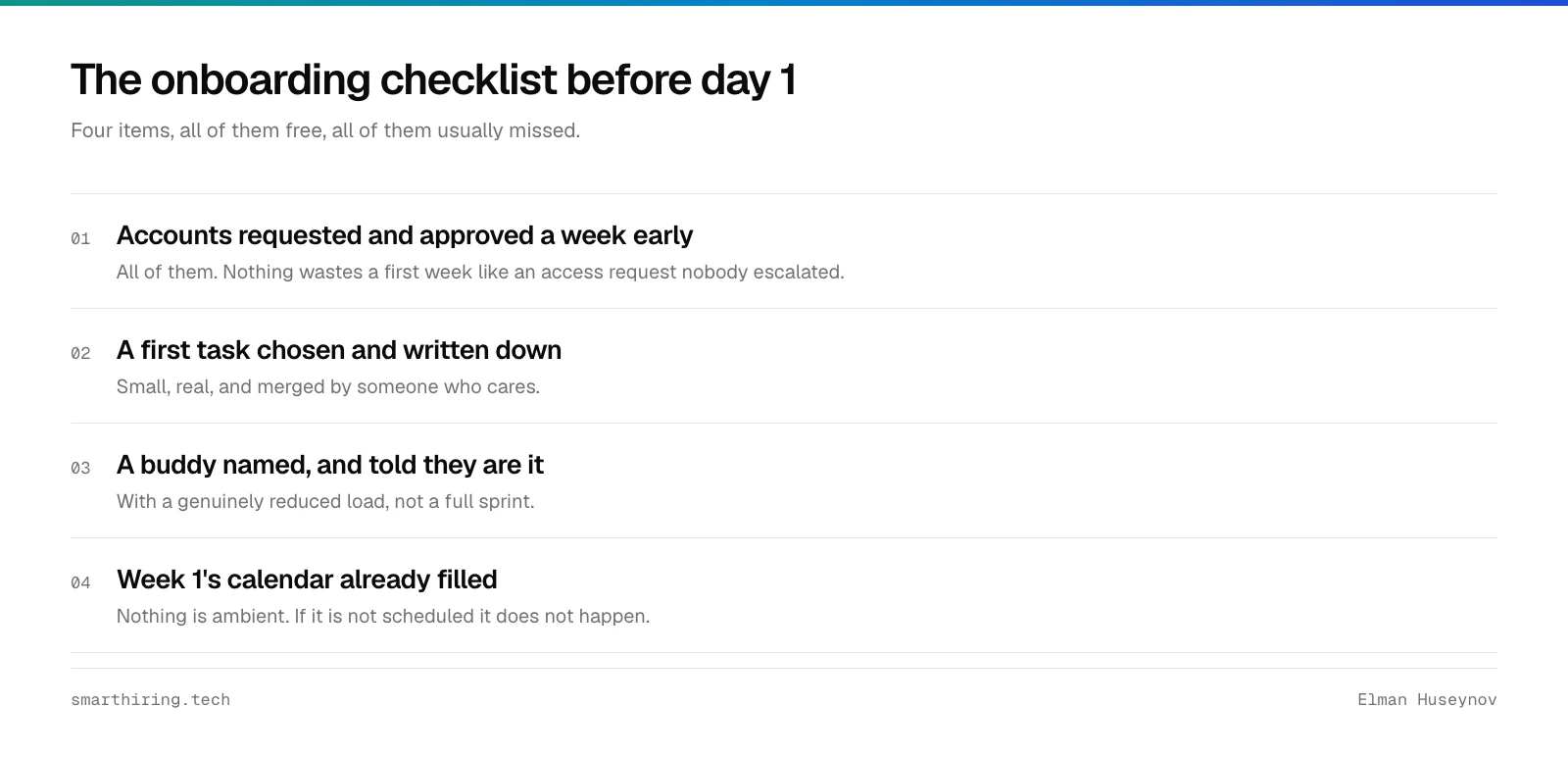
The onboarding checklist before day 1 has 4 items, and all of them are free.
Accounts requested and approved a week early. A first task chosen and written down.
A buddy named and told. A calendar already filled for week 1.
Accounts, a week early. Nothing wastes a first week like an access request that needs 3 approvals.
A first task, written down. Small, real, and merged by someone who cares. “Read the codebase” fails the test.
A buddy with reduced load. Someone whose job for 2 weeks is answering questions. The new hire never weighs whether to ask.
Week 1 on the calendar. An empty calendar in week 1 is being lost.
What does the software engineer onboarding process look like by week?
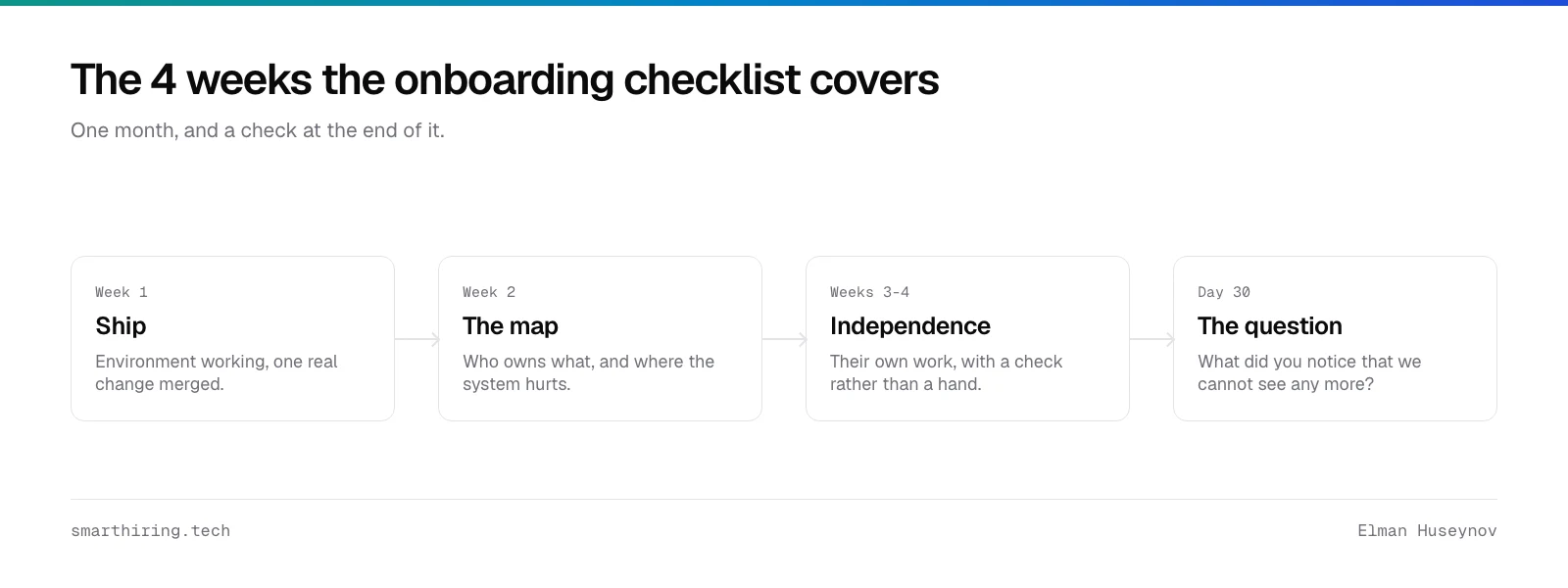
The software engineer onboarding process runs 4 weeks. Ship, map, own, and the 30-day question.
Week 1 proves the pipeline. Week 2 draws the map. Weeks 3 and 4 hand over a piece of work. Day 30 asks 2 questions.
| When | Onboarding checklist item |
|---|---|
| Day 1: ship | Environment running, then a tiny change through the whole pipeline. A typo, a log line, a flaky test |
| Days 2 to 5: friction list | Every failed command and every question asked. Fix the top 3 before the next hire |
| Week 1: 6 conversations | Buddy, manager, 4 people whose work touches theirs. 25 minutes each: what do you need from this team? |
| Week 2: the map | They draw the systems badly, then correct it with someone. Shadow 1 on-call shift |
| Weeks 3 and 4: own something | Design, implementation, review, deploy, and the fix when it breaks |
| Day 30: 2 questions | What have you stopped asking about? What have you noticed that we no longer see? |
The second day-30 question expires after month 1, so ask it on time.
What should the new hire write down?
Each new hire starts one document on day 1. What they asked, and what the answer was.
At the end of the month that document extends the onboarding checklist.
The next hire starts from it. After 3 hires you have a real onboarding checklist template, built at no extra cost.
Which 4 onboarding checklist failures are most common?
Four onboarding checklist failures recur, and all 4 are free to avoid.
No first task chosen before arrival. Access requests started on day 1 and escalated by nobody.
A buddy carrying a full sprint. And a week-1 calendar nobody filled, which remote teams feel first.
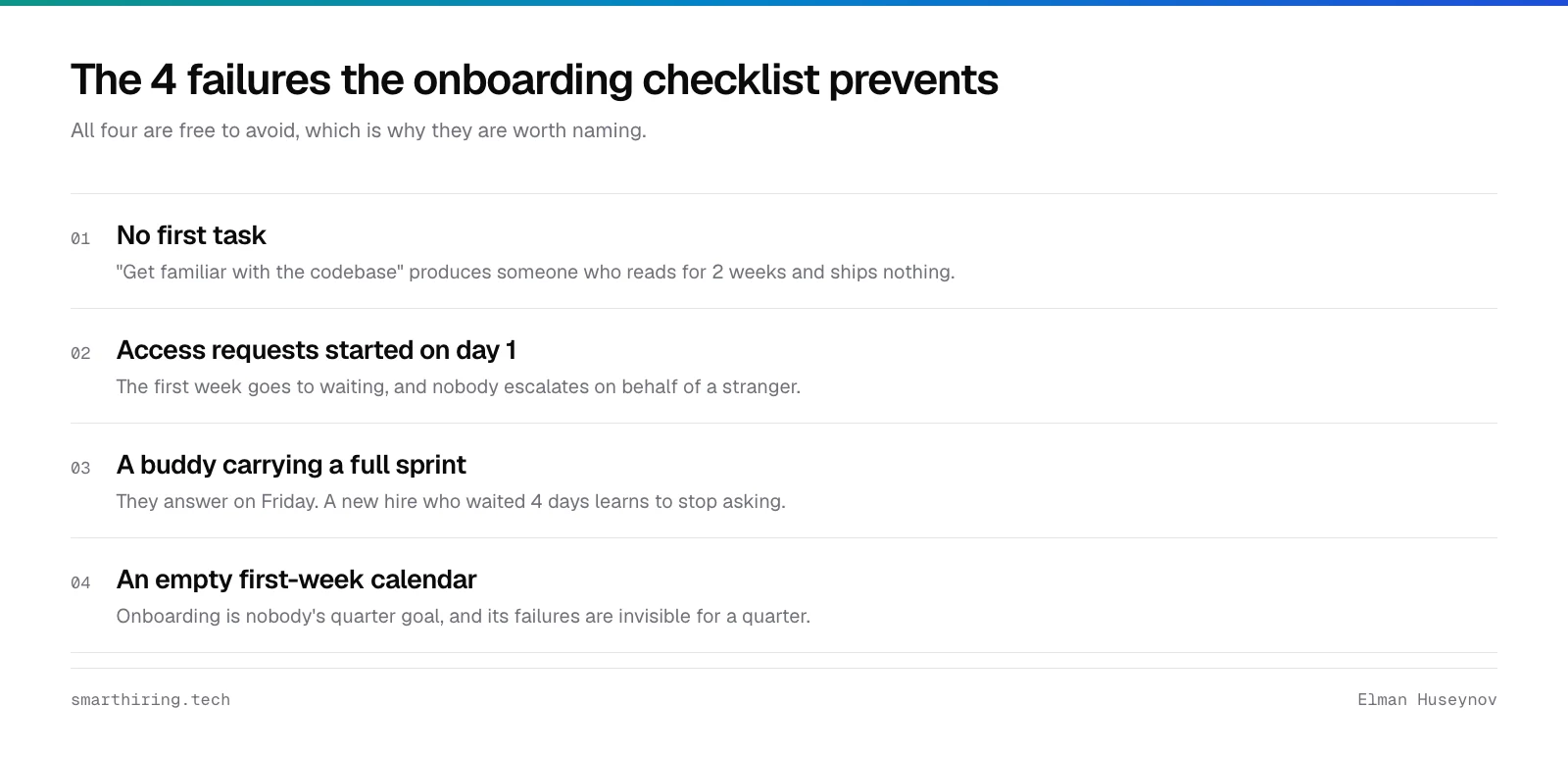
No first task. “Get familiar with the codebase” produces 2 weeks of reading. The new hire starts believing they were a mistake.
Access on day 1. Costs a week, every time.
The busy buddy. Name someone without reducing their load and they are unavailable when it matters. The new hire stops asking.
The empty calendar. In a remote team nothing is ambient. Week 1 has to be scheduled or it does not happen.
Remote adds 1 more rule. Make asking cheap. A channel where questions are expected, and a person whose job that week is answering.
Common questions
What should a new engineer ship in week 1?
A new engineer should ship something deliberately tiny in week 1. A typo, a log line, a flaky test. Pick it before they arrive. The point is proving the whole path works. Environment, review, pipeline, deploy. You are testing your own setup. A new hire still notices the steps your team stopped seeing.
How do you measure whether the onboarding checklist works?
Time to first production change shows whether the onboarding checklist works. Track it per hire, posted where the team can see it. It is the only onboarding metric that is cheap to collect and hard to game. If it is 3 weeks, the cause is upstream. Accounts, environment, or nobody choosing a first task.
Who should own the onboarding checklist?
The onboarding checklist needs one named owner per hire, with time taken off their workload. Onboarding fails because it is nobody’s quarter goal and its failures are invisible for months. A buddy carrying a full sprint answers on Friday. A new hire who waited 4 days learns to stop asking.
How do you keep the onboarding checklist current?
Keep the onboarding checklist current by having each new hire write it. One document per person, started day 1, holding every question they asked and the answer. At the end of the month it replaces the previous version. The onboarding checklist stays current. The only person who can see the gaps is the one who just hit them.
What is an onboarding checklist?
An onboarding checklist is the list of things ready before a new hire arrives. Accounts approved a week early. A first task chosen. A buddy named and told. Week one’s calendar filled in. One metric checks the whole thing: time to first production change.
The short version
Measure time to first production change. Target day 1 or 2.
Accounts before they arrive, and a first task chosen.
A buddy with reduced load, and a full calendar for week 1.
Have the new hire record every friction point. Fix the top 3 before the next one. Their questions extend the onboarding checklist.
Ask at 30 days what they have stopped asking about.
Ask what they noticed that you cannot see any more.
A manager hire needs a different first 90 days.
Onboarding often fails because the hiring bar moved. The loop is the place to start.
An audit of your loop, so the next hire starts with a written scorecard. Book a free 30-minute call.
Excel, 2 sheets
Engineering onboarding checklist
Every item from a week before day 1 to day 30, with an owner and a date column, and a second sheet for the new hire's own friction list.
Leave a work email: the file opens right here, and one hiring stage, taken apart, follows every week. One click to leave.
Read next
How to Hire Software Engineers
The job ad is step 2. Step 1 is a written bar, and the rest of the loop follows from it.
The 30 60 90 Day Plan the Manager Writes for a New Engineer
Candidates write 30 60 90 day plans to get the job. The version that matters is the one the manager writes before day 1. Here it is.
Want this fixed in your loop?
SmartHiring trains engineering interview panels on their own open roles. Elman Huseynov, a Tech Hiring Expert in Berlin, runs every engagement. One workshop writes the scorecards for your roles, then calibration runs until the panel agrees. It starts with a free 30-minute call.
No pitch if the loop is already fine. See an example audit report.