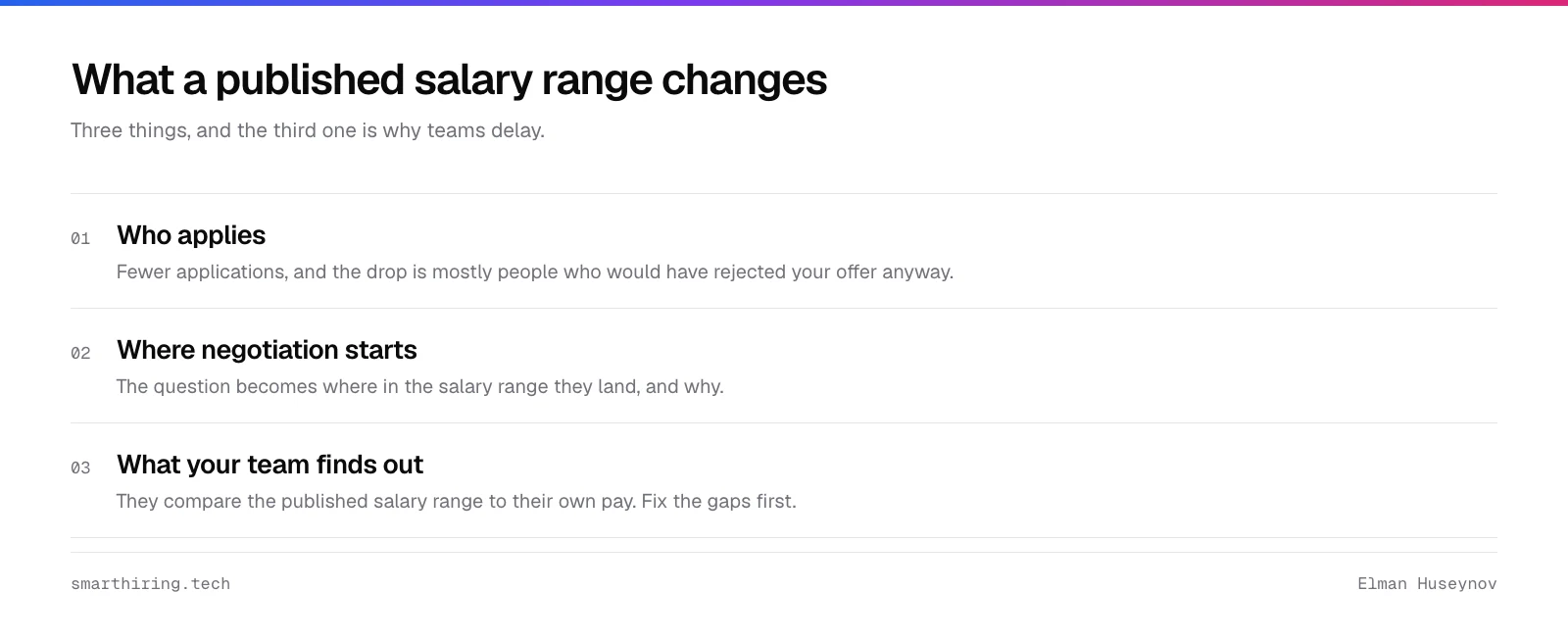
A published salary range in a job ad changes 3 things immediately.
More people apply. In a 2023 SHRM survey, 70% of US employers listing ranges saw more applicants.
Someone already on your team does the arithmetic.
Team pay arithmetic is the reason many companies hold back.
On this page
Audit what you pay before you publish anything. The salary range exposes gaps that already existed.
What does not publishing a salary range cost?
Without a published salary range, pay ends up correlated with negotiation confidence rather than contribution.
Take 2 engineers at the same level who join one team in one quarter.
One negotiated, one did not. Say the gap is 12,000 euro.
The 12,000 euro gap compounds through every raise after that.
Nobody decided it. It is the default outcome of a private price. Salary information leaks, because people talk.
What does a published salary range actually change?
Publishing the band changes 3 things. More people apply, negotiation gets shorter, and your team checks its own pay.
More people apply. SHRM’s 2023 survey found 66% of employers listing ranges saw better applicants.
A candidate who needs more than the top of the range can skip the ad.
Negotiation gets shorter. A conversation about evidence is a better conversation than a conversation about extraction.
Your existing team checks. If the answer is uncomfortable, you have found a problem that was already there.
What do you do before you publish anything?
Audit what you currently pay.
Are 2 people at the same level 15% apart for no defensible reason?
Fix that before the salary range goes public. Publishing first turns a quiet problem into a loud one.
Fixing the internal gap is the work of salary transparency. Writing the number into the job ad takes 5 minutes.
How do you write the salary range?
Make the salary range real and attach the level.
Publish the salary range for the level you are hiring at.
Say what moves someone within it. Scope, autonomy, the specific skills the team is short of.
A title with a band tells a candidate more than either half alone.
How wide should the salary range be?
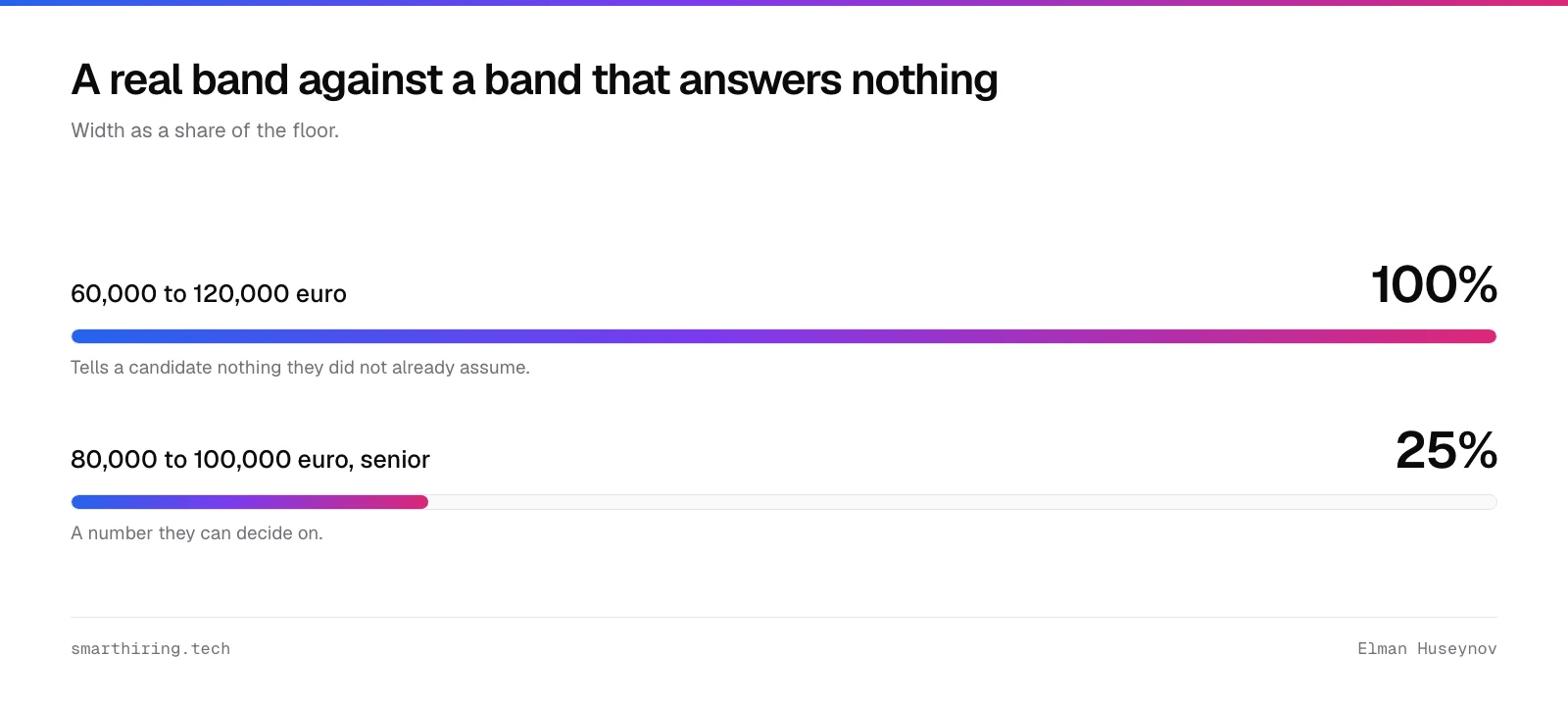
A salary range should span at most 25% of its own floor.
Senior Engineer at 85,000 to 100,000 euro spans 18%.
A range of 60,000 to 120,000 euro spans 100%. A band that wide reads as a refusal.
Say the currency, and say whether the number is base or total.
Put the salary range in the job ad itself.
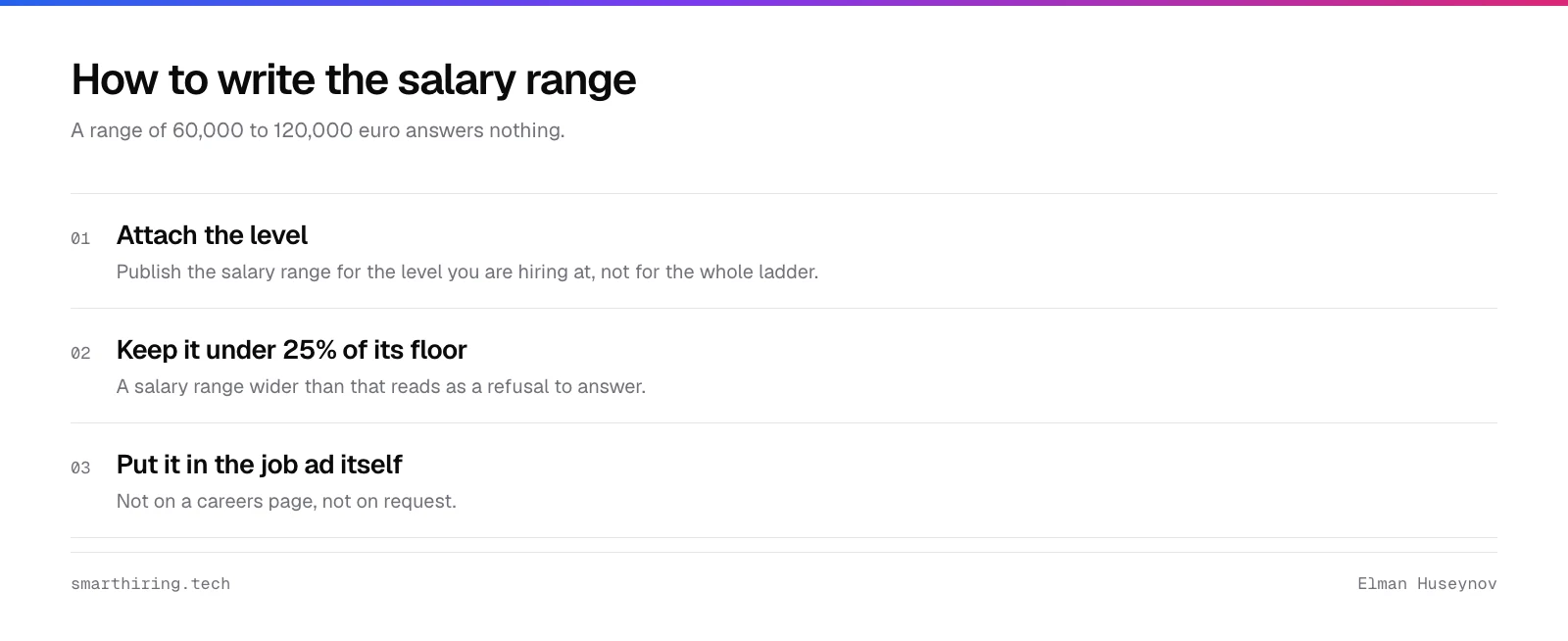
A number that surfaces only after a screen has cost both sides an hour.
What do you say when someone asks for the top of the salary range?
Answer with the criteria rather than with a yes or no.
“The top of the salary range is for someone already operating at the next level.”
“Here is what that looks like on this team. From what I have seen, you are here.”
A placement explained that way survives being repeated to a colleague.
The objection that is actually valid
Publishing bands makes you easier to poach from.
A competitor now knows what to beat. That is real and it is the cost.
People who leave for money alone are usually leaving for other reasons too. Better to find out early.
Where is pay transparency going anyway?
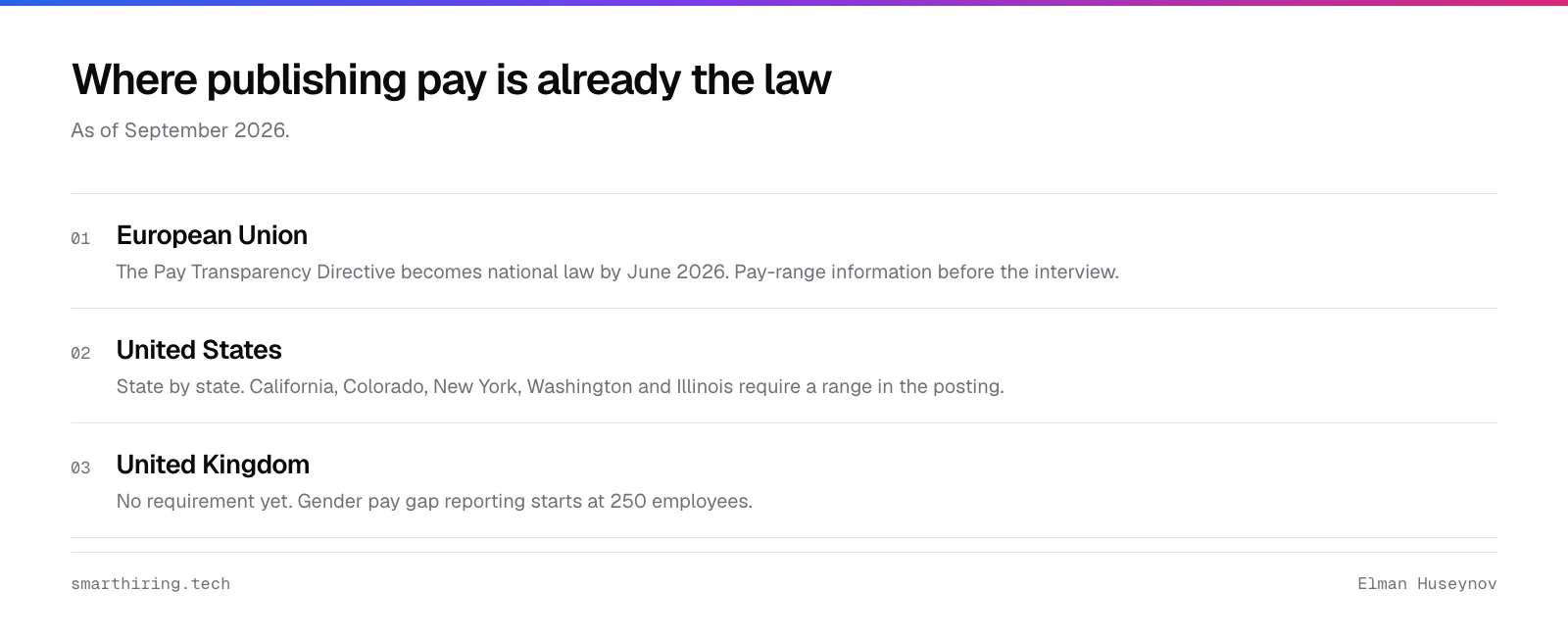
Pay transparency law is moving at different speeds in three markets. Remote hiring means you meet all three.
The EU. The Pay Transparency Directive had to be in national law by 7 June 2026.
Employers give the pay range in the ad or before the first interview. Salary history questions are banned.
The United States. States that require a range in the posting include California, New York, Washington and Illinois.
Post a remote role that could be filled in California, and California’s rule applies.
The United Kingdom. No band requirement yet. A government consultation proposes pay in every job advert.
The consultation closes on 27 October 2026. Gender pay gap reporting applies from 250 employees.
UK candidates still expect a number. You will be publishing bands either way.
The rules above were checked on 12 October 2026. This summary is general information, not legal advice.
Common questions
Does publishing a salary range reduce the number of applications?
A published salary range usually brings more applications. In SHRM’s 2023 survey of US employers listing ranges, 70% saw more applicants. A candidate who needs more than the band can still opt out early. Without a range they find out at the offer. Count offers accepted per engineering hour, before and after you publish.
What if your current pay is not defensible?
Fix indefensible pay before you publish the band. Budget for the correction rather than the announcement. A band published over unaddressed gaps hands your team the evidence and no explanation. List everyone outside the band. Fix the gaps with no reason, and write down the reason for the rest.
Is publishing a salary range mandatory?
A pay range is mandatory in some markets. EU states had to enact the Pay Transparency Directive by 7 June 2026. In the United States the rule is state by state. California, New York, Washington and Illinois require a range in the posting. The United Kingdom has no such rule yet. A consultation on one closes on 27 October 2026.
What is a salary range?
A salary range is the band a company will pay for one level. The range runs from the bottom of that band to the top. A published range names the level next to it. A range with no level tells a candidate nothing.
Should you publish bands for existing roles too?
Publish bands for open roles first. That gives you one cycle to fix internal gaps. Publishing everything at once turns a private problem into a public one. Over pay you never audited, that lands in a single afternoon. Extend it to existing roles once the gaps are fixed.
The short version
Fix your internal pay gaps, then publish a real salary range with the level attached.
More applicants, shorter negotiations, and pay gaps you find before a candidate does.
Your team will do the arithmetic either way. Better that the answer is defensible.
Rather not run the band audit alone? I do that as a fixed engagement.
The process audit covers your levels and your bands. Book a free 30-minute call.
PDF, 2 pages
Salary range: pre-publish checklist and ad lines
The pay audit to run before the number goes public, the 3 ad lines that work, the answer to "can I have the top of the range", and where a range is already required by law.
Leave a work email: the file opens right here, and one hiring stage, taken apart, follows every week. One click to leave.
Read next
How to Hire Software Engineers
The job ad is step 2. Step 1 is a written bar, and the rest of the loop follows from it.
The Job Description That Gets the Right Engineers to Apply
A job description needs 5 lines. The problem, the first 90 days, 3 skills, the range and the loop. A template to copy.
Want this fixed in your loop?
SmartHiring trains engineering interview panels on their own open roles. Elman Huseynov, a Tech Hiring Expert in Berlin, runs every engagement. One workshop writes the scorecards for your roles, then calibration runs until the panel agrees. It starts with a free 30-minute call.
No pitch if the loop is already fine. See an example audit report.