← All posts
Structured Interview Questions, With the Strong Answer Written First
4 min read Elman Huseynov
4 min read Elman Huseynov
Structured interview questions are the same 3 questions per round, for every candidate. Each maps to a scorecard line.
A strong answer to each is written before the first interview. That is the whole definition.
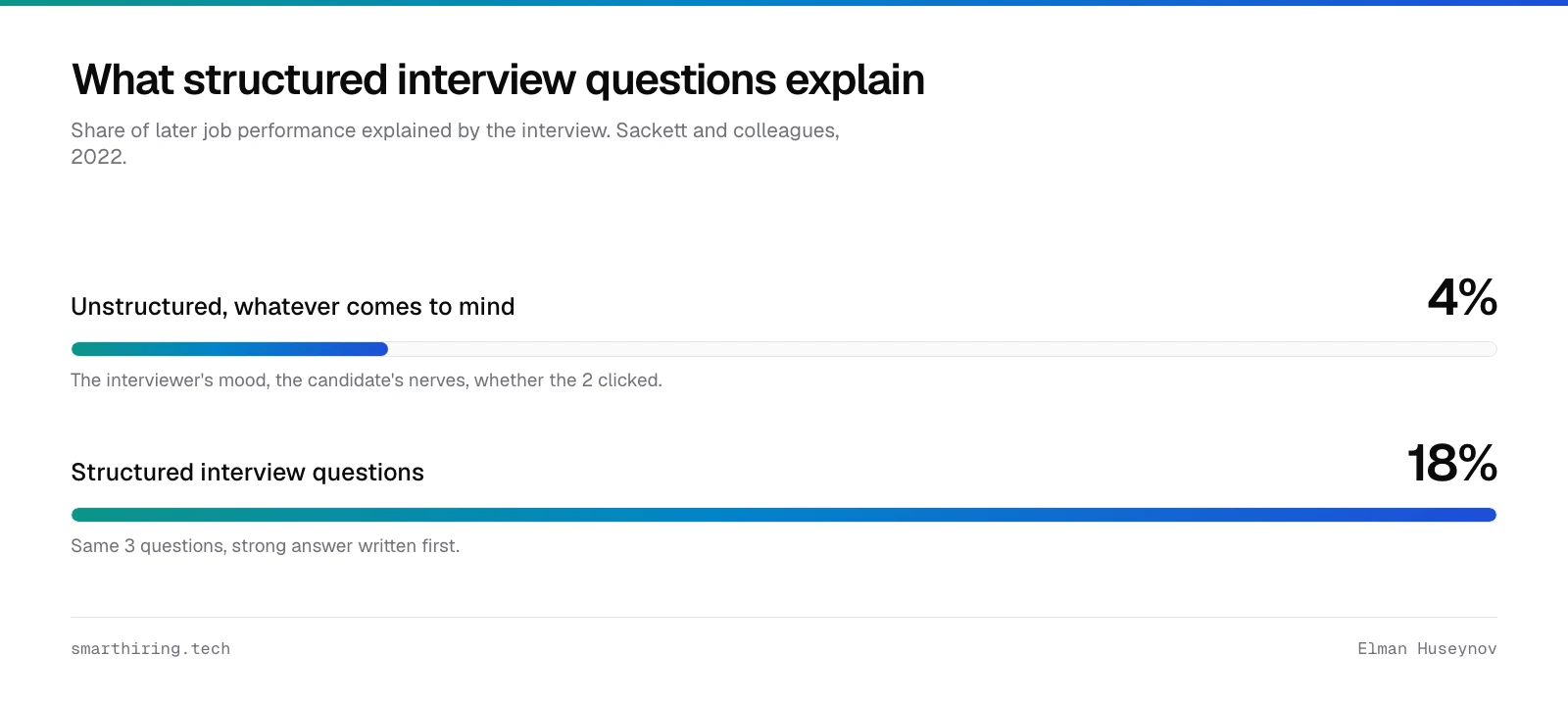
Unstructured interviews explain about 4% of later job performance.
Structured ones explain about 18% (Sackett and colleagues, 2022).
Same hours, same people. The gap is the questions. Here is how to write them.
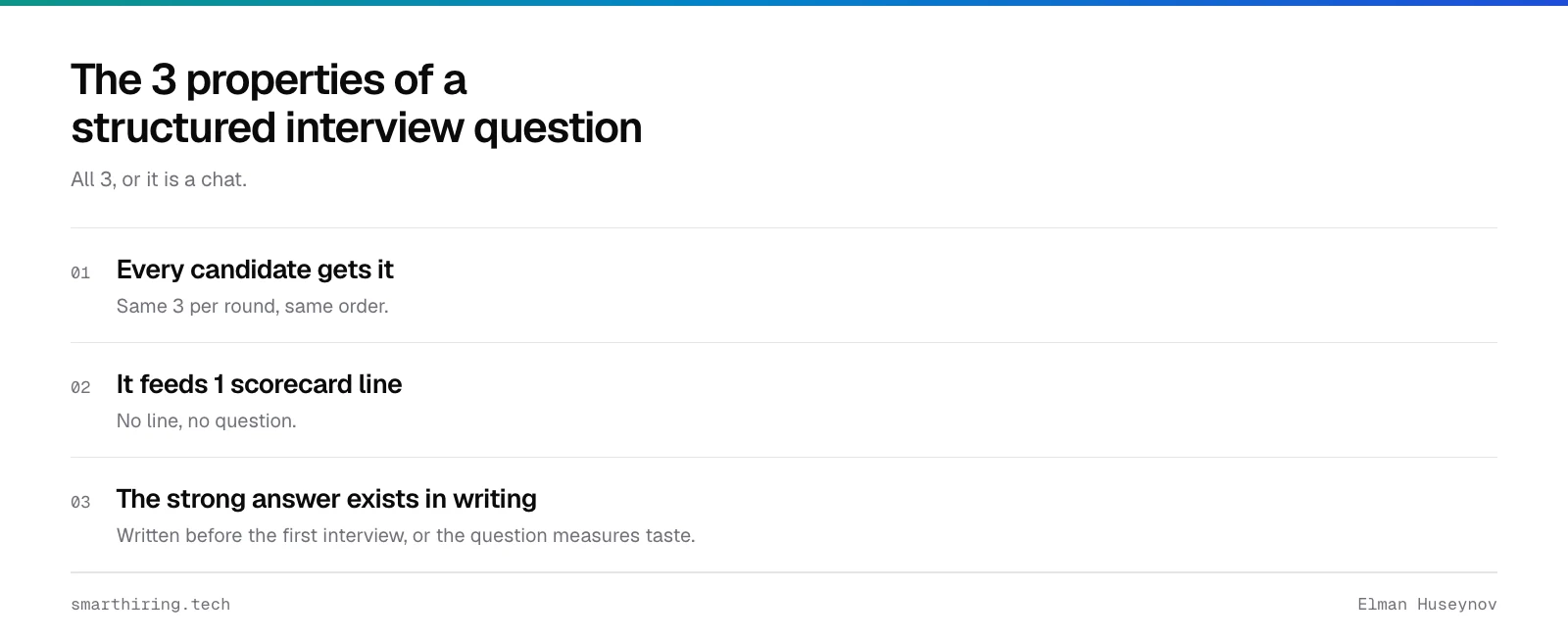
A structured interview question has 3 properties. Every candidate gets it. It feeds 1 scorecard line.
A strong answer to it is written in advance.
An unstructured question has none. The interviewer asks what comes to mind and writes “good technically”.
In a study of 691 real interviews, most interviewers decided between minute 5 and 15.
The rest of the slot then tends to look for support.
Structure interrupts that. The questions are fixed before the view forms.
Three questions per 60-minute round. One per scorecard line the round owns.
Fifteen minutes each, and 15 minutes for the candidate’s own questions.
The scorecard has 4 to 6 lines across the whole loop. No round owns more than 3.
A round with 8 questions is a quiz. A round with 1 is a chat.
Three questions, each with 2 written follow-ups, fill an hour with evidence.
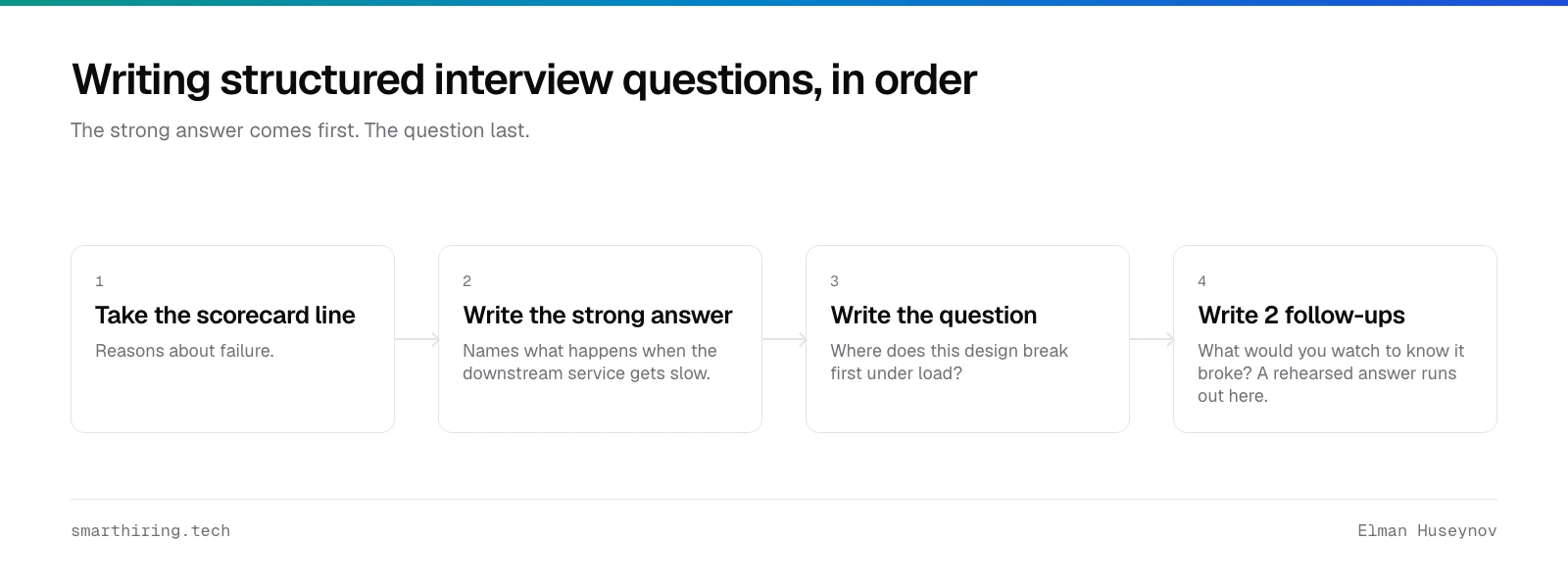
Write the strong answer first, then the question that would produce it.
A question with no strong answer written down measures taste.
Take the scorecard line “reasons about failure”. The strong answer names what happens when the downstream service gets slow.
The question that produces it: “Here is the design. Where does it break first under load?”
The follow-up: “What would you watch to know it broke?” Write both follow-ups in advance.
Anyone with a rehearsed answer runs out inside 2 follow-ups. Anyone with a real one gets more specific.
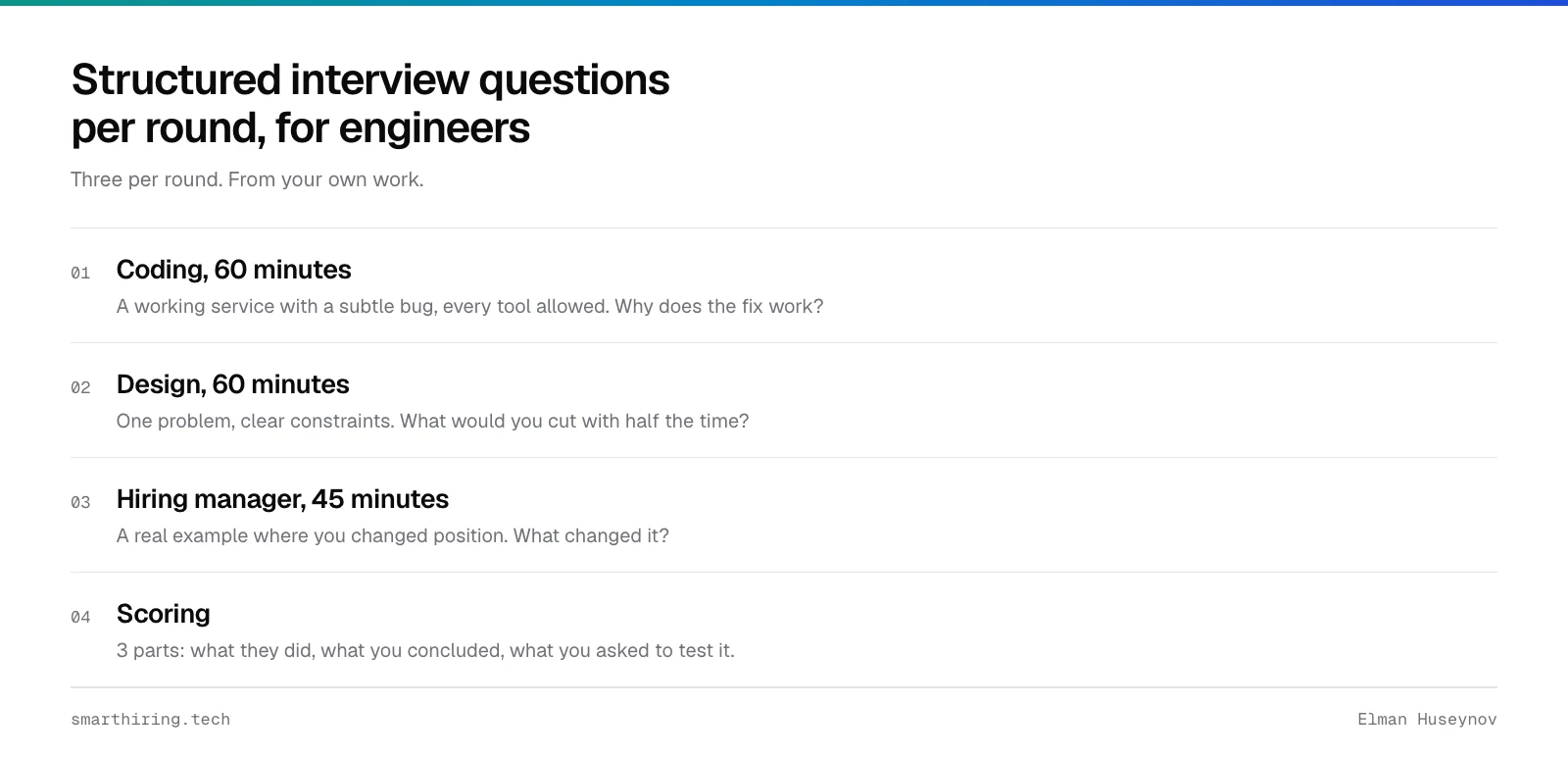
Structured interview questions for engineers come from the work. Your codebase, your system.
Coding, 60 minutes: a small working service with a subtle bug, every tool allowed. Then “why does the fix work?”
Design, 60 minutes: one problem with clear constraints. “What would you cut with half the time?”
Hiring manager, 45 minutes: “Give me a real example where you changed position.” Then: “What changed it?”
The behavioural prompts stay the same for every candidate. Scored against: can disagree without stalling.
Each answer is scored against the strong answer, in 3 parts.
What the candidate did. What you concluded. What you asked to test it.
“Could not explain why the retry count was 3. Asked twice, in different ways.” That line survives a debrief.
“Some concerns about depth” survives nothing.
Scores go in writing, alone, before anyone talks. The 30-minute debrief starts with all of them on one screen.
Give the same questions to 2 interviewers and a recording. Where their scores differ, your bar still lives in people’s heads.
For the first 2 candidates, yes. Then it feels like the first fair round the interviewer has run. The questions are fixed; the follow-ups are where the conversation lives. Candidates prefer it too. They know what the round tests and stop guessing what the interviewer wants.
The same 3 questions with heavier strong answers. At senior level the design question expects the constraint named before any proposal. At staff level the strong answer includes what not to build. The question stays and the written bar moves.
Once a year, or when one leaks. A question tied to your own codebase leaks slowly. The written follow-ups still work on someone who read the answer. Rotate 2 or 3 versions of the coding exercise. Keep the behavioural prompts, which cannot leak.
Score the answer against the line it belongs to. Note that the question did not produce it. After 10 candidates, a question that never produces its own evidence gets rewritten. That is how the set improves without anyone moving the bar.
Three questions per round, the same for every candidate, each mapped to one scorecard line.
Write the strong answer first, then the question, then 2 follow-ups.
Score in 3 parts, in writing, before the debrief.
A workshop sprint: the question set written with your panel in one day. Book a free 30-minute call.
PDF, 2 pages
The 5-step order to write a question in, 4 worked examples with follow-ups, the 60-minute round, a blank sheet for your 3, and the 3-part scoring line.
Leave a work email: the file opens right here, and one hiring stage, taken apart, follows every week. One click to leave.
A take-home costs the candidate 6 hours and you 45 minutes of marking. A 60-minute pair costs 1 hour each side and tells you more. Here is the comparison.
Robert Walters found 40% of hiring managers never had formal interview training. These 5 habits make an interviewer worth listening to in the debrief.
SmartHiring trains engineering interview panels on their own open roles. Elman Huseynov, a Tech Hiring Expert in Berlin, runs every engagement. One workshop writes the scorecards for your roles, then calibration runs until the panel agrees. It starts with a free 30-minute call.
No pitch if the loop is already fine. See an example audit report.