A take-home assignment in hiring moves cost from your calendar to the candidate’s evenings.
A take-home assignment shows how someone writes code unwatched, and how they scope vague work.
A take-home assignment also filters by free time, and strong candidates decline. A 60-minute pair usually beats it.
On this page
The trade is worth it far less often than the companies asking believe.
Here is when a take-home test earns its place in an interview.
What is a take-home assignment good at?
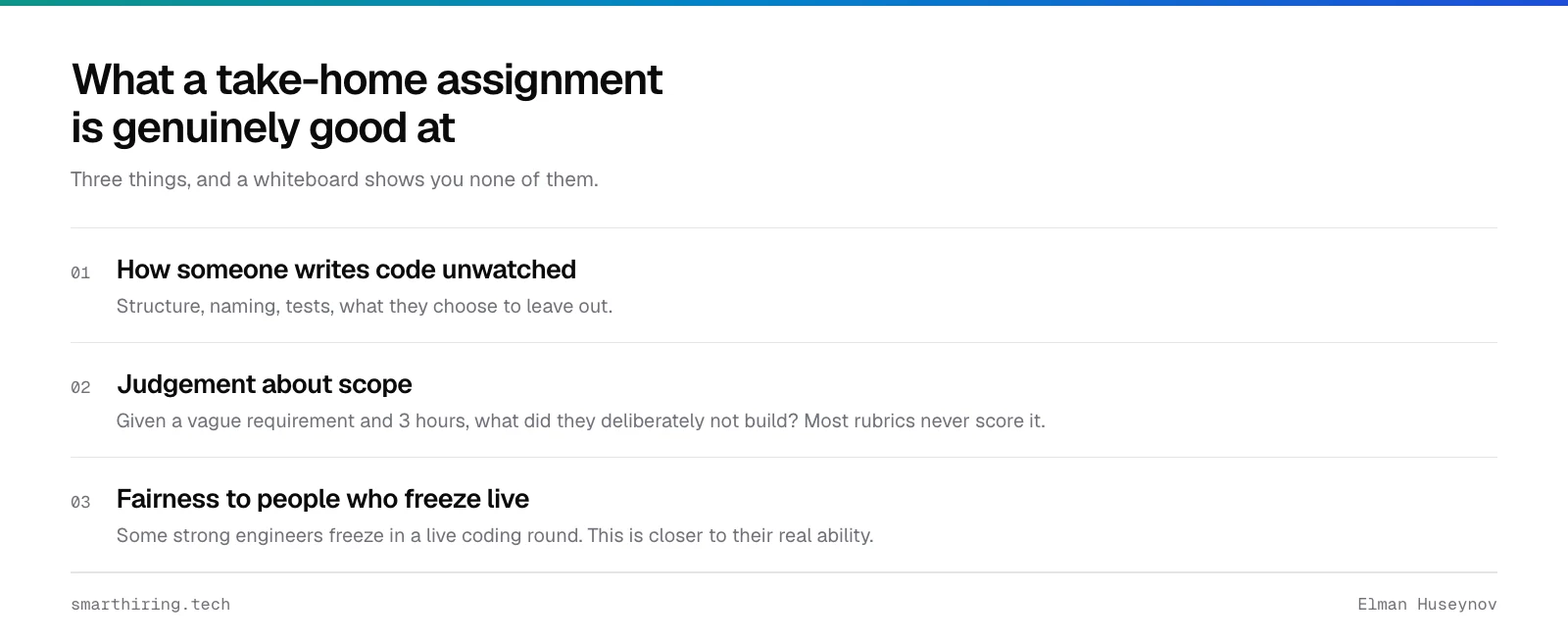
A take-home assignment is good at 2 things, and fair to a third group.
Showing how someone writes code when nobody is watching. Structure, naming, tests.
Testing judgement about scope. Given a vague requirement and 3 hours, what did they build and skip?
Unwatched code. A whiteboard cannot show this, and it is close to what the job is.
Scope judgement. What a candidate leaves out is the most useful signal in the exercise. Most rubrics do not score it.
Fairness. Some strong engineers freeze in a live coding round. A take-home assignment gives them a route closer to their real ability.
What do take-home assignments cost you?
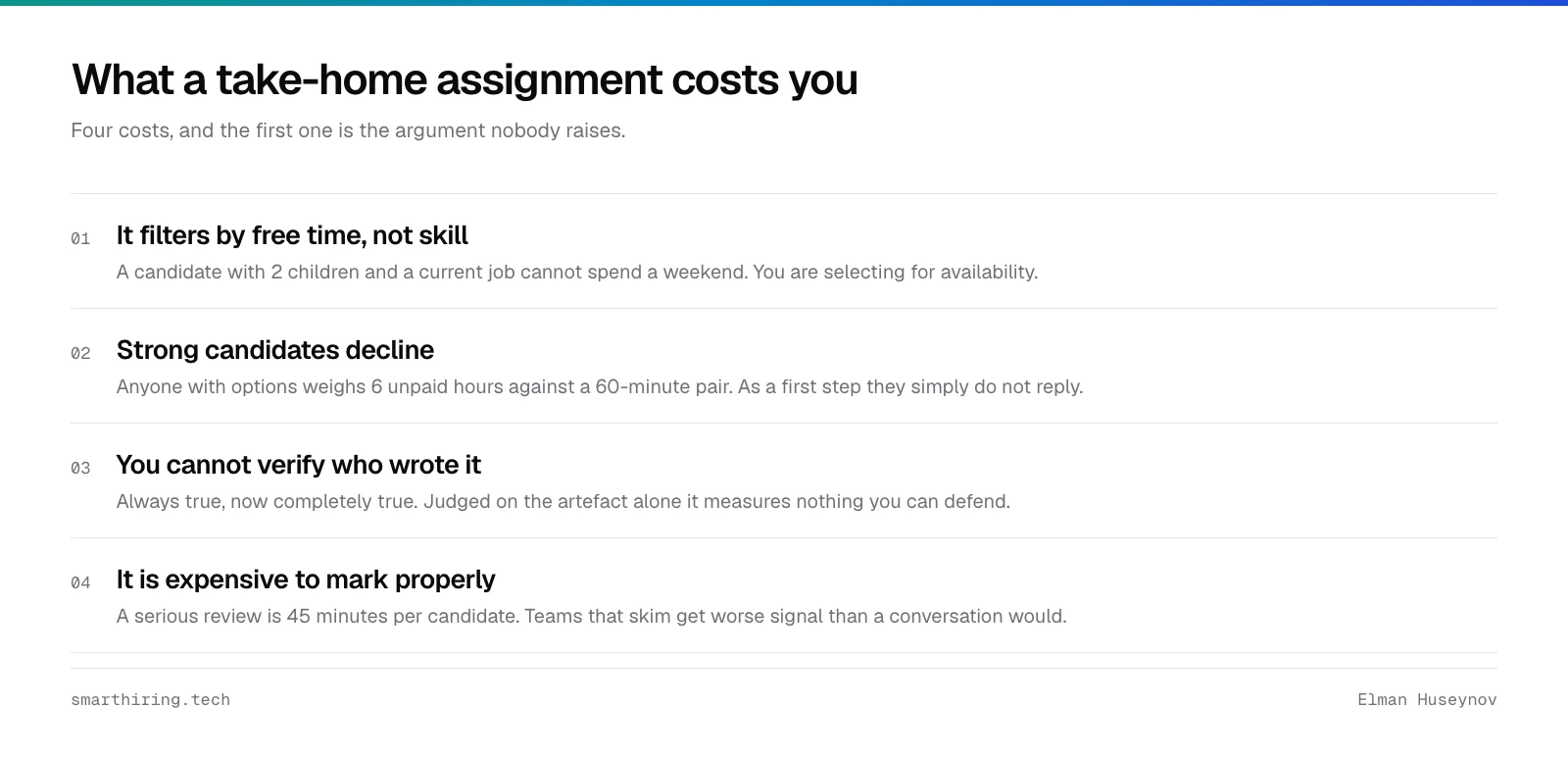
Take-home assignments cost you 4 things, and the first one nobody raises.
A take-home filters by free time. Strong candidates decline. You cannot verify who wrote it.
Somebody has to mark them consistently, which almost nobody does.
Free time. A candidate with 2 children and a current job cannot spend a weekend on it. You are selecting for availability.
Declines. Anyone with options weighs 6 unpaid hours against a 60-minute pair. As a first step, they do not reply.
Authorship. A take-home judged on the artefact alone measures nothing you can defend. The way through is a conversation.
Marking. A serious review is 45 minutes per candidate. Teams that skim get worse signal than a conversation would.
What are the 5 rules for a take-home assignment?
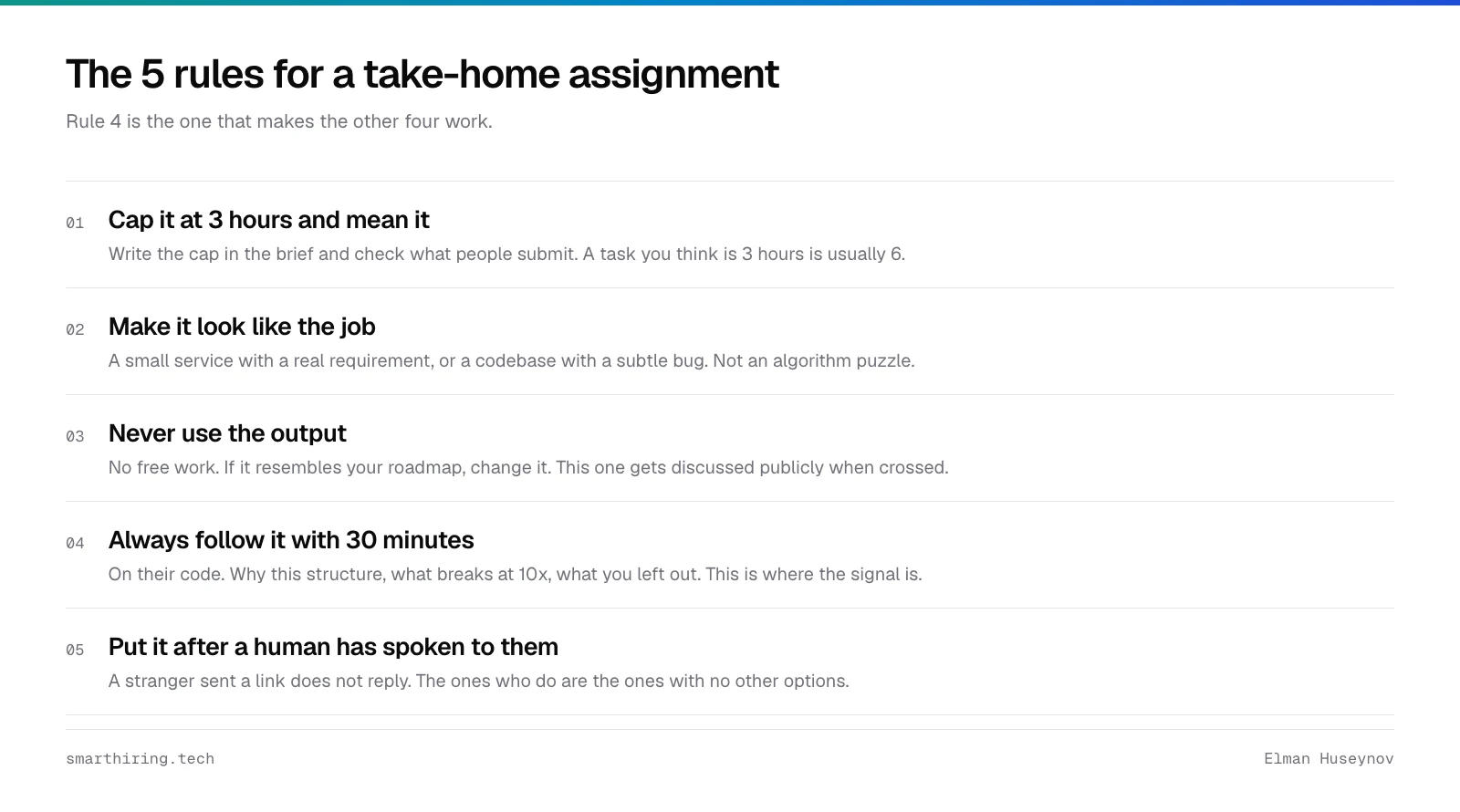
Five rules make a take-home assignment defensible. Skip any of them and the stage costs more than it returns.
Cap it at 3 hours, in writing. Make the work resemble the job. Never use the output.
Always follow it with a 30-minute conversation. Put it after a human has spoken to the candidate.
1. Cap it at 3 hours and mean it. Check what people submit. A task you believe is 3 hours is usually 6.
2. Make it look like the job. A small service with a real requirement, or an existing codebase with a subtle bug.
3. Never use the output. If the task resembles something on your roadmap, change it. Free work gets discussed publicly.
4. Always follow it with a conversation. 30 minutes on their code. Why this structure? What did you leave out?
5. Put it after a human has spoken to them. A stranger sent a link will not spend the 3 hours.
The conversation is where the signal is. Someone who did not make the decisions runs out inside 2 follow-ups.
What works better than a take-home test?
A 60-minute pair on a small prepared codebase works better than a take-home test. All tools allowed.
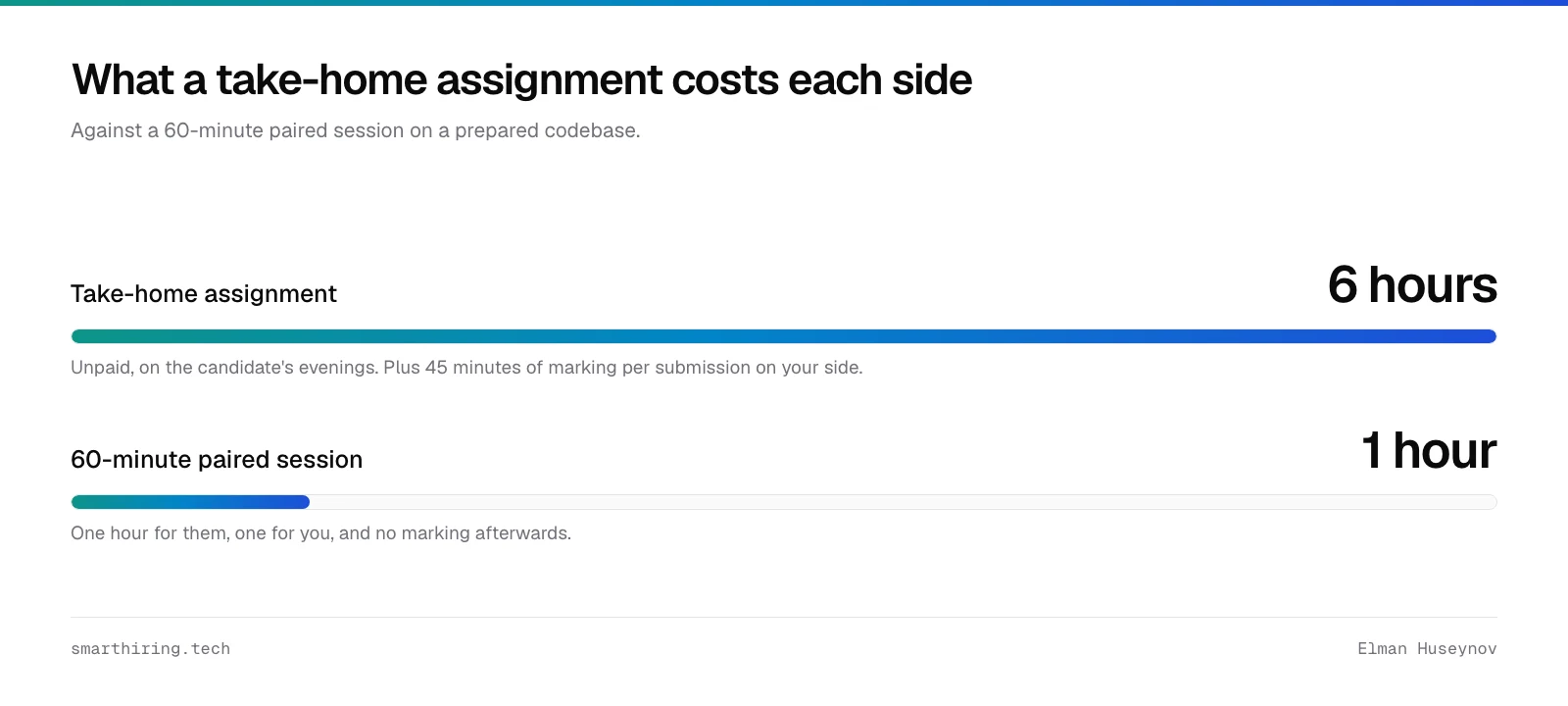
A pair costs the candidate 1 hour instead of 6. It costs you 1 hour, and needs no marking.
You see how they read unfamiliar code and what they do when something breaks. Authorship is answered for free.
You lose the unwatched-writing signal, which matters less than teams assume.
| What it costs | Take-home assignment | 60-minute pair |
|---|---|---|
| Candidate time | 3 hours in the brief, often 6 | 1 hour |
| Your time | 45 minutes of marking, then a 30-minute talk | 1 hour, no marking |
| Authorship | Checked in the follow-up talk | Seen live |
| Reading unfamiliar code | Not observed | Observed |
| Unwatched writing | Observed | Not observed |
| Free time | Filters by it | Fits a working day |
Keep the take-home assignment for 1 case. Where writing alone, over hours, is central to the job.
How do you tell if your take-home assignment is working?
Three checks tell you whether a take-home assignment interview stage is working.
Completion rate by stage. Whether the score predicted anything about the last 10 hires.
Marking consistency: 2 people score the same 3 submissions blind.
Completion rate. If a meaningful share go quiet after receiving it, you are losing people. You have no idea which ones.
Correlation with the outcome. Look back at the last 10 hires. If the score predicted nothing, cut the stage this quarter.
Marking spread. A wide spread between 2 markers means you are measuring the marker. Almost nobody runs the second check.
Common questions
How long should a take-home assignment be?
Cap a take-home at 3 hours in the brief, and check it against real submissions. A task you believe is 3 hours is usually 6 for someone learning your conventions. If the strongest submissions clearly took a weekend, the cap is fiction. You are scoring free time.
Should you pay candidates for a take-home?
Paying fixes the fairness problem and not the conversion one. It signals you value their time. Strong candidates with options still prefer an hour of pairing. If you pay, pay everyone who submits, or the gesture reads worse than not paying.
Can a take-home be used in production?
Never, and candidates are right to ask. Using submitted work is unpaid labour whatever the brief says. In the UK a work trial that produces usable output can trigger the minimum wage. One public complaint also costs more applications than the task ever saved. Say in the brief that the code is deleted, and delete it.
Do you still need a conversation afterwards?
Always, and 30 minutes is enough. Ask why they made 3 specific decisions and what they left out deliberately. That conversation is where the scope judgement shows, and it resists AI assistance. Without it the submission tells you far less than you think.
How do you conduct a coding test online?
Run an online coding test on a small prepared codebase for 60 minutes, interviewer watching. Ask the candidate to narrate. Allow every tool they use at work. Then ask what the tool suggested that they rejected. An online pair costs a sixth of a take-home assignment and tells you more.
The short version
A take-home assignment is good at showing unwatched code and scope judgement.
A take-home assignment also selects for free time rather than skill.
If you ask: 3 hours capped and verified, and work that resembles the job.
Never used in production, and never as the first step. Always followed by a 30-minute conversation.
Run a 60-minute pair on a prepared codebase instead. It costs a sixth as much and tells you more.
Check whether the stage predicts anything. If it does not, delete it.
Loops accumulate stages nobody has checked. Rebuilding one is the work I do here.
An audit of your loop. Book a free 30-minute call.
The wider argument is in why your interview loop rejects good engineers.
PDF, 2 pages
Take-home brief and marking sheet
The brief a candidate receives, the 5 rules written into it, the 30-minute conversation that follows, and the 3 checks that tell you whether the stage earns its place.
Leave a work email: the file opens right here, and one hiring stage, taken apart, follows every week. One click to leave.
Read next
The Technical Assessment That Tests the Job
A take-home costs the candidate 6 hours and you 45 minutes of marking. A 60-minute pair costs 1 hour each side and tells you more. Here is the comparison.
How to Hire Software Engineers
The job ad is step 2. Step 1 is a written bar, and the rest of the loop follows from it.
Want this fixed in your loop?
SmartHiring trains engineering interview panels on their own open roles. Elman Huseynov, a Tech Hiring Expert in Berlin, runs every engagement. One workshop writes the scorecards for your roles, then calibration runs until the panel agrees. It starts with a free 30-minute call.
No pitch if the loop is already fine. See an example audit report.