A panel interview is one round where 2 or more interviewers assess the same candidate.
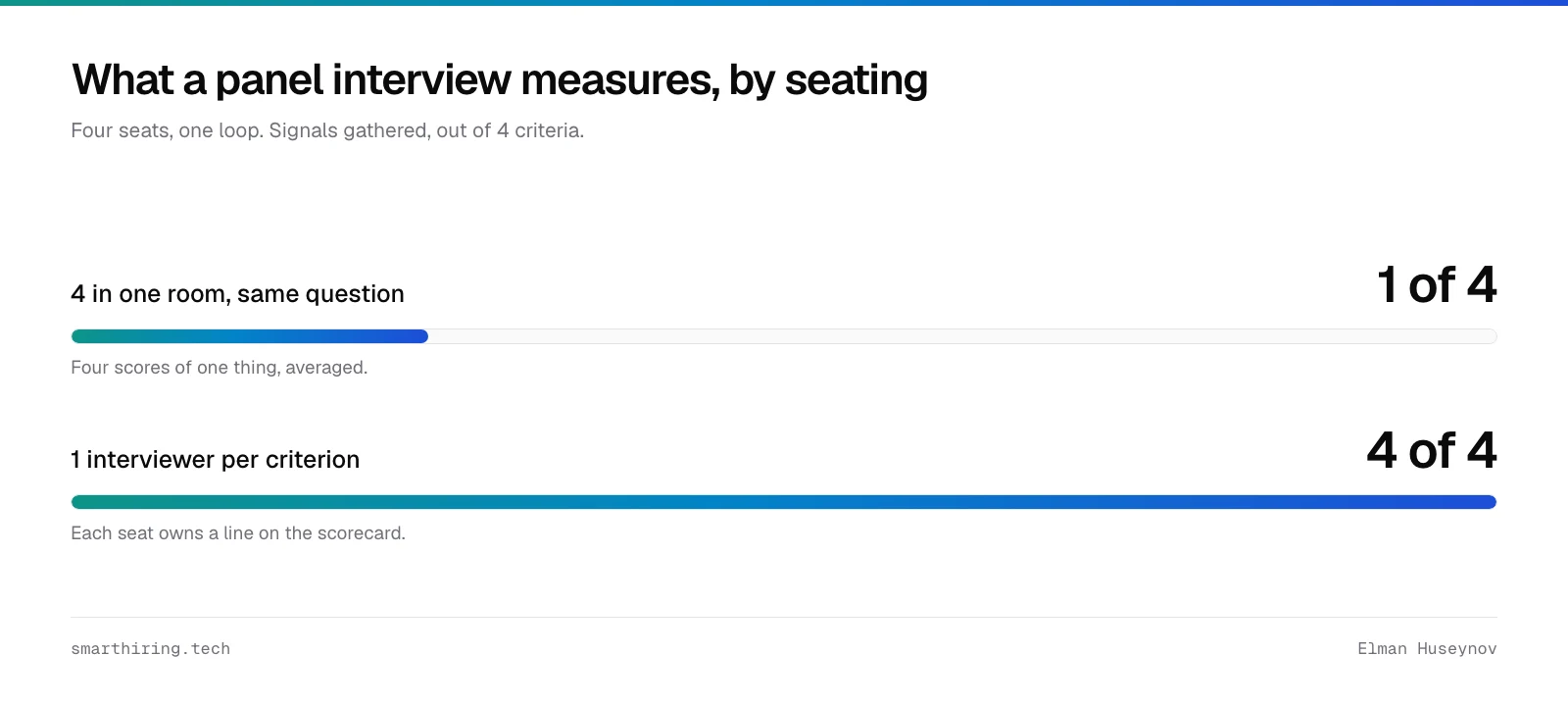
A panel interview works when each interviewer owns one criterion. Four people asking the same question produce 1 opinion, 4 times.
Panels exist to average out one interviewer’s bias. A shared question undoes that.
On this page
A nervous candidate in front of 4 faces performs below their level. The panel then scores the nerves.
I have run 100+ technical interviews and sit in the debriefs where panels decide.
What is a panel interview?
A panel interview is a round with 2 or more interviewers and one candidate.
A panel interview exists to gather more evidence than one interviewer can.
The panel only does that when each person owns a different signal.
Four engineers who ask about one hard bug get 4 versions of one story.
Two interviewers per round, with separate assignments, gather more than 4 with none.
The fix is the seating plan. The seating plan comes from the scorecard.
Who should be on the interview panel?
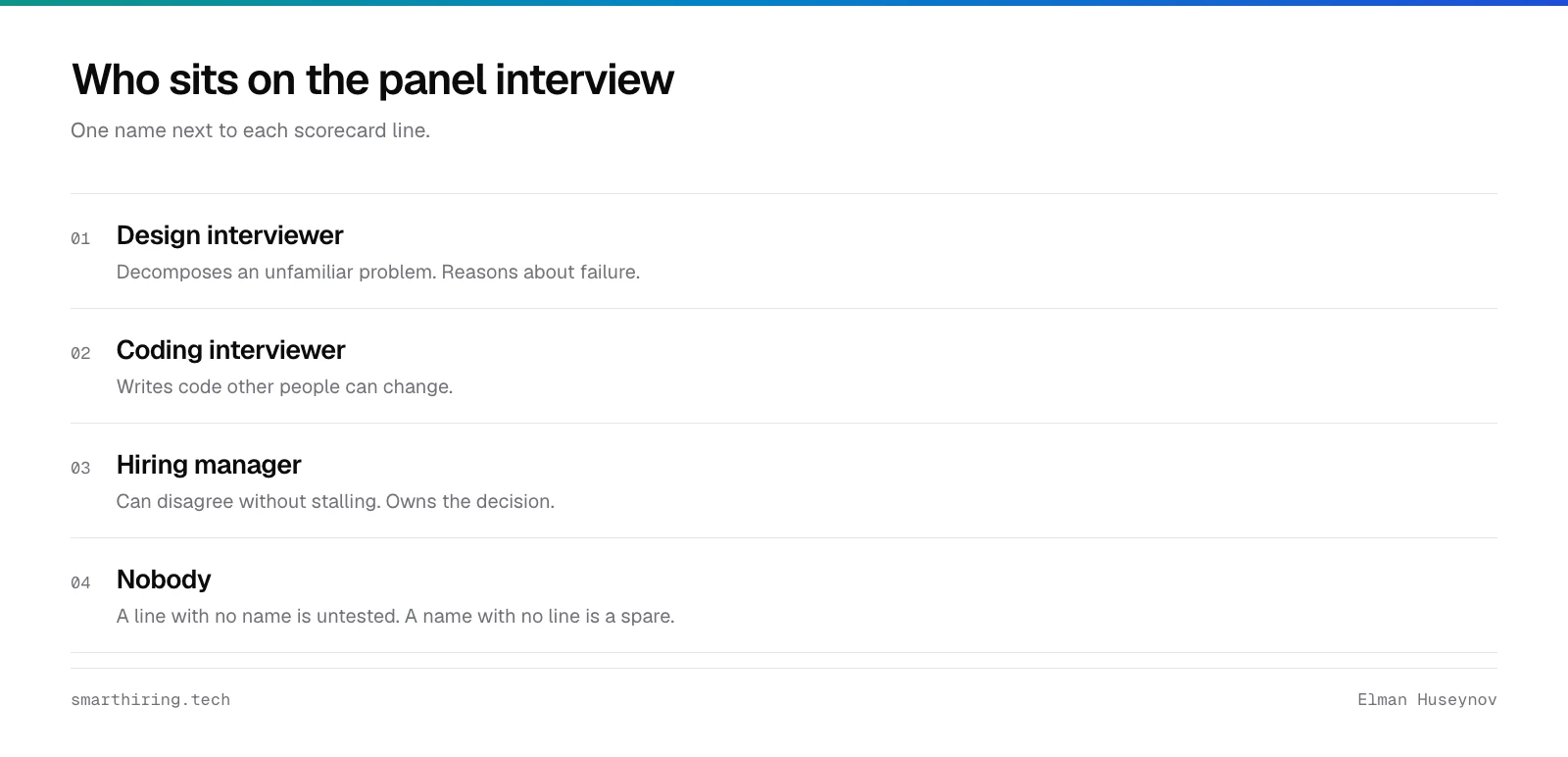
The interview panel is one interviewer per scorecard criterion. Four to 6 criteria means 4 to 6 interviewers across the loop.
Never put 4 interviewers in one room. Two at most, each with their own line.
Each interviewer gets a name next to a line. The design interviewer owns “decomposes an unfamiliar problem”.
The coding interviewer owns “writes code others can change”. The hiring manager owns 1 line and the decision.
A panel member with no line is a spare. A line with no panel member is untested.
How do you prepare a panel interview?
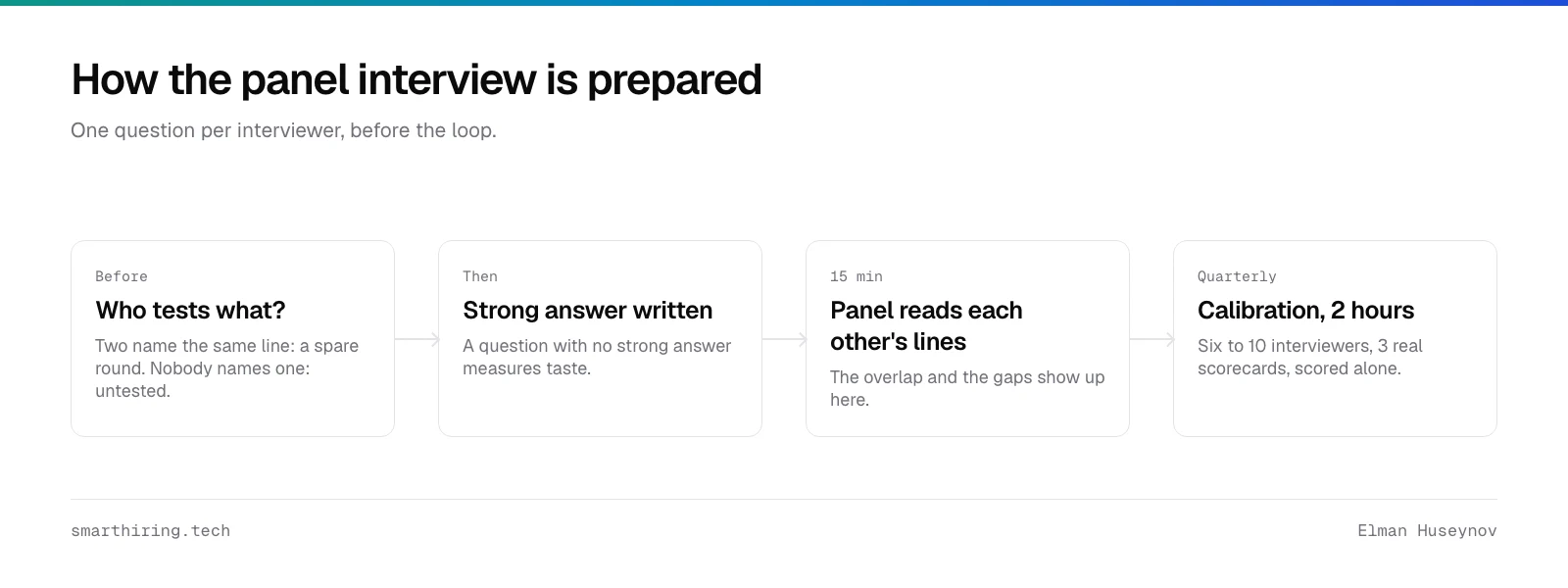
Panel preparation is 1 question to each interviewer, before the loop. Which criterion are you testing?
If 2 people name the same one, you have a spare round. If nobody names the third, it is not being tested.
Each interviewer then writes their questions. A strong answer to each is described in advance.
A question with no strong answer written down measures taste.
The panel meets for 15 minutes before the loop to read each other’s lines. The overlap shows up there.
Two lines that overlap get merged, and the spare interviewer takes the untested one.
How do you chair an interview panel?
The interview panel chair runs the room and keeps the panel on its seating plan.
The chair is one of the 2 panelists, usually the best calibrated one. They still own a scorecard line.
Before the round, the chair sends each panelist their criterion. The candidate gets the schedule too.
In the room, the chair opens with names and what each person tests. Then they keep time.
A follow-up that drifts into another panelist’s line gets parked. The chair notes it for that round.
The chair leaves the last 5 minutes for the candidate’s questions. Scores go in writing before anyone talks.
Do panel interviewers need training?
Panel interviewers need training, and many never had any.
Robert Walters research found 40% of hiring managers never had formal interview training. Panels are built from them.
Untrained panelists score the same answer far apart. One hears depth where another hears waffle.
Interviewer calibration is 2 hours a quarter. Six to 10 interviewers score the same 3 scorecards alone, then compare.
New panel members calibrate before their first real round. The 5-year veterans attend most of all.
The veterans’ standard is the one everyone else drifts toward. That standard needs checking most.
How does a panel interview reach a decision?
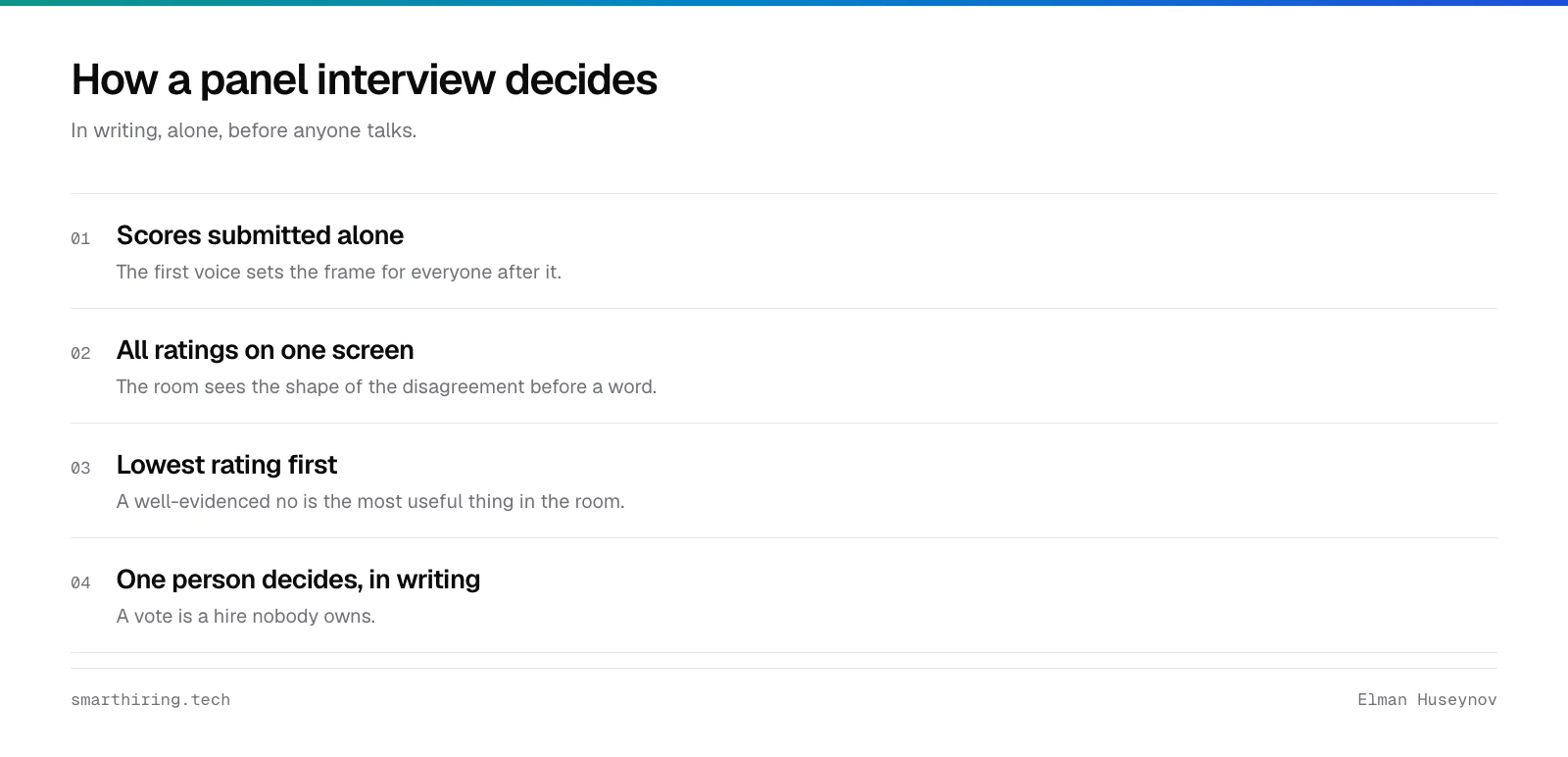
The panel decides in writing, alone, before anyone talks. Scores first, a 30-minute debrief second, one person deciding third.
The first voice sets the frame for everyone after it.
Written scores, submitted alone, fix that at zero cost.
The debrief runs 30 minutes. All ratings on screen at once, and the lowest rating presents first.
The hiring manager decides out loud, with a reason. A vote is a hire nobody owns.
Common questions
How many people should be on a panel interview?
A panel interview needs one interviewer per scorecard criterion. Four to 6 across the loop, at most 2 in a room. A panel of 4 in one room asks the same question 4 times. A nervous candidate then performs below their level. Two interviewers with separate assignments gather more evidence than 4 with none.
Should the hiring manager sit on every panel round?
No. The hiring manager owns 1 criterion and the final decision. The criterion is usually how the candidate handles disagreement. Sitting in every round anchors the other interviewers on the manager’s view. The manager reads the written scores first and hears the lowest rating before speaking.
What if 2 panel interviewers disagree?
When 2 panel interviewers disagree, find out why before the debrief averages it away. Different evidence is a scorecard problem: one interviewer saw something the other did not. Different standards is a calibration problem. Both saw the same thing and rated it 2 levels apart. Write down which one it was, and fix that one.
Is a panel interview fair to the candidate?
A panel interview is fair when the candidate knows what each round tests. The candidate also faces at most 2 people. Tell them the schedule and the criteria in advance. A 4-person room with no stated purpose is an interrogation. It measures composure rather than the job.
The short version
One interviewer per scorecard criterion. Never 4 in one room.
Ask each interviewer which criterion they test, before the loop. Calibrate the panel 2 hours a quarter.
Scores in writing before anyone talks. A 30-minute debrief, lowest rating first, one person decides.
An audit of your loop, with your panel mapped to your scorecard. Book a free 30-minute call.
Excel, 3 sheets
Panel seating plan
The 4-line senior backend panel with a named owner, backup, question and strong answer per line, a blank sheet for your loop, and the before-and-after checklist with the 2 kinds of disagreement.
Leave a work email: the file opens right here, and one hiring stage, taken apart, follows every week. One click to leave.
Read next
How to Be a Good Interviewer
Robert Walters found 40% of hiring managers never had formal interview training. These 5 habits make an interviewer worth listening to in the debrief.
The Technical Assessment That Tests the Job
A take-home costs the candidate 6 hours and you 45 minutes of marking. A 60-minute pair costs 1 hour each side and tells you more. Here is the comparison.
Want this fixed in your loop?
SmartHiring trains engineering interview panels on their own open roles. Elman Huseynov, a Tech Hiring Expert in Berlin, runs every engagement. One workshop writes the scorecards for your roles, then calibration runs until the panel agrees. It starts with a free 30-minute call.
No pitch if the loop is already fine. See an example audit report.