Why technical hiring is broken: interview loops measure things nobody agreed on in advance.
Many interviewers are never trained. Rejections say nothing, because legal risk is easier than feedback.
I have run more than 100 technical interviews. I started SmartHiring to fix the room where the decision happens.
On this page
Candidates say they cannot find work. Employers hiring engineers say they get hundreds of applications and no good ones.
Both statements are true at the same time. That is the shape of tech hiring in 2026.
Why technical hiring is broken, in three failures
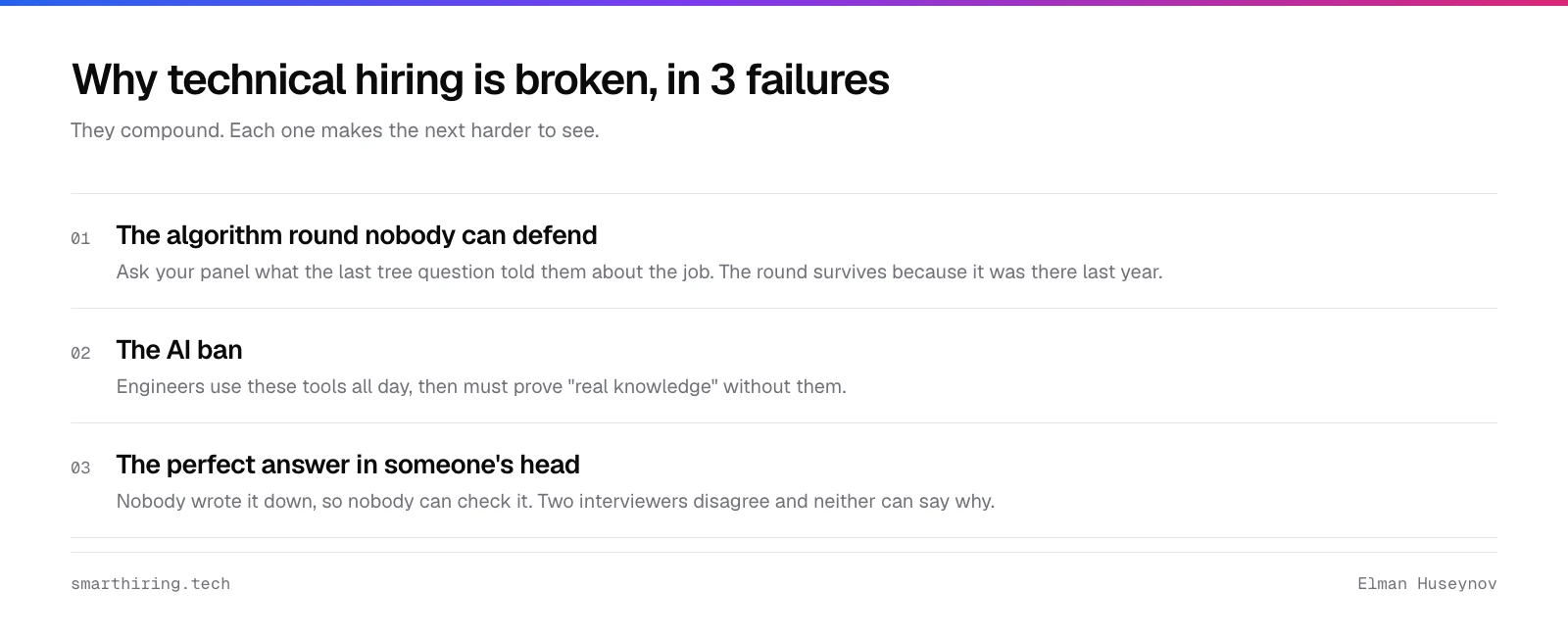
Technical hiring breaks in three failures, and they compound. Companies test algorithms for jobs that never touch them.
Others ban AI tools. Stack Overflow’s 2026 survey: 80% of respondents used AI at least an hour a day.
Leadership rounds are the worst of the three.
The interviewer holds a perfect answer in their head. You do not match it, so you are rejected.
The algorithm round nobody can defend. Ask your panel what the last tree question told them about the job.
Most teams cannot answer. The round survives because it was there last year.
The AI ban. Engineers use these tools all day, then must prove “real knowledge” without them.
The perfect answer in someone’s head. Nobody wrote it down, so nobody can check it against anything.
Two interviewers then disagree about the same candidate and neither can say why.
Why do rejections say nothing?
Rejection emails say nothing because saying something feels like risk. Saying nothing feels free.
“After careful consideration” costs nothing to send. It also teaches the candidate nothing.
Companies call this legal caution. In the UK, Acas advises giving feedback anyway. No UK law requires it, as of 12 October 2026.
The exposure comes from feedback that describes the person, or cites an unpublished criterion. Both are fixable in an afternoon.
Write what you can safely say once, tie it to the scorecard, and reuse it.
A specific rejection is the cheapest reputation work a hiring team can buy.
What does broken technical hiring cost you?
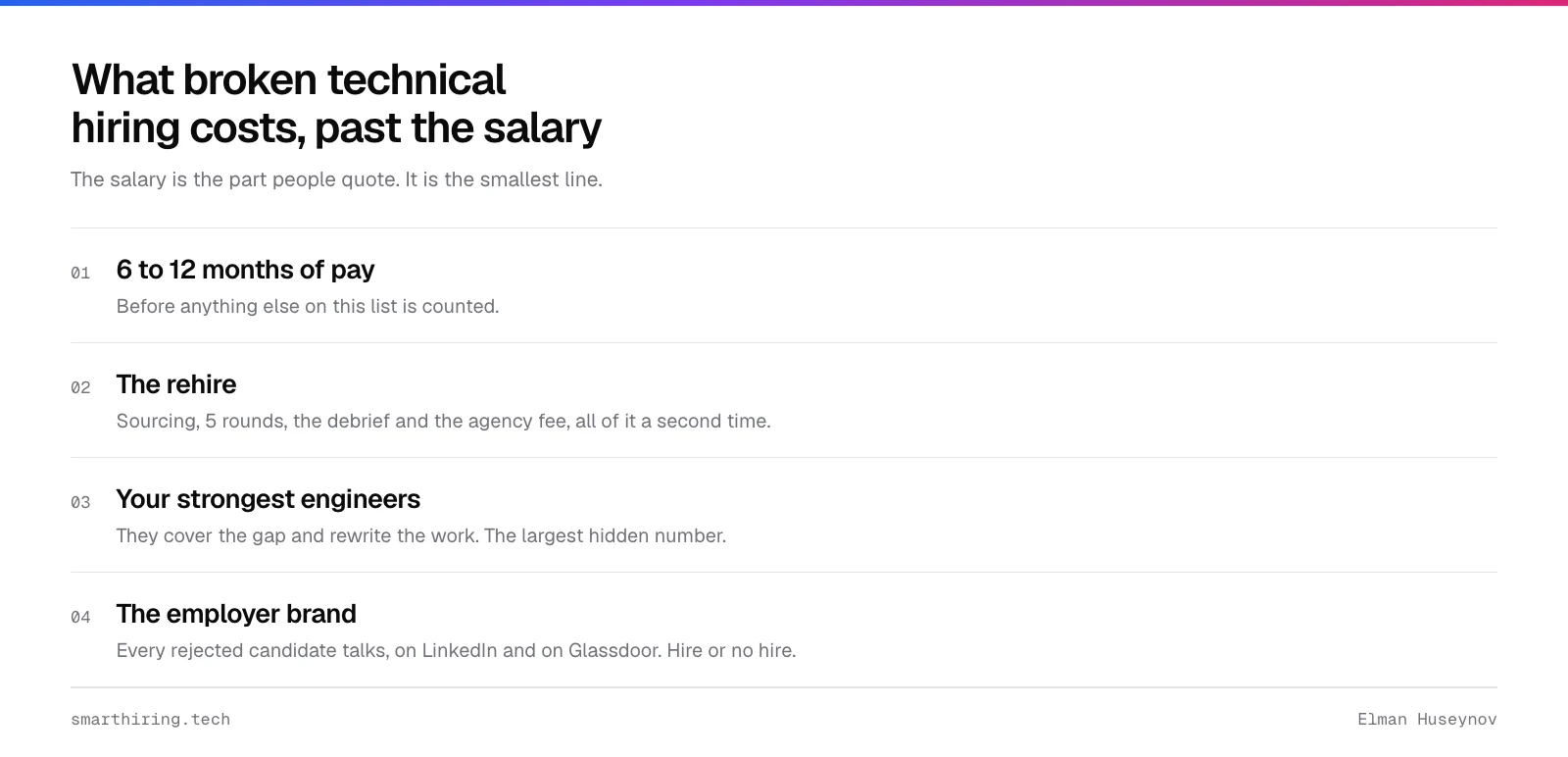
Broken technical hiring produces bad hires. Salary is the smallest line on a bad hire’s bill.
The bigger lines are the rehire, the team’s lost time and your brand.
Every loop that misjudges a candidate pays all three of them again.
The rehire. Sourcing, five rounds, the debrief and the agency fee, all of it a second time.
The team. Your strongest engineers cover the gap and rewrite the work. That is the largest hidden number.
The brand. Every rejected candidate talks, on LinkedIn and on Glassdoor.
Your employer brand pays for every bad interview you run, hire or no hire.
Who is SmartHiring for?
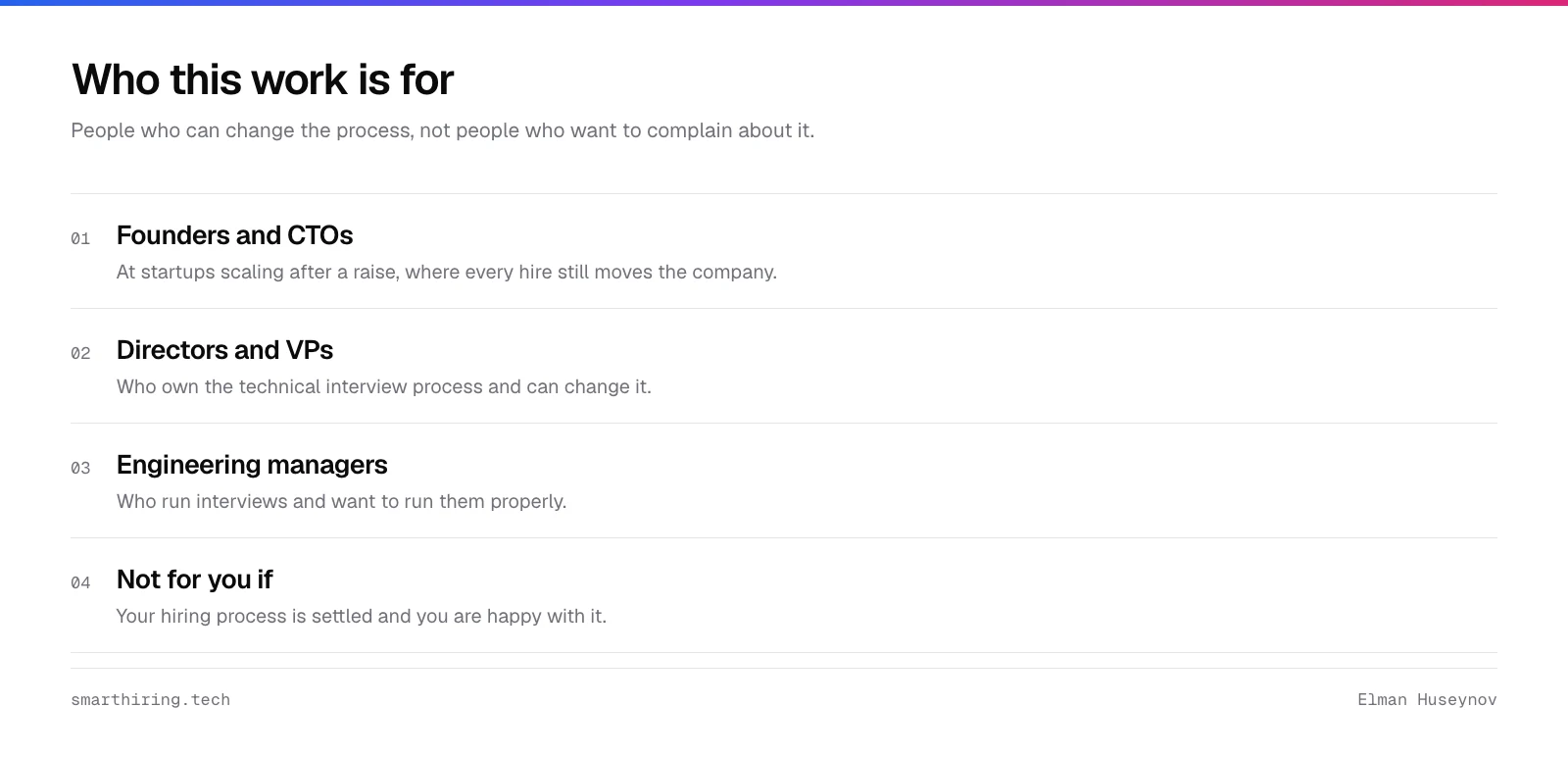
SmartHiring is for people who can change the technical hiring process. Founders and CTOs at startups scaling after a raise.
Directors and VPs who own technical hiring at their company.
Engineering managers and engineers who run interviews and want to run them properly.
If your technical hiring is already “established” and settled, this work is not for you. Two questions decide it.
Are your interviewers doing this well, and how would you know?
Does the panel judge on evidence, or on a feeling from the first 15 minutes?
Am I competing with your recruiters?
No, SmartHiring does not compete with recruiters, and the split is clean.
Recruiters own the funnel, the sourcing and the candidate experience.
I fix what happens inside the room where technical hiring is decided.
Better criteria mean fewer wasted screens, which is a recruiter’s own metric.
No recruiter gains anything from vaguer criteria.
What the SmartHiring blog covers
The SmartHiring blog covers seven questions, one a week, also in the newsletter.
- How to define who you actually need.
- How to write a job description that filters.
- How to build a pipeline that works.
- How to train interviewers nobody trained.
- How to test real skills.
- Whether you need to interview algorithms at all.
- How to use AI instead of banning it.
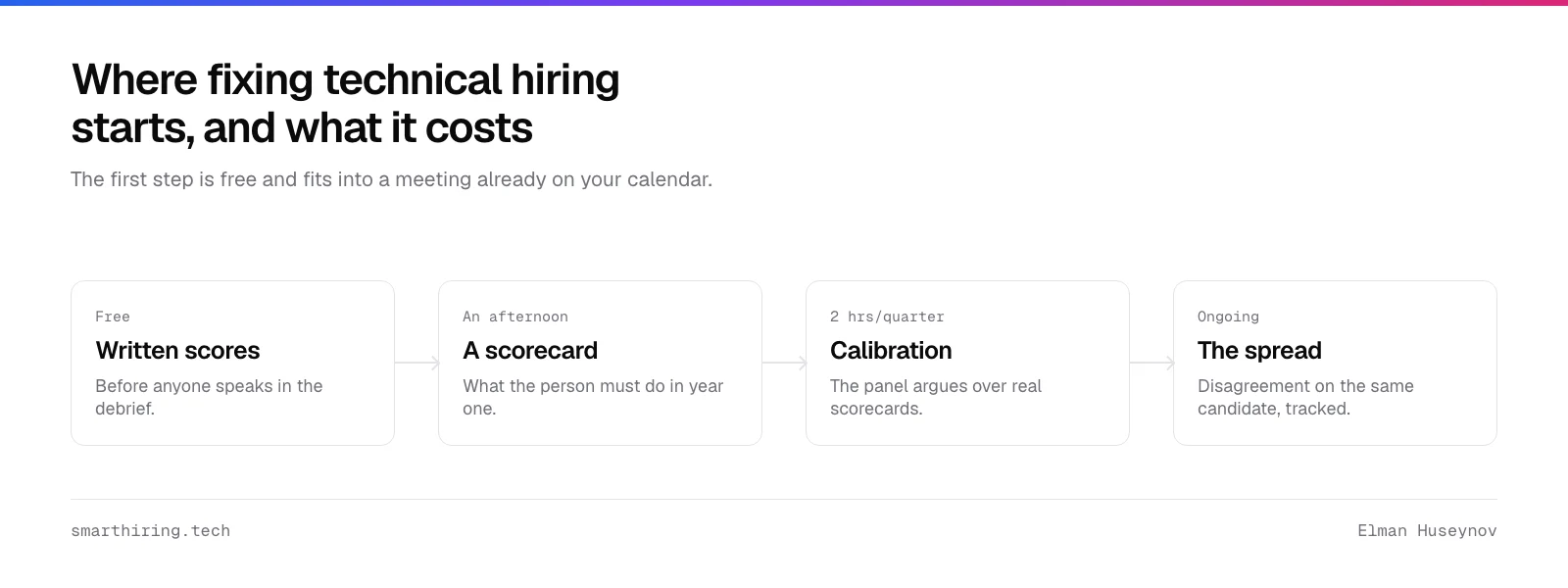
The first one is already here: write the scorecard before you write the job ad.
The candidate side of the same problem lives on my other site.
Common questions
What does SmartHiring actually do?
SmartHiring audits technical hiring at one company and trains the panel that runs it. It also calibrates the people who score. The work is the interview room, not the funnel. Engagements run from a one-off audit to embedded shadowing across a hiring quarter. The first call is 30 minutes and free.
Why should a hiring manager listen to you?
I have run more than 100 technical interviews and helped hire over 10 engineers. I sit in the debriefs where the decision is made. Nothing here asks you to trust that. Each post gives a method to test on your next loop. Keep it or drop it on the results.
Is SmartHiring only for big companies?
No, and small teams get more from SmartHiring. A 20-person company makes every hire matter more. It also has no internal process to unlearn. Most of the work is writing down what a strong candidate looks like. That costs an afternoon and does not scale with headcount.
How do you hire an engineer?
Write down what the person must do in year one, before the job ad exists. Then decide what evidence proves they can. Four rounds cover it: a screen, practical coding, a depth round, a hiring manager conversation. Train the interviewers, or the rest of the process is decoration.
The short version
Most interview loops measure things nobody agreed on in advance.
Interviewers were never trained, and rejections say nothing.
The bill arrives as rehires, as your best engineers’ time, and as your brand.
Writing the criteria down before the conversation fixes most of it.
Want it done with you rather than by you? An audit of your loop.
Book a free 30-minute call. I will say if your loop is already fine.
PDF, 2 pages
Hiring loop self-check: 10 questions
10 yes-or-no questions about your loop. Under 6 yes, and the loop is deciding at close to random. Each no points at the post that fixes it.
Leave a work email: the file opens right here, and one hiring stage, taken apart, follows every week. One click to leave.
Read next
How to Run a Debrief Meeting
A debrief anchors on whoever speaks first. Scores go in writing before the meeting, and the hiring manager decides on the record.
Interview Calibration, Explained
Two interviewers watch the same candidate and reach opposite conclusions. Here is how to run the session that fixes it.
Want this fixed in your loop?
SmartHiring trains engineering interview panels on their own open roles. Elman Huseynov, a Tech Hiring Expert in Berlin, runs every engagement. One workshop writes the scorecards for your roles, then calibration runs until the panel agrees. It starts with a free 30-minute call.
No pitch if the loop is already fine. See an example audit report.