The cost of a bad hire in engineering runs 12 months and 7 lines. Salary is the smallest line.
On this page
Salary and overhead for the period. The hiring cost paid twice. Your strongest engineers’ time spent covering.
The work that did not happen, and what the team concludes about the bar.
Ask a hiring manager what a bad hire costs and you get the salary. Here is the rest of the bill.
What is a bad hire?
A bad hire is someone who cleared your bar and cannot do the work. The bill runs 12 months.
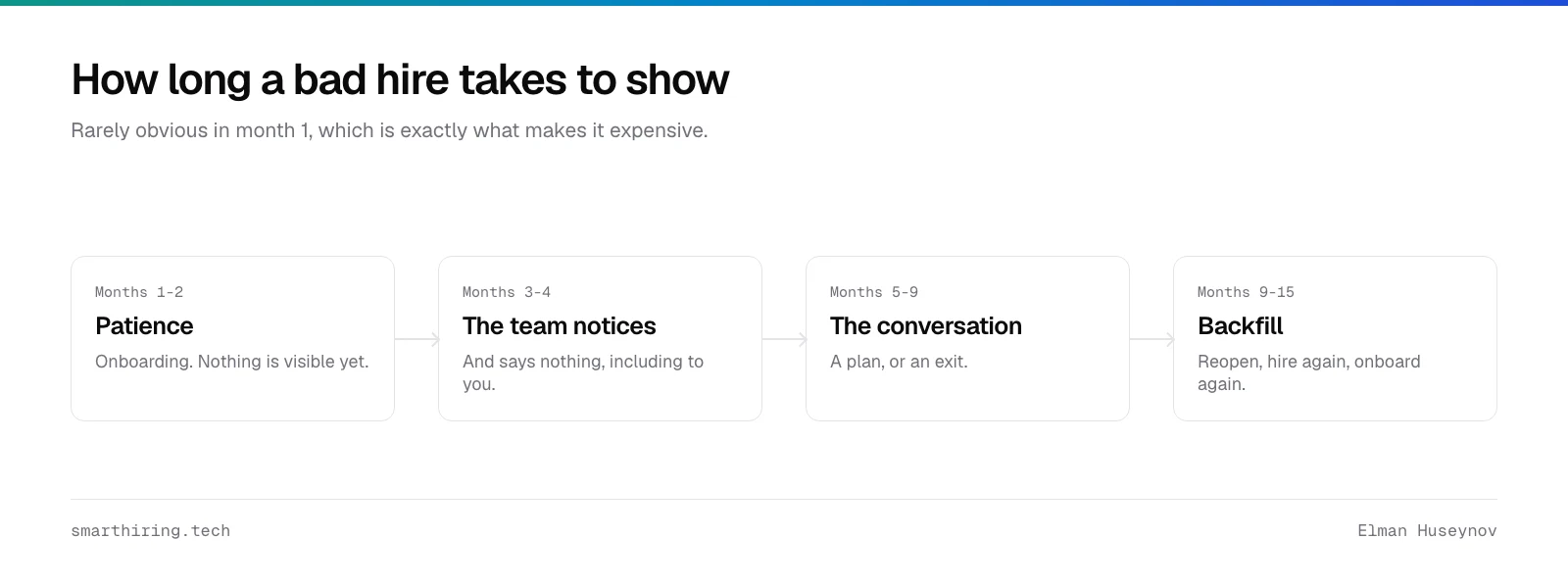
Months 1 to 3 look like normal ramp-up.
Months 3 to 6 the team covers quietly. Months 6 to 9 someone says it out loud.
Months 9 to 15 cover the exit and the backfill.
| Months | What is happening |
|---|---|
| 1-2 | Onboarding. Everyone is patient. Nothing is visible yet |
| 3-4 | The team notices. Nobody says it out loud, including to the manager |
| 5-6 | The manager notices. The first vague conversation happens |
| 7-9 | Real conversations, a plan, or an exit |
| 9-15 | Backfill: reopen the role, hire again, onboard again |
The honest unit is a year, and often more.
What is the true cost of a bad hire?
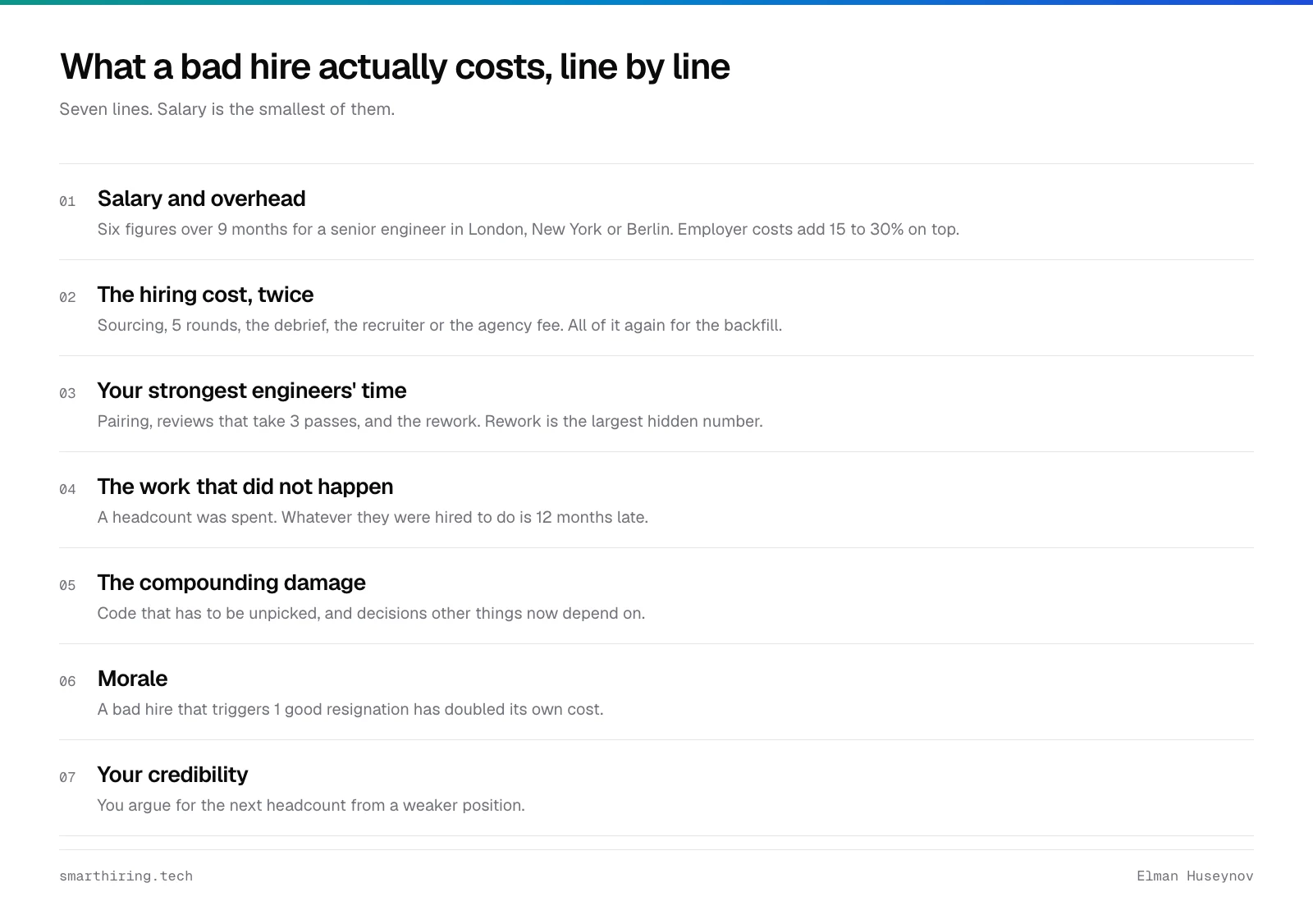
The true cost of a bad hire is 7 lines. Salary is the smallest of them.
Salary and overhead, the hiring cost twice, the team’s time, the missed work. The code, morale, and your credibility.
Salary and overhead. Six figures over 9 months for a senior in London, New York or Berlin. Employer costs add 15 to 30 percent.
The hiring cost, twice. Sourcing, 5 rounds, the debrief, the agency fee. All of it again for the backfill.
The team’s time. Reviews that take 3 passes, and the rework. Rework lands on your strongest engineers.
The work that did not happen. Whatever the headcount was for is 12 months late. The roadmap assumed otherwise.
The compounding damage. Code to unpick. Decisions other things now depend on.
The morale cost. A team carrying someone for 6 months sees the bar. One resignation doubles the bill.
Your credibility. The next headcount request starts from a weaker position.
Why do teams keep paying the cost of a bad hire?
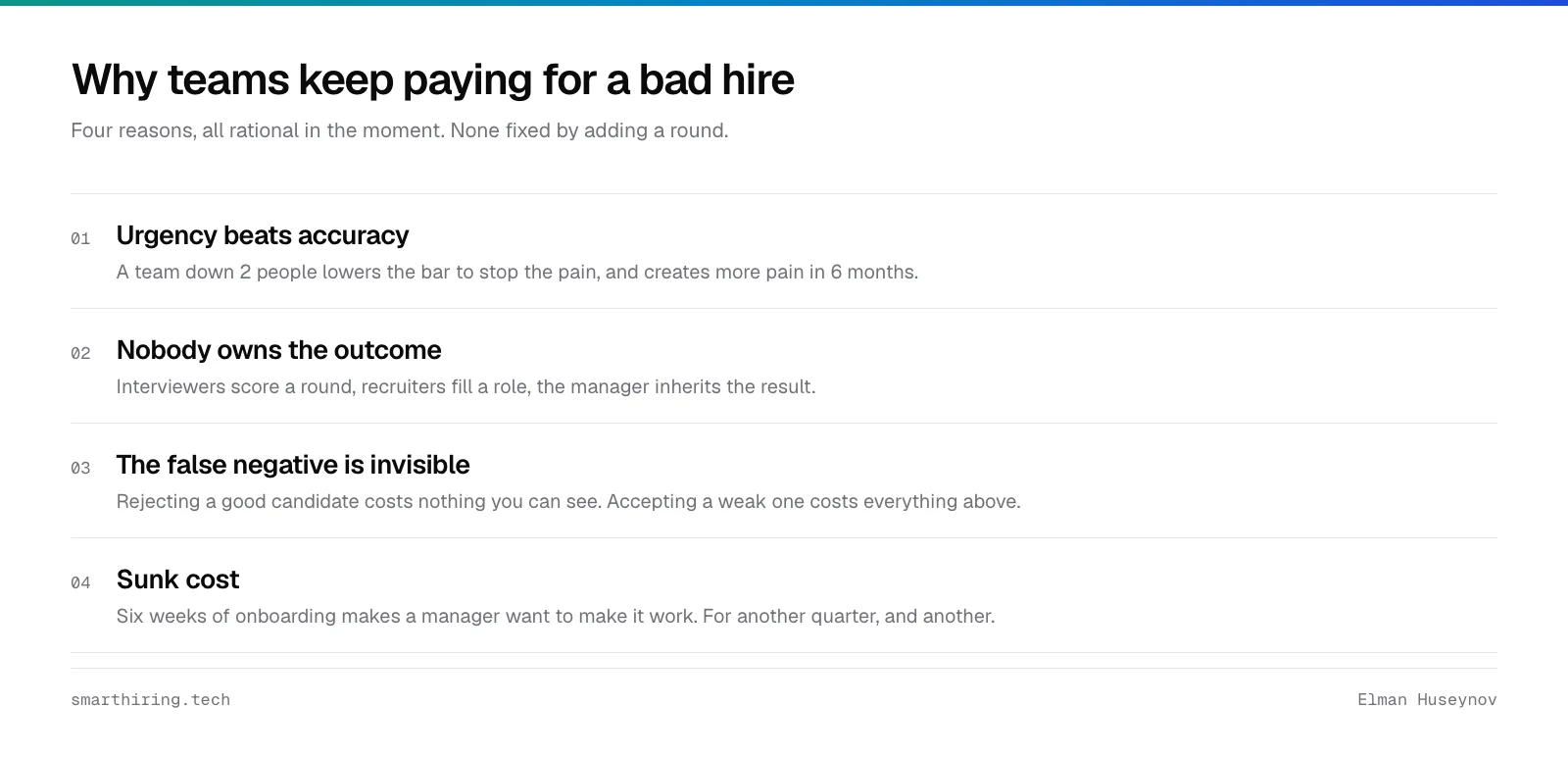
Teams keep paying the cost of a bad hire because the empty seat hurts today. Four reasons, all rational in the moment.
Urgency beats accuracy, and nobody owns the outcome. The false negative stays invisible. Sunk cost buys one more quarter.
Urgency beats accuracy. A team down 2 people lowers the bar to stop the pain. The pain returns in 6 months.
Nobody owns the outcome. Interviewers score a round. Recruiters fill a role. The manager inherits the result.
The false negative is invisible. Rejecting a good candidate costs nothing you can see. Accepting a weak one costs the whole list above.
Sunk cost. Six weeks of onboarding makes a manager try for one more quarter. And another.
What reduces the cost of a bad hire?
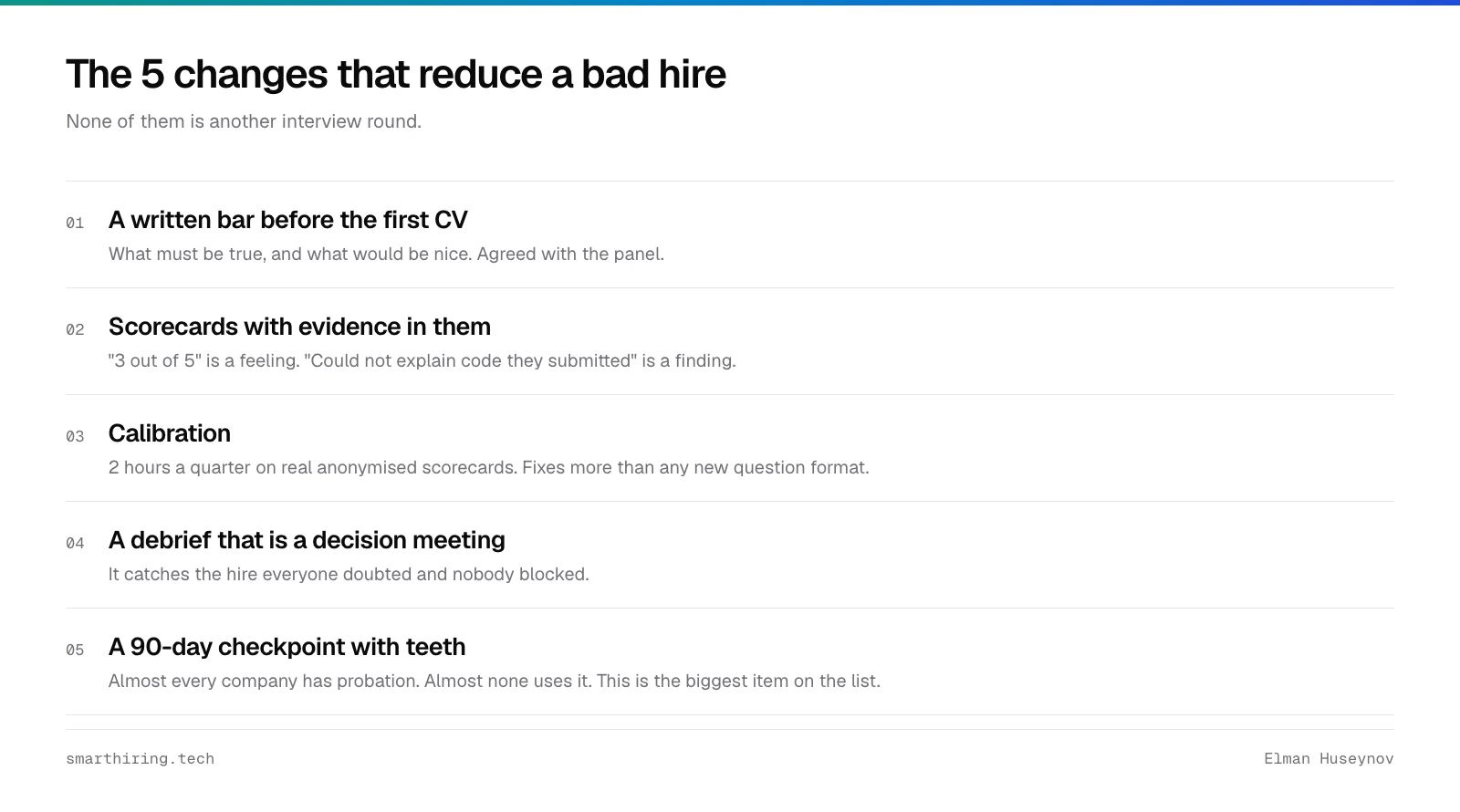
Five changes reduce the cost of a bad hire. None of them is another interview round.
A written bar before the first CV. Scorecards with evidence. Calibration. A debrief that decides. A 90-day checkpoint with teeth.
More rounds do not help. Longer loops mostly lose good candidates.
A written bar. What must be true, and what would be nice. Agreed with the panel before the first CV.
Scorecards with evidence. “3 out of 5” is a feeling. “Could not explain code they submitted” is a finding. Examples here.
Calibration. 2 hours a quarter reviewing real anonymised scorecards, together. That fixes more than any new question format.
A debrief that decides. Run from the scorecard, it catches the hire everyone doubted and nobody blocked.
A 90-day checkpoint. Most companies have a probation period and almost none use it. Month 3 is far cheaper than month 9.
How do you calculate the cost of a bad hire?
A cost of a bad hire calculator needs 3 inputs. Loaded cost per month, months on the timeline above, and the team’s hours.
A director needs a comparison, and a precise figure can wait.
Take your loaded cost for the level. Multiply by the months in the table. Add a conservative estimate of the team’s time.
Put that next to 2 hours of calibration per interviewer per quarter. The ratio is the whole argument for fixing the loop.
Published averages from SHRM or Robert Half fit on a slide. Your own number is the one a director trusts.
Common questions
How much does a bad engineering hire actually cost?
Take a senior engineer. Salary and overhead over 9 months is six figures in London, New York or Berlin. It is the smallest line on the bill. Add the hiring cost twice, and your best engineers’ time covering and rewriting. Then the work that did not happen, and the standard the team now believes in.
Do more interview rounds reduce bad hires?
No, and longer loops mostly lose good candidates instead. Three things reduce bad hires. A written bar agreed before the first CV, and scorecards submitted before the debrief. And a probation checkpoint someone actually uses. Rounds 5 and 6 re-measure what the first 3 already showed.
How do you make the case to a director?
With a comparison rather than a precise figure. Take your loaded cost for the level and multiply by the months in the timeline. Add a conservative estimate of the team time. Put that next to the cost of 2 hours of calibration a quarter. Precision is not what moves the decision.
What is the 90-day checkpoint everyone skips?
Probation, used as a decision rather than a formality. Most companies have the period and almost none review it deliberately. The month-3 signal gets carried to month 9. Put a date in the calendar at offer time. Make someone answer whether they would hire this person again.
What is a bad hire?
A bad hire is someone who cleared your bar and cannot do the work. The cost is a 12-month event rather than a salary. Salary and overhead. The hiring cost paid twice. Your strongest engineers’ time spent covering. The work that did not happen. Salary is the smallest line.
The short version
A bad hire is a 12-month event, not a salary.
The largest costs are your strongest engineers’ time and what they conclude about the bar.
Loops keep producing them because urgency is visible and false negatives are not.
No part of the process ever gets told what happened.
Write the bar before the role opens. Score evidence. Calibrate. Run the debrief as a decision. Use the 90-day checkpoint.
Fixing this is the work on this site. An audit of the loop from 500 euro, a workshop sprint at 2,500.
The first call is 20 minutes and free.
One hiring stage, taken apart, every week
The same teardowns that run on LinkedIn, in your inbox. No pitch, one click to leave.
Read next
Interviewer Calibration, Explained
Two interviewers watch the same candidate and reach opposite conclusions. Here is how to run the session that fixes it.
Why Technical Hiring Is Broken
Most loops measure things nobody agreed on in advance. Here is what that costs, and why I started SmartHiring.
Want this fixed in your loop?
Interview training for hiring managers and their panels: one workshop on your open roles, scorecards written for them, and calibration until the panel agrees. It starts with a free 20-minute call.
No pitch if the loop is already fine.