AI in hiring and recruitment works for drafting, rewriting and summarising. It breaks when it ranks people or tries to catch them.
Use it to turn a role into a scorecard draft. To cut inherited nonsense from a job ad. To structure your own interview notes.
On this page
Keep AI hiring tools out of resume screening and detection entirely.
Candidates use AI in your interviews. You cannot stop them. The hours spent trying are the worst-spent hours your team has.
Where does AI in hiring work?
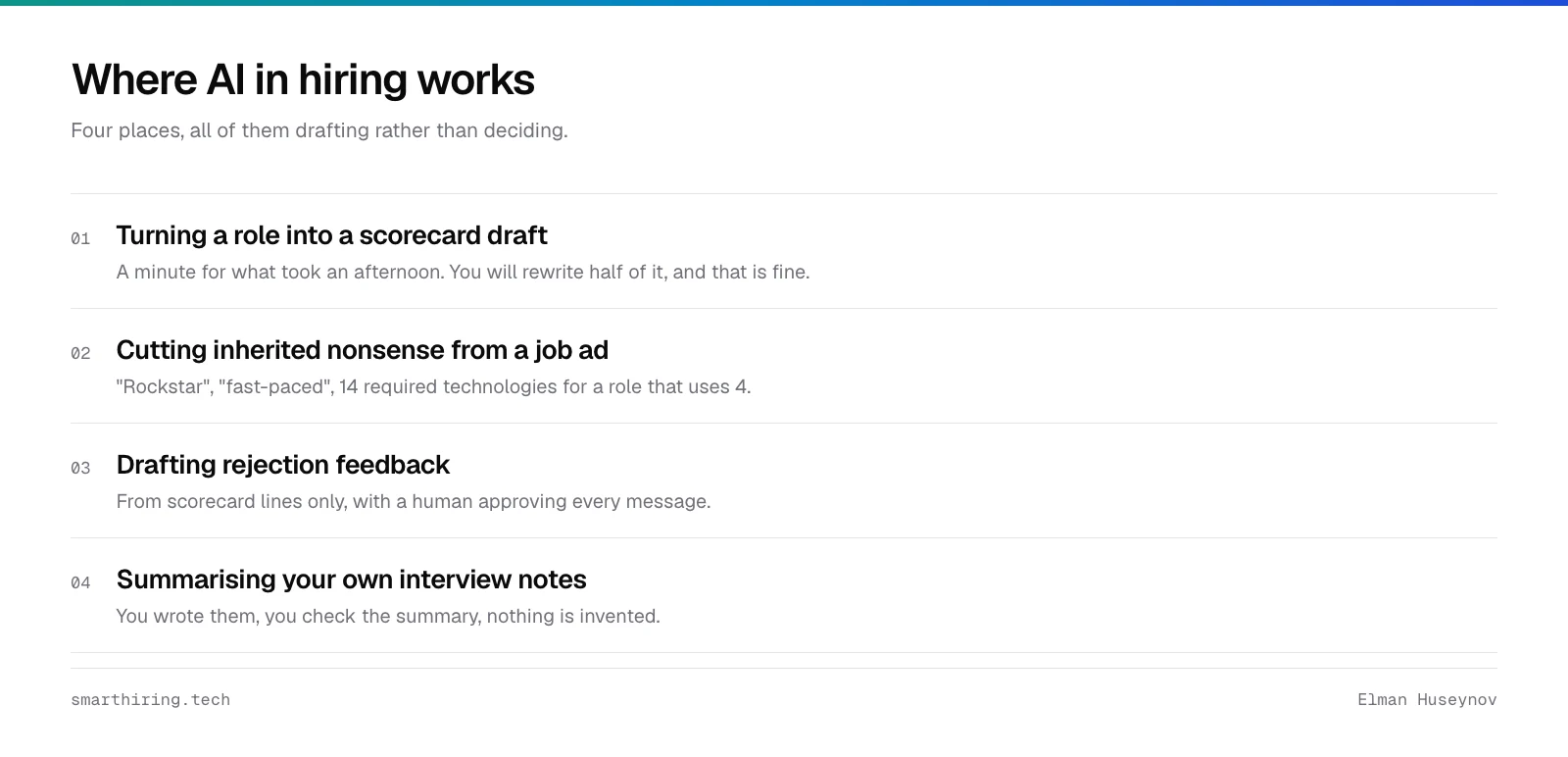
AI in hiring works in 4 places, all of them drafting rather than deciding.
Turning a role into a first-draft scorecard. Cutting inherited nonsense out of a job ad.
Drafting rejection feedback from scorecard lines, with a human approving every message. Structuring your own interview notes.
Scorecard drafts. Give a model the real responsibilities and ask for the signals. A generic draft beats a blank page.
The scorecard still comes before the ad, and a human decides it.
Job ads. “Rockstar”, 14 required technologies for a role that uses 4. A model cuts that and flags phrases that narrow the pool.
Rejection feedback. Only from scorecard lines, and a human approves every message. The safe wording is in interview feedback for rejected candidates.
Your own notes. Three pages of messy notes into a scorecard draft. You wrote the notes, you check the summary, nothing is invented.
Where does AI in the hiring process break?
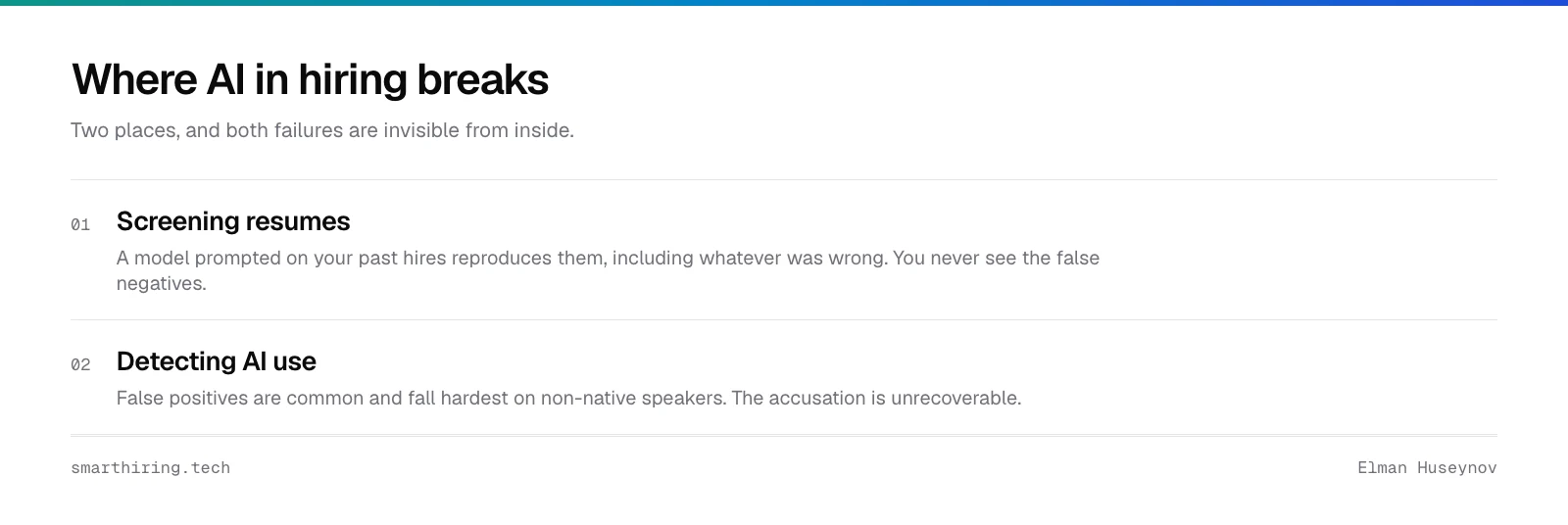
AI in the hiring process breaks in 2 places. Both failures are invisible from inside.
Resume screening reproduces your past hires, including whatever was wrong with them. AI hiring bias is now regulated.
AI detection is worse. False positives are common.
Screening resumes. A model prompted on your past hires reproduces them. You will not see the false negatives. Use it to extract facts, never to rank.
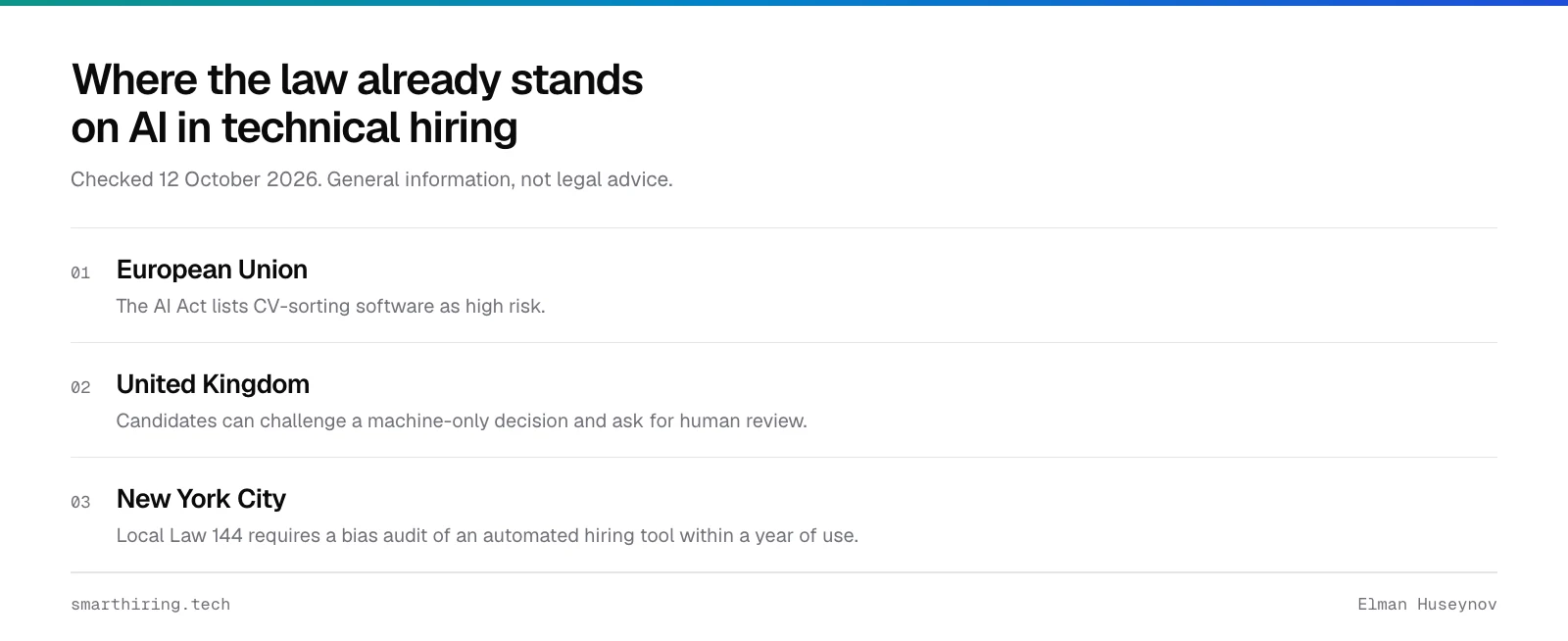
The law. New York City requires a yearly bias audit of these tools.
The EU AI Act lists CV-sorting software as high risk.
UK candidates can challenge a machine-only decision and ask for human review.
Rules checked 12 October 2026. This is general information, not legal advice.
Detecting AI use. The detectors fail hardest on non-native English speakers. A wrong accusation is unrecoverable.
What do you do about candidates using AI?
When candidates use AI, change the question and allow every tool. Hand them a working service with a subtle bug and 40 minutes.
Ask why the fix works and what else it might break. Ask what the model suggested that they rejected.
A task that assumes AI. A model can find the bug. It cannot defend the fix under 3 follow-ups from someone who knows the code.
The rejected suggestion. “What did the model suggest that you did not use, and why?” That separates thinking with a tool from pasting from it.
The candidate’s own code. Ask about a specific decision on line 40. Anyone who did not make it runs out of answers within 2 follow-ups.
A code-defence question takes more work to design than a LeetCode problem. It also predicts the job better.
What does it mean if a model can pass your interview?
A passing model means the interview was testing recall. AI in hiring did not create that, it made it visible.
The loops struggling most with AI are the ones that were weakest to begin with.
Structure was the fix then and it is the fix now. The numbers are in why your interview loop rejects good engineers.
What should your AI in hiring policy say?
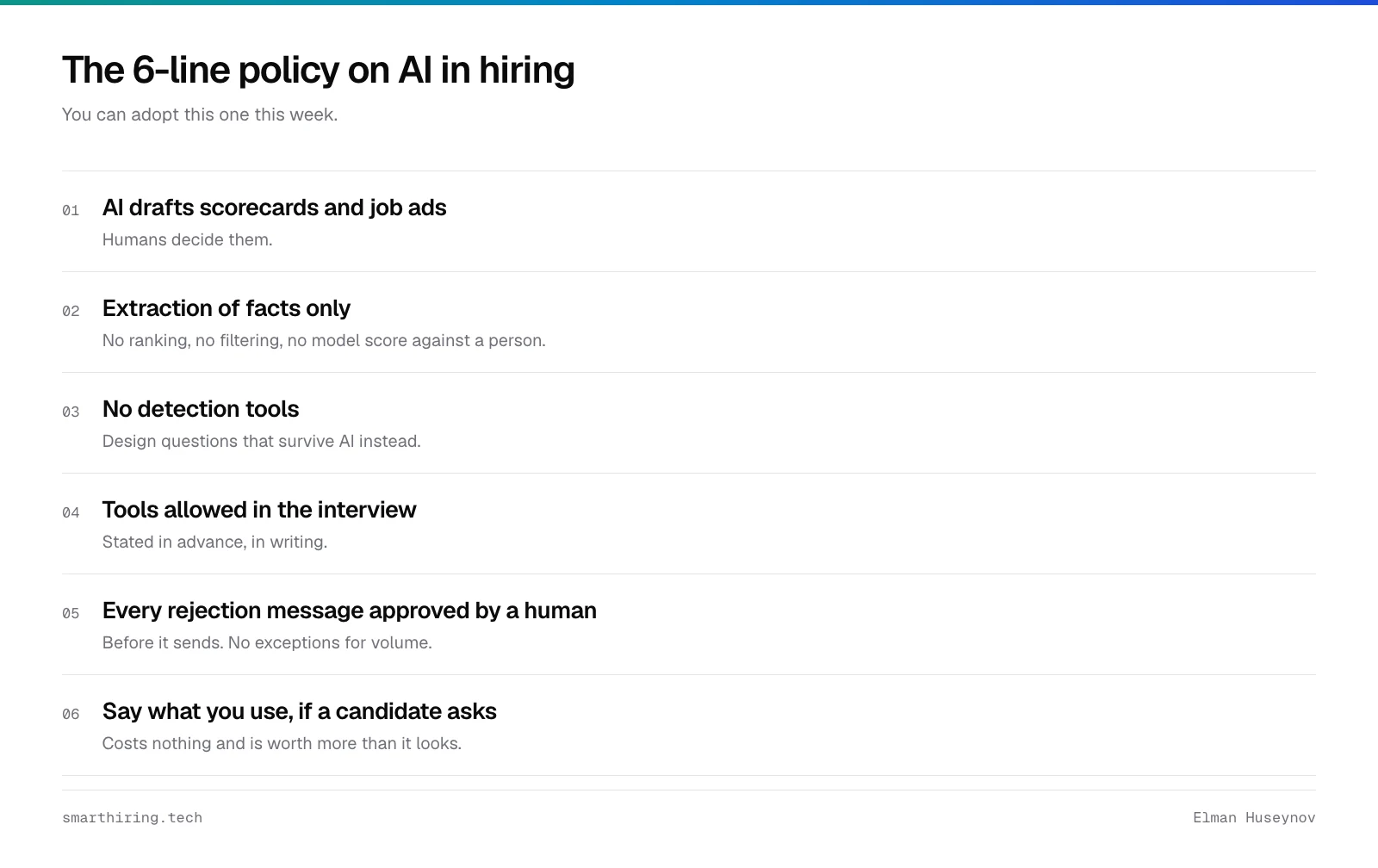
An AI in hiring policy needs 6 lines, and you can adopt them this week.
AI drafts, humans decide. Extraction of facts only. No detection tools. Tools allowed in the interview.
Every rejection message approved by a human. Say what you use.
- AI drafts scorecards and job ads. Humans decide them.
- Extraction of facts only. No AI recruiting tools rank or filter people.
- No AI detection tools. Design questions that survive AI instead.
- Tools are allowed in the interview and this is stated in advance, in writing.
- Every rejection message is approved by a human before it sends.
- Say what you use, if a candidate asks.
Common questions
Is it legal to use AI to screen candidates?
AI screening is legal with market-specific limits, as of 12 October 2026. The EU AI Act treats CV-sorting software as high risk. In the UK, candidates can challenge a machine-only decision and ask for a human review. New York City requires an annual bias audit of any automated hiring tool. Ranking people by model score is what these rules target.
Should you tell candidates you use AI in hiring?
Yes, and say exactly where. One line in the invitation is enough. “We do not use AI for decisions. It drafts our scorecards and feedback, and a person edits both.” A vague answer leaves the candidate guessing what you automate.
Do AI detection tools work?
AI detection tools do not work well enough for a decision that changes someone’s career. False positives are common. They fall hardest on non-native English speakers. The accusation is unrecoverable for the candidate. The cost of being wrong is asymmetric, and that is the whole argument.
What does an AI-proof interview question look like?
An AI-proof question has a defence step. Give a working service with a subtle bug and allow every tool. Spend the last 15 minutes on why the fix works and what it might break. A model finds the bug. It cannot hold the fix up under 3 follow-ups from someone who knows the code.
How is AI used in recruitment?
AI works for drafting. Turn a role into a scorecard draft. Cut inherited nonsense from a job ad. Structure your own interview notes. Shape rejection feedback a human then edits. AI breaks on ranking resumes and on detecting candidates. Both of those decide something, and neither can be audited.
The short version
Use AI in hiring for drafting, rewriting and summarising. Never for ranking people, and never for catching them.
Assume candidates have the tools. Design questions that need judgement on top of them.
Ask what they rejected.
The rejected-suggestion question does more work than any detector.
Loop needs rebuilding rather than patching? That is the work I do here.
An audit of your loop, with an AI in hiring policy in the write-up. Book a free 30-minute call.
PDF, 2 pages
AI in hiring policy, 6 lines
The policy you can adopt this week, where AI drafts and where it must not decide, and the legal lines in New York, the EU and the UK.
Leave a work email: the file opens right here, and one hiring stage, taken apart, follows every week. One click to leave.
Read next
Stop Trying to Catch Candidates Using AI in Interviews
Detection does not work well enough for a decision that ends a career. Design questions that survive the tools instead.
Why Technical Hiring Is Broken
Most loops measure things nobody agreed on in advance. Here is what that costs, and why I started SmartHiring.
Want this fixed in your loop?
SmartHiring trains engineering interview panels on their own open roles. Elman Huseynov, a Tech Hiring Expert in Berlin, runs every engagement. One workshop writes the scorecards for your roles, then calibration runs until the panel agrees. It starts with a free 30-minute call.
No pitch if the loop is already fine. See an example audit report.