Safe interview feedback comes from the scorecard.
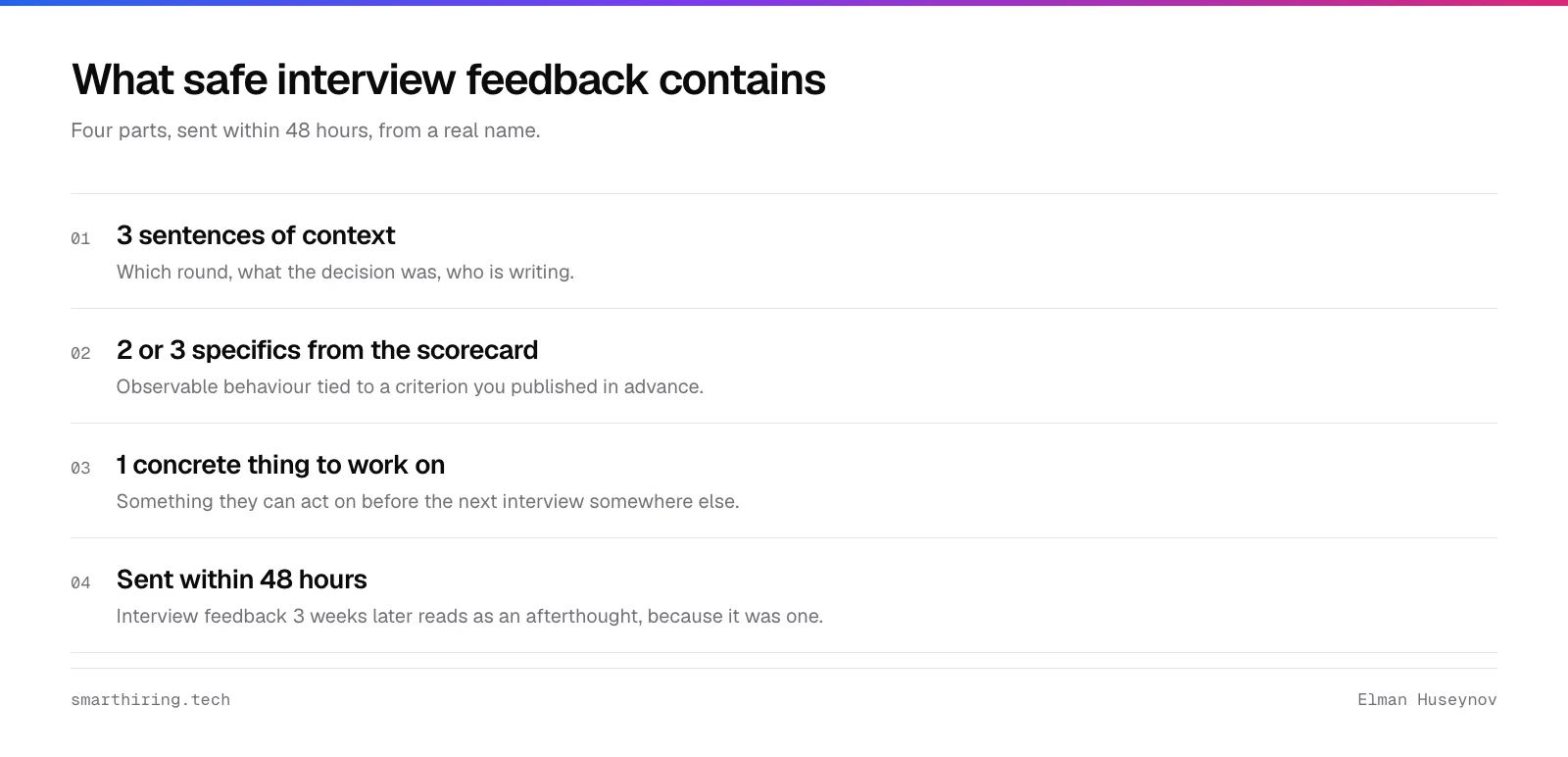
Quote 2 or 3 observable behaviours you recorded during the loop.
Tie each to a criterion you published in advance. Add 1 thing to work on.
Send it within 48 hours. If the scorecard is empty, there is nothing safe to say.
On this page
“After careful consideration, we have decided to move forward with other candidates.”
The candidate spent 8 hours on your process. That sentence tells them nothing they can use.
Most companies send it because legal told them to. Writing something better takes 4 minutes with a scorecard.
Why do companies send no interview feedback?
Companies skip interview feedback for two real reasons and one bad one.
In the US, specific interview feedback can be read as evidence in a discrimination claim.
A recruiter writing freely at volume is a genuine risk.
A recruiter closing 40 candidates from a long loop cannot write 40 thoughtful emails.
Nobody wrote down why the candidate was rejected. There is no rejection feedback to give.
What makes safe interview feedback possible?
Safe interview feedback needs a scorecard with evidence in it. You cannot personalise what you did not record.
A line reading not a fit gives you nothing safe to send.
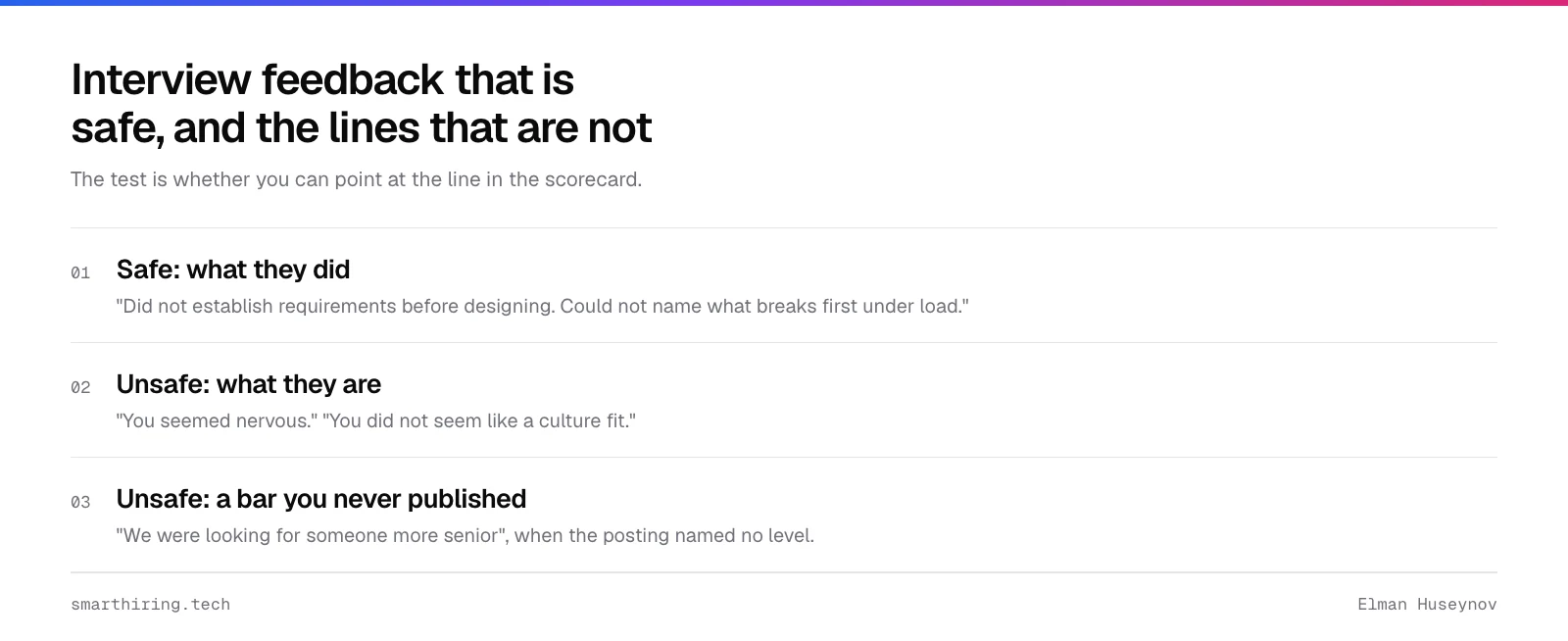
One line does the work. “Did not establish requirements before designing. Could not name what breaks first under load.”
Specific, job-related, defensible.
Who should the feedback come from?
Feedback should come from a named person the candidate can reply to.
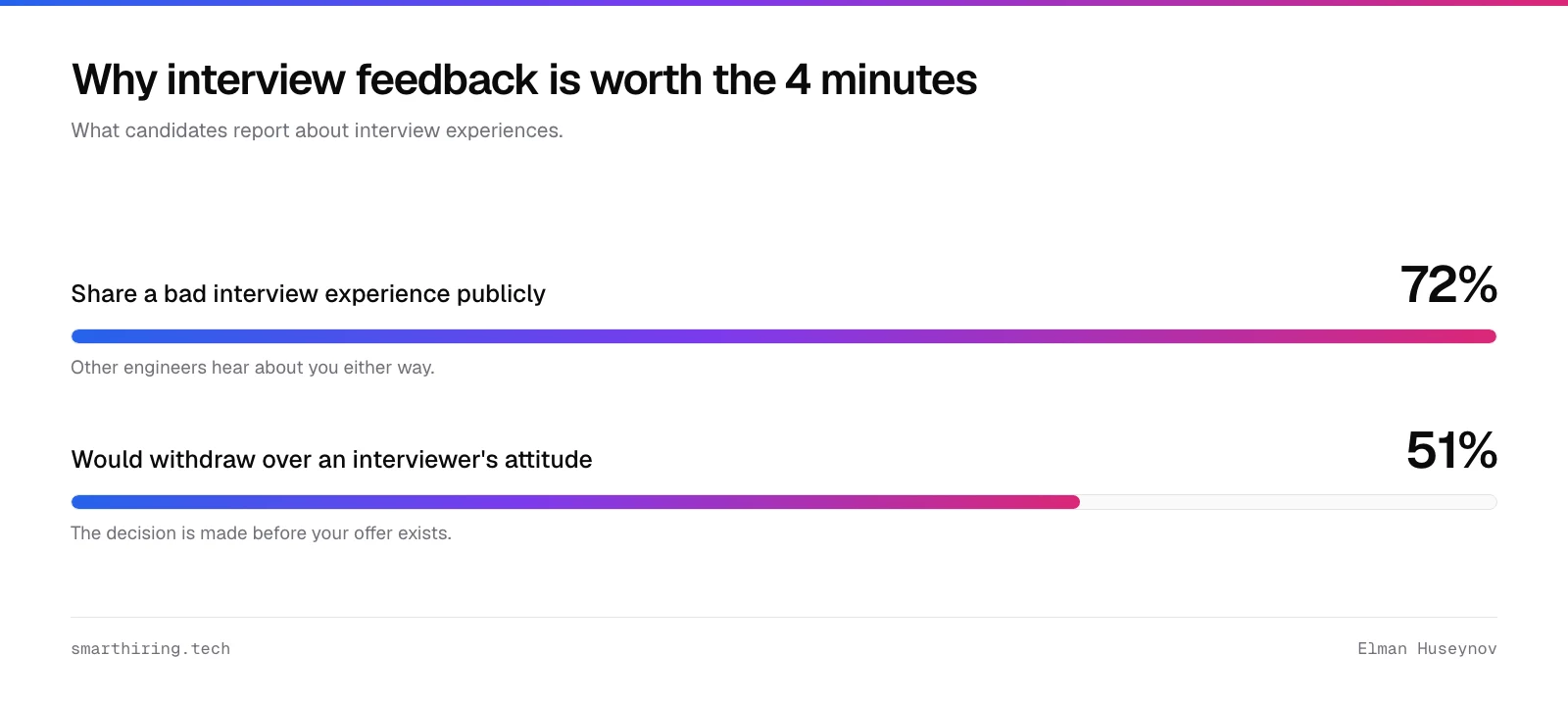
A candidate who can reply to a person stops posting about you.
The interview feedback problem is a scorecard problem. Fix the recording and the writing goes fast.
What is safe to say in interview feedback?
Safe feedback names observable, job-related behaviour tied to criteria you published in advance.
In the system design round, the design worked and the requirements were not established first.
The test is whether you can point at the line in the scorecard.
The line must describe what the candidate did, not what they are.
Not safe: “You seemed nervous.” “You did not seem like a culture fit.”
Unsafe too: “we were looking for someone more senior”, when the posting named no level.
Where does AI help with interview feedback?
AI helps by turning recorded evidence into readable prose at volume.
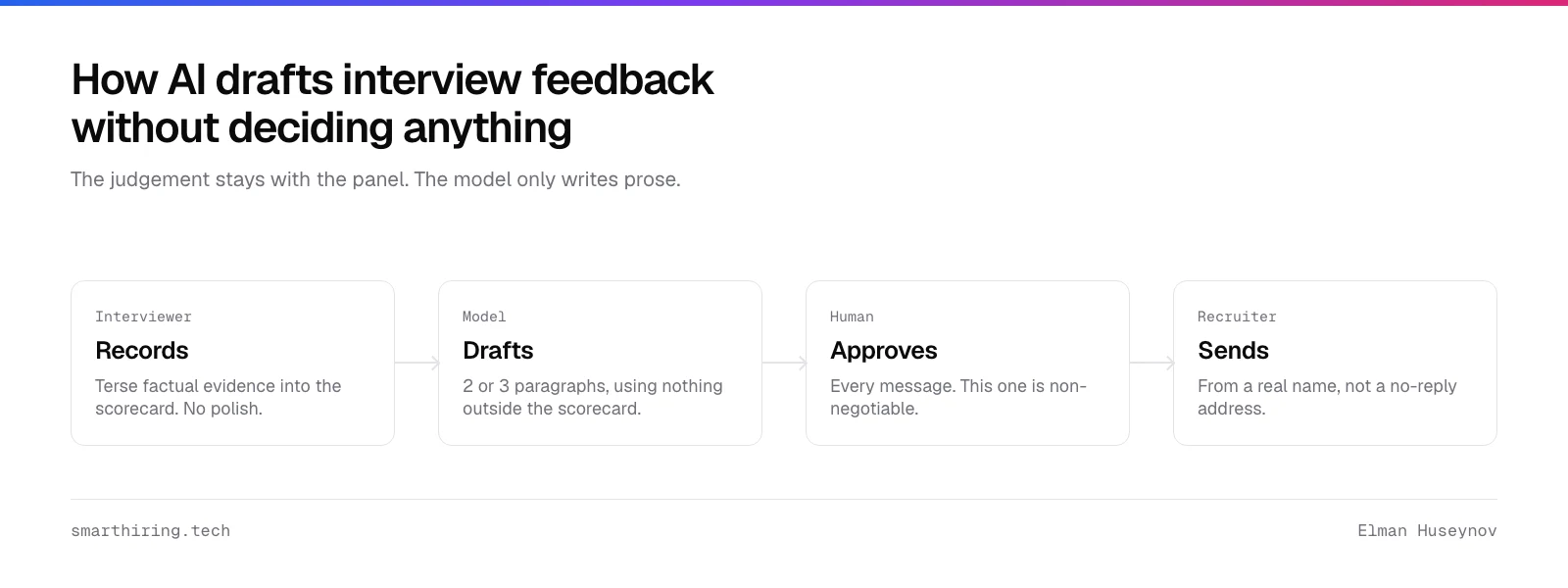
The interviewer writes terse factual evidence into the scorecard. A model turns those lines into 2 or 3 paragraphs.
A human reads it and sends it. The judgement stays with the panel.
- The interviewer writes evidence into the scorecard as usual. Terse, factual, no polish.
- A model turns the scorecard lines into 2 or 3 paragraphs, using only what is in the scorecard.
- A human reads it and sends it.
2 guardrails matter. The prompt must forbid adding anything absent from the input. A human must approve every message.
Where does AI not help with feedback?
AI does not help with feedback in 3 places. Deciding who to reject, which the EU AI Act treats as high risk.
Softening a decision nobody can justify. A well-written email invites a reply you cannot answer.
Personalising at the top of the funnel is the other trap. A CV-screen rejection needs a clear fast no.
Save the detail for people who spent hours with you.
What are safe interview feedback examples?
The interview feedback email is 3 sentences of context. Then 2 or 3 specifics from the scorecard, and 1 thing to work on.
A specific: “In the design round you chose a queue early and explained the trade-off. The retry model stayed open.”
The thing to work on: “We scored recovery as the gap. Practise walking a design back when a constraint changes.”
Keep the offer to answer questions if you can honestly staff it. Do not offer it if you cannot.
Send it within 48 hours. That is the whole interview feedback template. Three weeks later it reads as an afterthought.
Why bother
The people you reject this year are the people you want in 2 years.
A specific rejection is the cheapest reputation work available to a hiring team.
SmartHiring’s interview training writes the scorecards that make this feedback safe. Book a free 30-minute call.
Common questions
Are you legally required to give interview feedback?
In the UK, no. Acas says employers do not have to explain a rejection, as of 12 October 2026. Giving feedback is not itself a risk. The risk is interview feedback that describes the person rather than the behaviour. Or that cites a criterion you never published. Get your own legal read on the template once, for your country.
How much detail should a rejection email have?
Scale a rejection email’s detail to what the candidate spent. A CV screen gets 3 lines and a fast no. Someone who did 4 rounds and 8 hours gets 2 or 3 specifics. Plus 1 thing to work on. Detail beyond the effort they put in reads as performance, not respect.
How do you give interview feedback to a candidate?
Quote 2 or 3 behaviours recorded on the scorecard during the loop. Tie each one to a criterion published in advance. Add 1 thing to work on. Send it within 48 hours. An empty scorecard means there is nothing safe to say. Fix the scorecard first.
Does giving interview feedback change anything for the company?
Specific feedback changes who applies again. The people you reject this year are the people you want in 2 years. A candidate who got a specific reason knows what to fix before applying again. One who got a template email has no reason to try. A specific rejection is the cheapest reputation work a hiring team has.
Should the recruiter or the interviewer send the interview feedback?
The recruiter sends it, using lines the interviewer wrote. Interviewers write evidence, not emails, and they write it while it is fresh. Recruiters own the relationship and the tone. That split is what makes 40 rejections a month survivable. None of them ends up generic.
The short version
You cannot give useful interview feedback without a scorecard. Fix that first.
Use AI to turn recorded evidence into prose, never to decide anything.
Stay on observable, job-related behaviour. Send it within 2 days.
PDF, 2 pages
3 rejection emails, ready to send
One email for the CV screen, one after a first round, one after a full loop, each built from scorecard lines, plus the safe and unsafe sentences side by side.
Leave a work email: the file opens right here, and one hiring stage, taken apart, follows every week. One click to leave.
Read next
Stop Trying to Catch Candidates Using AI in Interviews
Detection does not work well enough for a decision that ends a career. Design questions that survive the tools instead.
AI in Hiring: Where It Helps and Where It Breaks
Candidates use AI and you cannot stop them. Where it genuinely helps a hiring process, where it makes things worse, and the line not to cross.
Want this fixed in your loop?
SmartHiring trains engineering interview panels on their own open roles. Elman Huseynov, a Tech Hiring Expert in Berlin, runs every engagement. One workshop writes the scorecards for your roles, then calibration runs until the panel agrees. It starts with a free 30-minute call.
No pitch if the loop is already fine. See an example audit report.