The hiring loop is judged by team health 9 months later. A team health check reads it in month 3, from 4 signals.
None of the 4 needs a survey tool. All of them sit in the board, the pull requests and the calendar.
On this page
A team carrying someone for 6 months sees the bar. One resignation from that team doubles the bill.
The check below is one to run every quarter.
Why does team health show a hiring problem first?
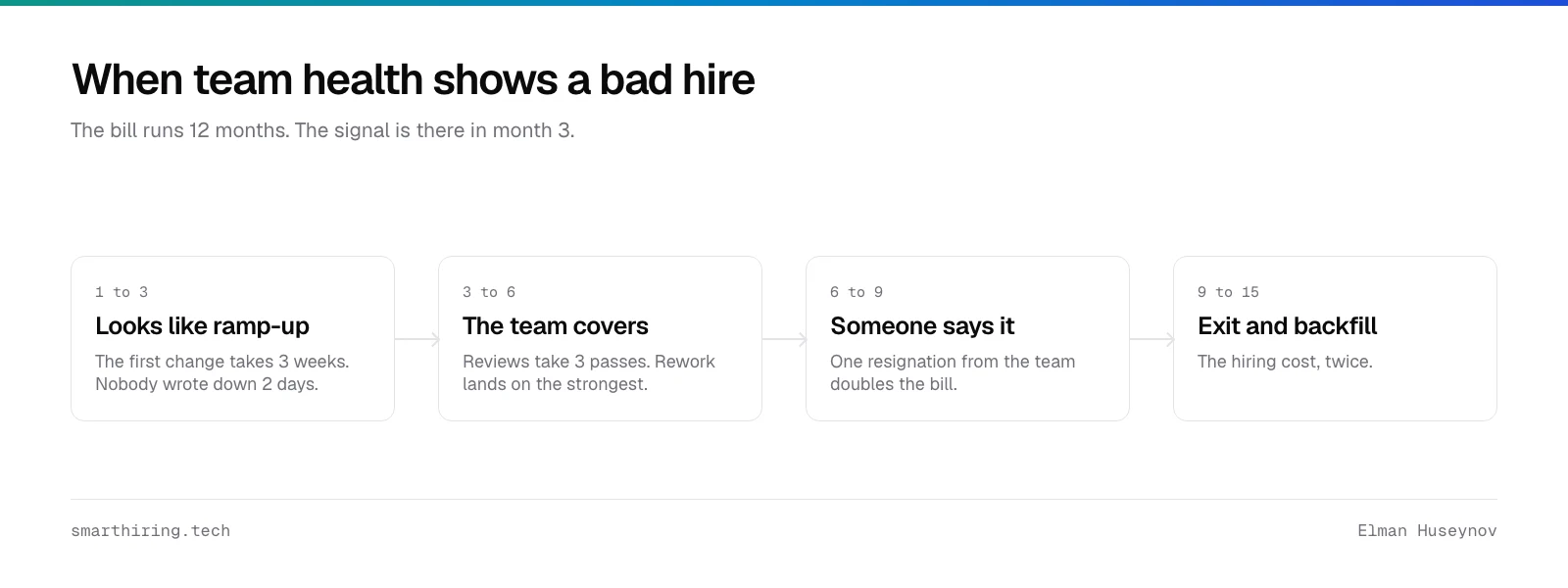
Team health shows a hiring problem first. The team covers for it before anyone reports it.
Months 3 to 6 are quiet.
Reviews take 3 passes. Rework lands on your strongest engineers. Nobody says anything, because everyone was in the loop.
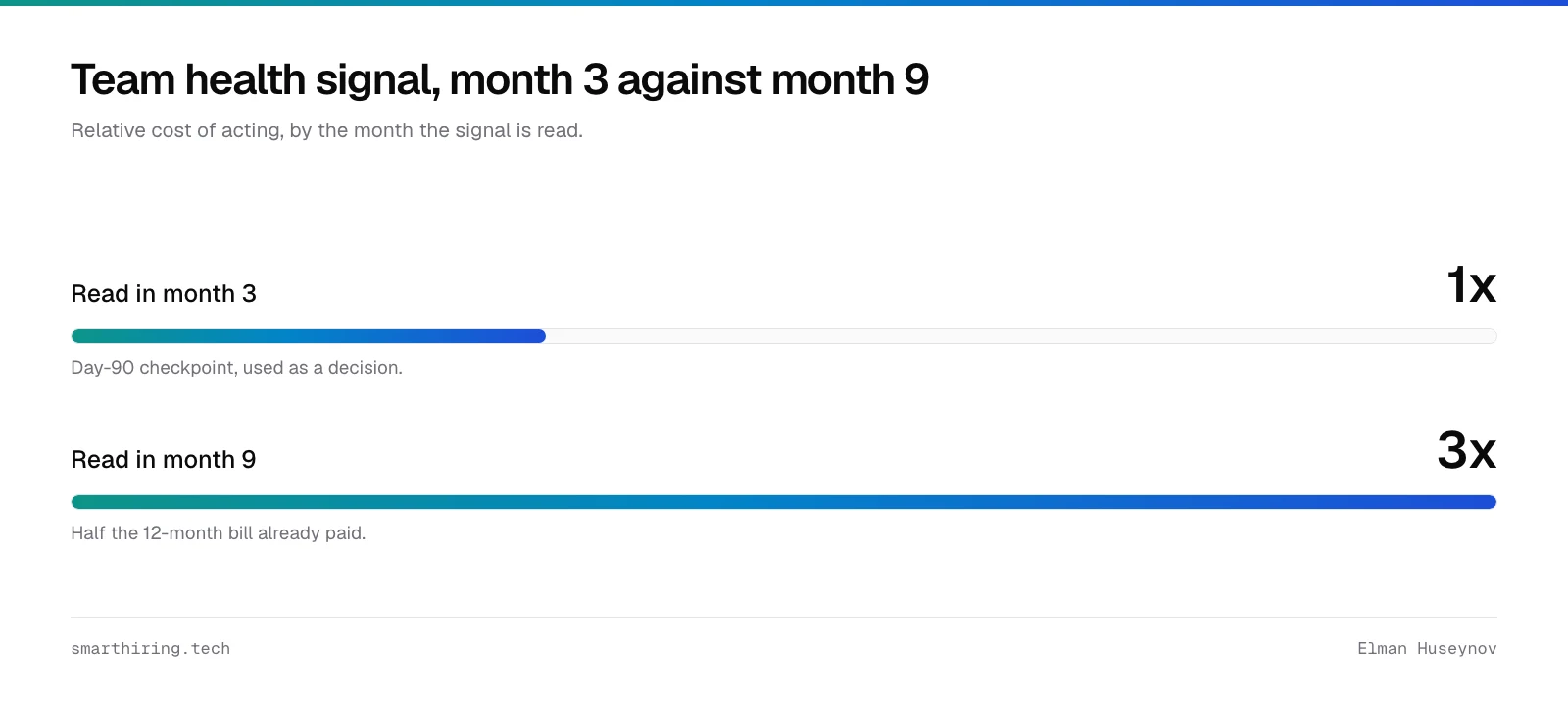
Months 6 to 9, someone says it out loud. By then the bill for a bad hire has run half its 12 months.
The 4 signals below are visible in month 3. That is the cheapest month to act.
What are the 4 team health signals?
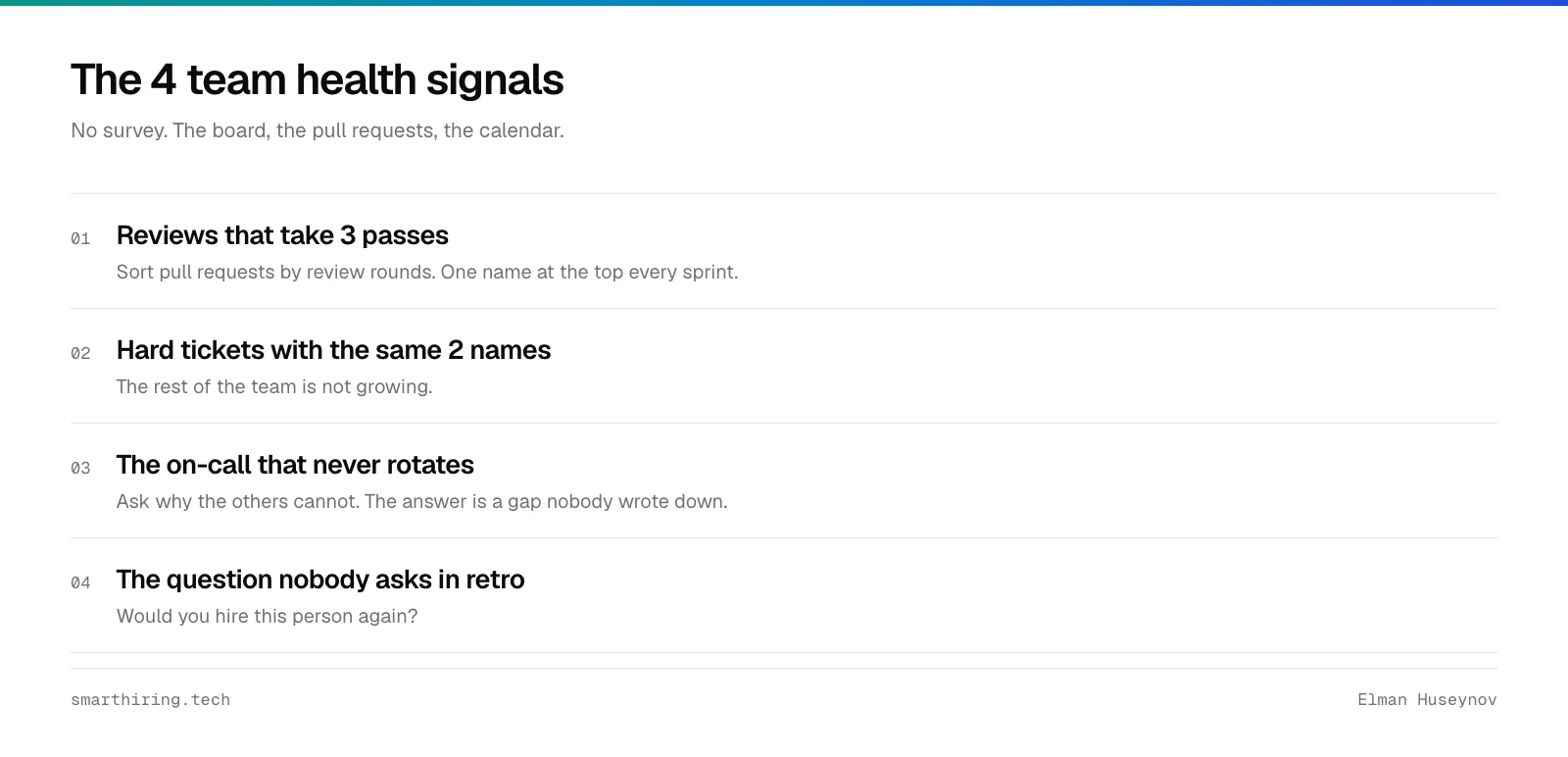
The 4 team health signals: reviews that take 3 passes. Work that lands on the same 2 people.
The on-call that never rotates. The question nobody asks in retro.
Each one is a symptom of one hire or one gap. Each one is readable without asking anyone anything.
Read all 4 in the same hour, once a quarter. One signal is a bad week. Three is a pattern.
How do you read the first 2 signals?
The first 2 signals are in the pull requests and the board.
One author with the same 2 reviewers every week. Hard tickets with 2 names on them.
Reviews that take 3 passes: sort pull requests by review rounds. One name at the top, every sprint, is a signal.
Work that lands on the same 2 people: look at the tickets marked hard.
If the same 2 names own them, the rest of the team is not growing.
Both signals point at the loop. A skill that was scored in the interview did not show up in the work.
How do you read the second 2 signals?
The second 2 signals are in the calendar and the retro. One person always has the pager, and one question never gets asked.
The on-call that never rotates: one person always carries it. Ask why the others cannot.
The answer is usually a gap nobody wrote down.
The question nobody asks in retro: would you hire this person again?
The manager asks it at day 90 for every hire and writes the answer down.
The 30 60 90 day plan gives that question its evidence.
Day 30 shipped, day 60 owned, day 90 a call the team trusted.
A new manager’s version is the first 90 days as an engineering manager.
What does the team health check change in the loop?
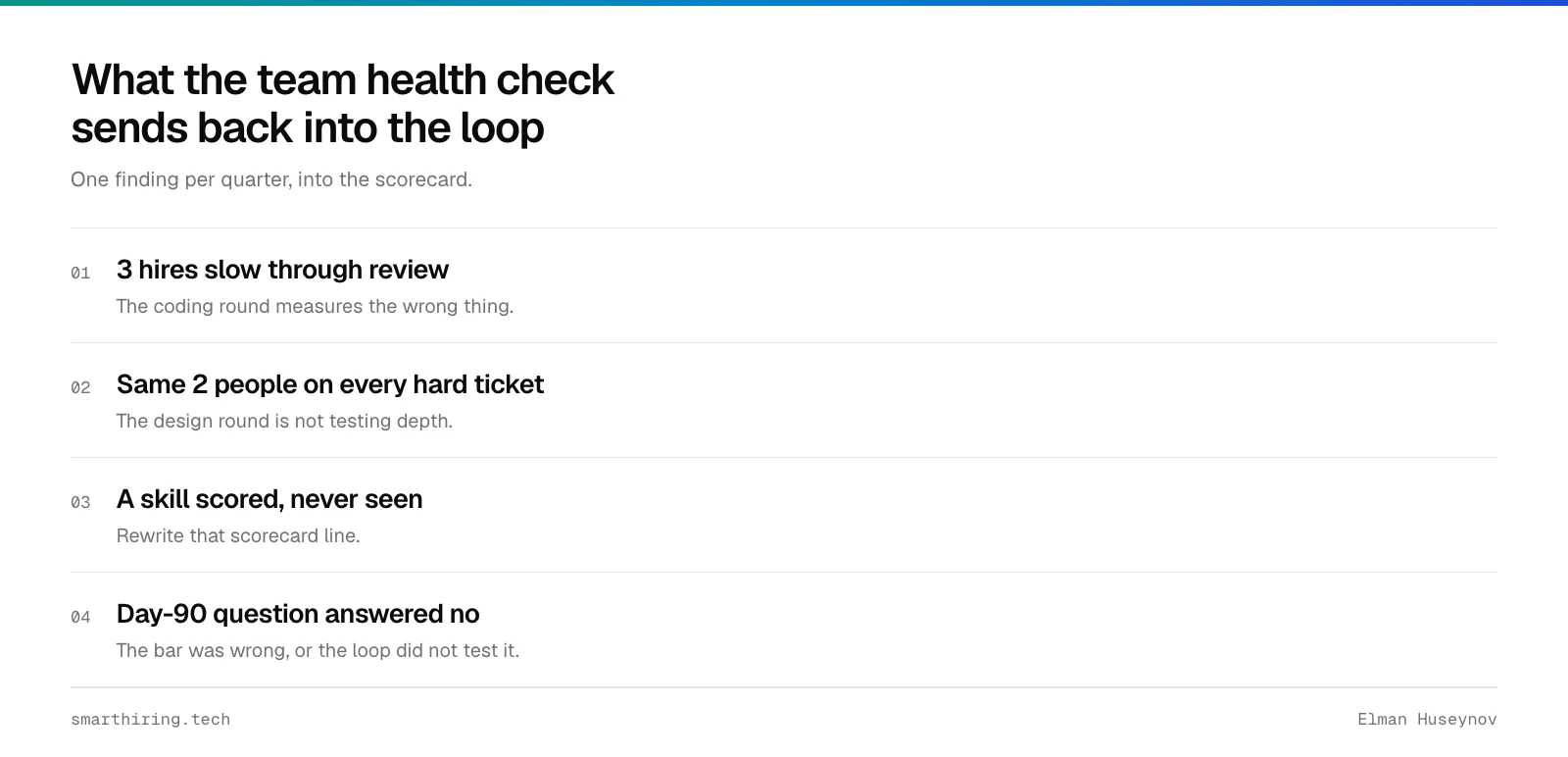
The team health check sends 1 finding back into the scorecard each quarter.
A skill that was scored and did not show up is a line to rewrite.
If 3 hires in a row are slow through review, the coding round is wrong.
If the same 2 people own every hard ticket, the design round misses depth.
The scorecard gets its first real test at day 60. The team health check is that test, run for the whole team.
Common questions
How often should you run a team health check?
Once a quarter, in the same hour, on the same 4 signals. Monthly while onboarding a new hire or after a resignation. The 4 signals are cheap to read. The cost of running it is the hour. The cost of skipping it is finding out in month 9.
Does a team health check need a survey?
No. A survey measures what people are willing to say. In months 3 to 6 nobody says anything. The 4 signals sit in the pull requests, the board, the calendar and the retro. They are visible before anyone is willing to name the problem.
What if the team health check points at one person?
Run the day-90 question, with evidence, even if day 90 has passed. Would you hire this person again, and what would you have scored differently? A missed day-30 goal is a pipeline problem first. A missed day-90 goal is the first real conversation about fit.
Is a team health check the same as a retrospective?
No. A retro asks the team what went wrong this sprint. The team health check reads 4 numbers the team may not want to say aloud. Run both. Bring one finding from the check into the retro as a question. See who answers.
The short version
Four signals, once a quarter. Reviews that take 3 passes. Hard tickets with the same 2 names.
The pager that never rotates. The day-90 question nobody asks.
All 4 are visible in month 3. Month 9 costs 3 times more.
Send 1 finding back into the scorecard each quarter.
Shadowing and calibration, with the check run on your last 3 hires. Book a free 30-minute call.
Excel, 2 sheets
Team health check, 4 signals
The 4 signals with where to read each, what to look for and what it points at, a column for this quarter's finding, and the day-90 question per hire.
Leave a work email: the file opens right here, and one hiring stage, taken apart, follows every week. One click to leave.
Read next
The Engineering Onboarding Checklist
A 4-week software engineer onboarding checklist. The first task is picked before day 1, and the 30-day question closes it.
The Recruitment Process for a 10-Engineer Team, End to End
A 10-engineer team has no recruiting department and no process to unlearn. Here is the recruitment process in 6 stages, from the written bar to the day-90 question.
Want this fixed in your loop?
SmartHiring trains engineering interview panels on their own open roles. Elman Huseynov, a Technical Interview & Calibration Trainer in Berlin, runs every engagement. One workshop writes the scorecards for your roles, then calibration runs until the panel agrees. It starts with a free 30-minute call.
No pitch if the loop is already fine. See an example audit report.