A good interviewer measures one criterion per interview and writes down what the candidate said.
A good interviewer scores alone, before hearing anyone else in the debrief.
Interviewers often learn the job by doing it. Robert Walters found 40% of hiring managers never had formal interview training.
On this page
Here are the 5 habits, and how an engineer learns them in a quarter.
What makes a good interviewer?
A good interviewer turns one hour of conversation into evidence another person can check.
The score comes from that evidence, against a criterion written before the interview.
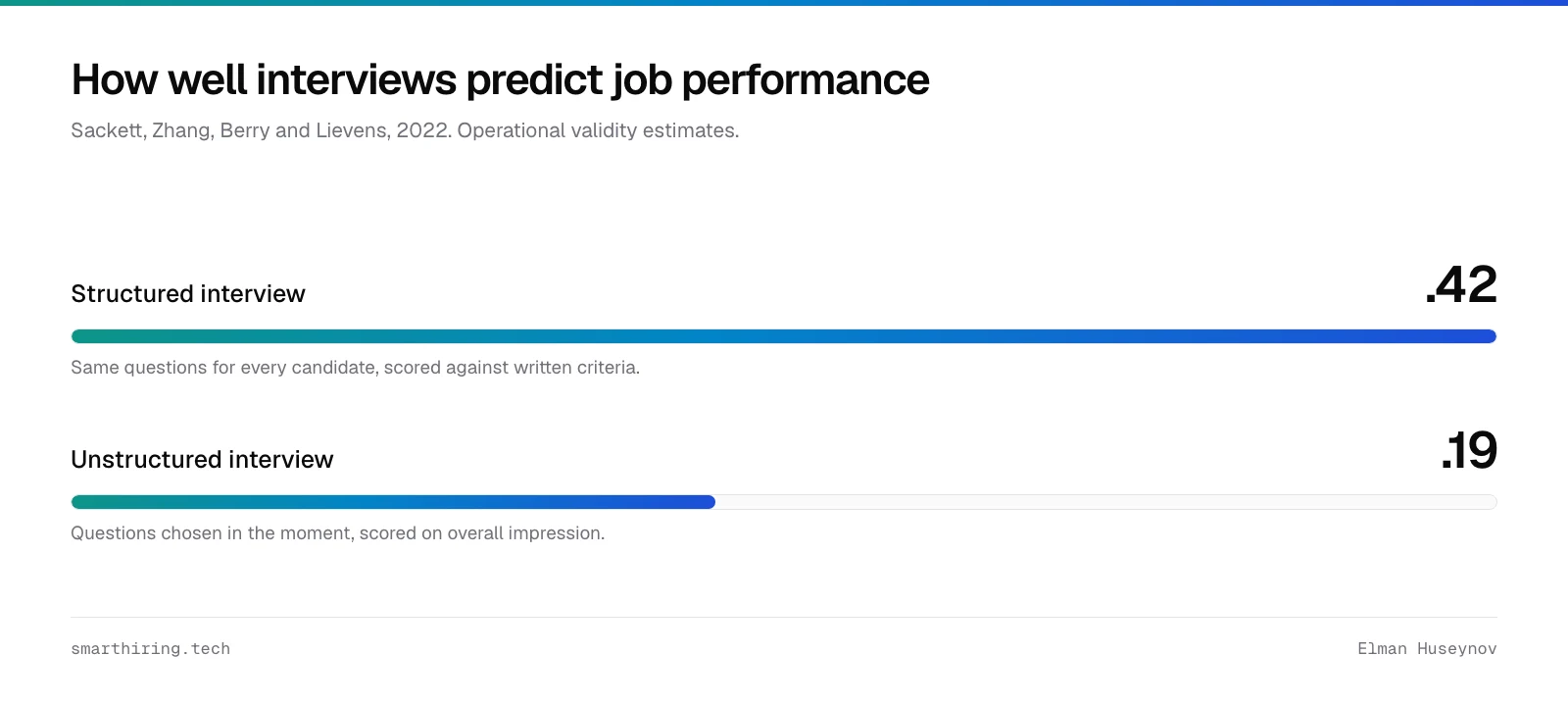
Research measures what structure adds. Sackett and colleagues, 2022 estimate the validity of structured interviews at .42.
Unstructured interviews come out at .19 in the same analysis.
The 5 habits below are what structure looks like from the interviewer’s chair.
The 5 habits
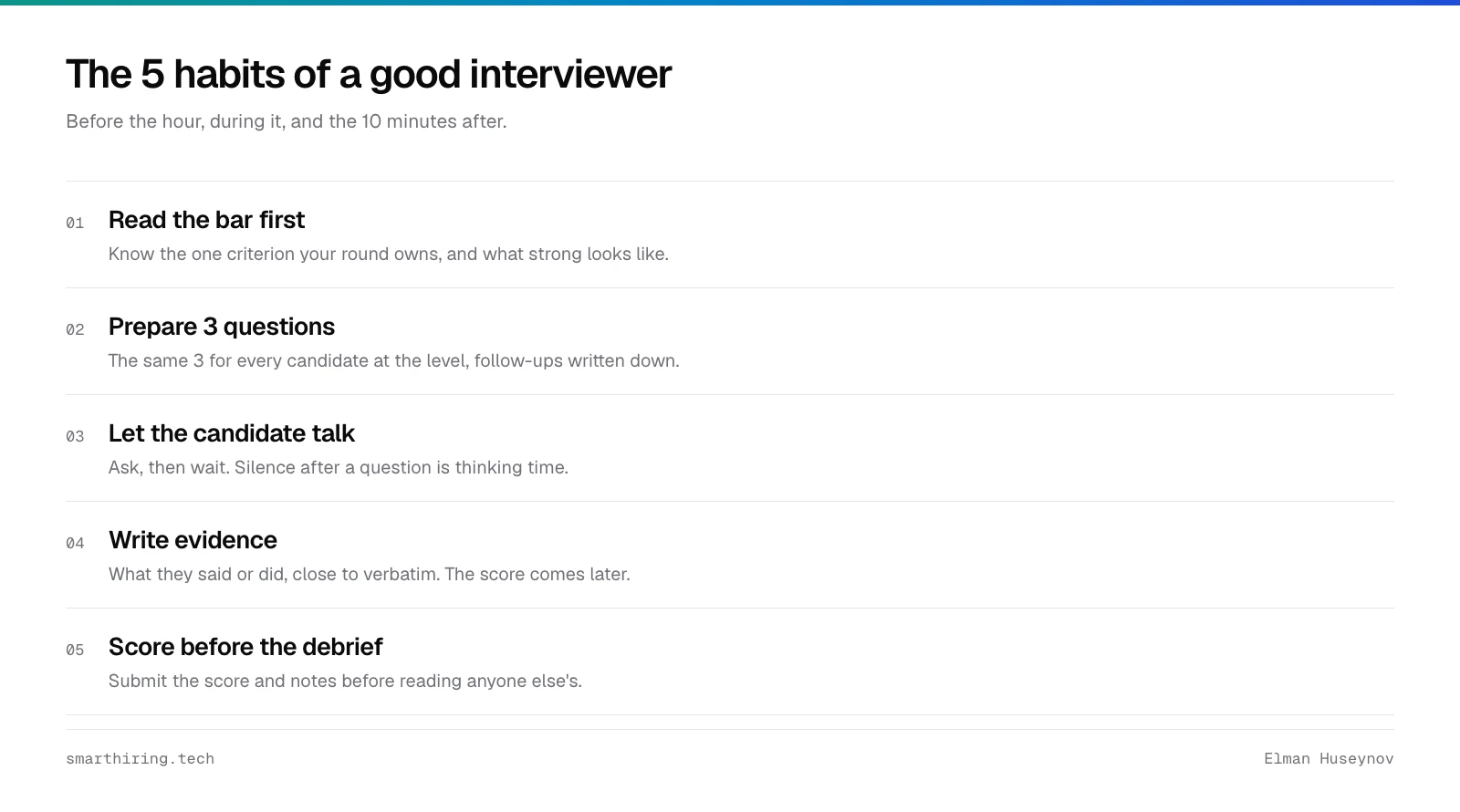
The 5 habits of a good interviewer cover 3 moments. The hour before, the hour itself and the 10 minutes after.
1. Read the bar first. Know which criterion your round owns, and what strong looks like. The scorecard template shows the format.
2. Prepare 3 questions. Same questions for every candidate at the level, with the follow-ups written down.
3. Let the candidate talk. Ask, then wait. Silence after a question is thinking time.
4. Write evidence. “Added a cache, measured p95 before and after” is evidence. “Strong on performance” is an opinion.
5. Score before the debrief. Submit the score and the notes before reading anyone else’s.
How does a good interviewer ask follow-up questions?
A good interviewer asks follow-up questions one level deeper into the candidate’s own example.
“What did you try first?” “What would you change now?” “Who disagreed, and what happened?”
Follow-ups expose who made the decision. A candidate describing a team’s work runs out of detail after 2 of them.
Hypothetical questions (“what would you do if”) measure how well someone talks. Past examples measure what they did.
What do new interviewers get wrong?
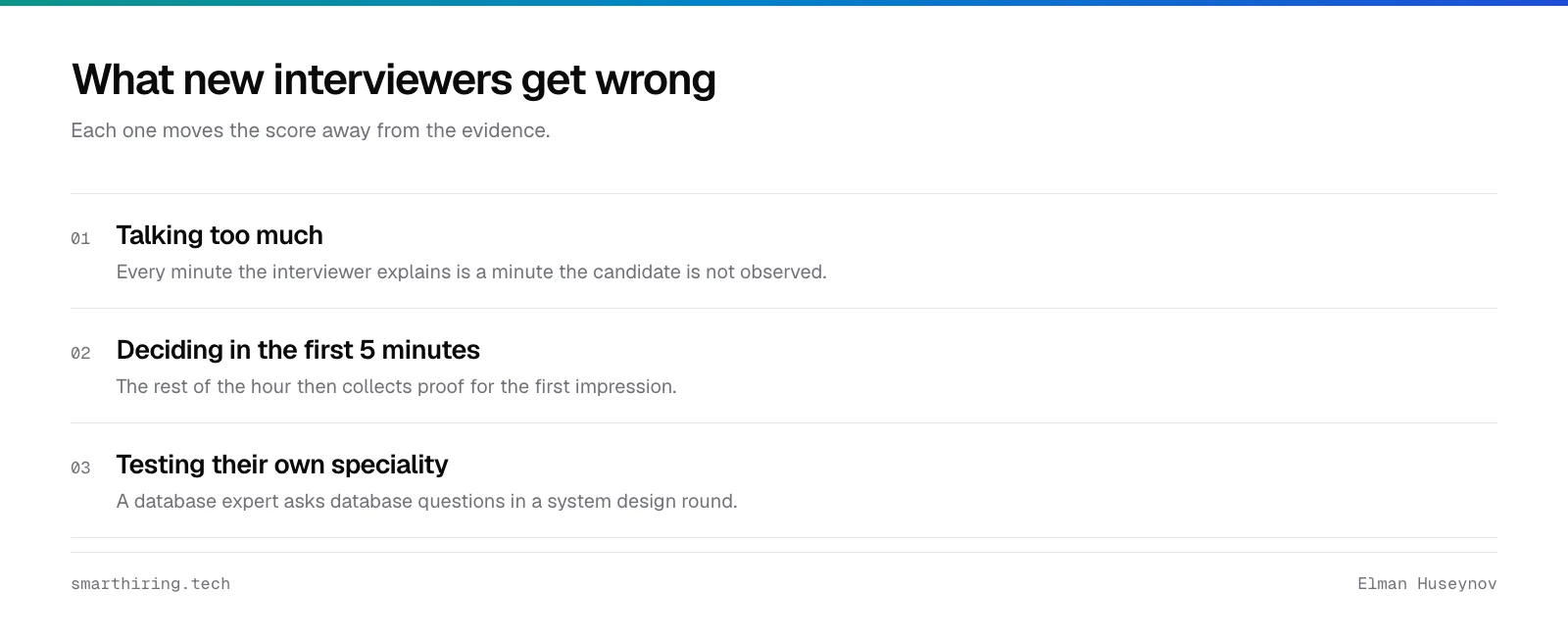
New interviewers talk too much, decide too early and test their own speciality. Each habit moves the score away from the evidence.
Talking too much. Every minute the interviewer explains is a minute the candidate is not observed.
Deciding in the first 5 minutes. The rest of the hour then collects proof for that first impression.
Testing their own speciality. A database expert asks database questions in a round about system design. A panel avoids this by giving each seat one criterion.
How do you write interview feedback that holds up?
Interview feedback holds up when every score points to something the candidate said or did.
Write the notes during the interview, close to verbatim. Finish them within the same day.
Separate the evidence from the score. The debrief can then argue about the score while the evidence stays fixed.
The debrief meeting post shows how a panel uses those notes to decide.
How do you become a better interviewer?
You become a better interviewer by being watched, then by comparing your scores with others.
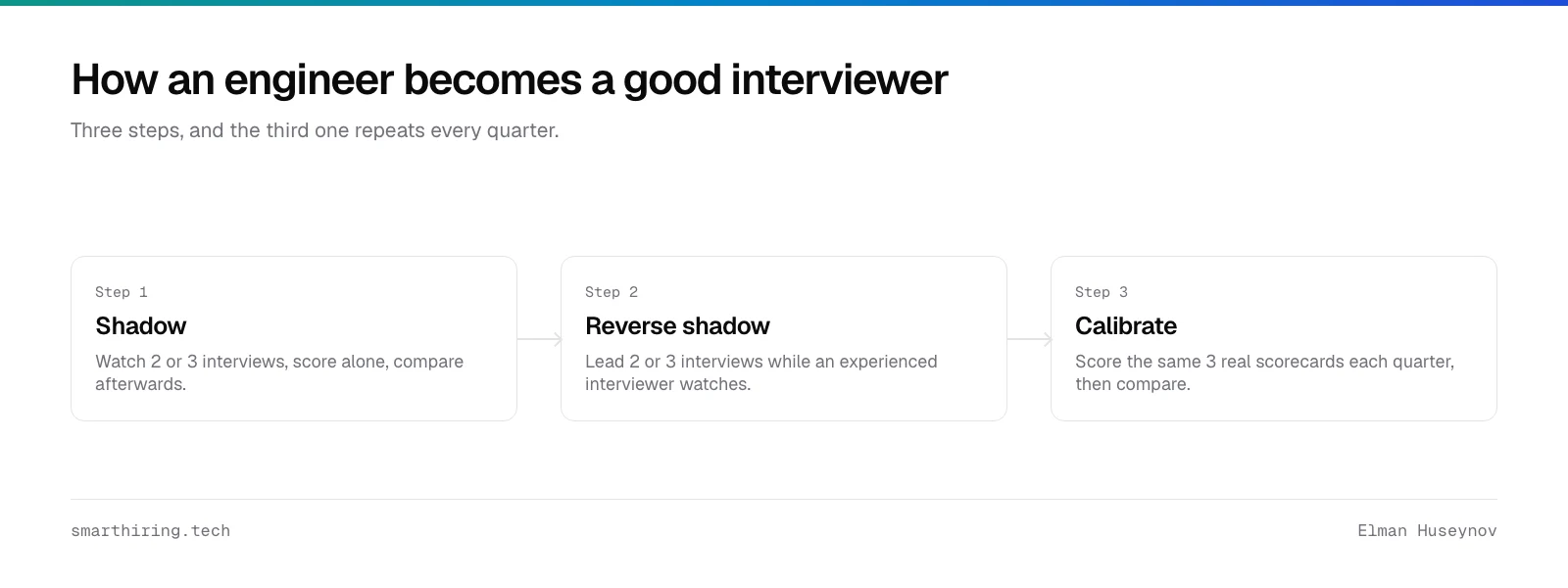
Three steps do it: shadow, reverse shadow, calibrate.
Shadow. Sit in on 2 or 3 interviews run by someone experienced. Write your own score and compare it afterwards.
Reverse shadow. Run the interview while the experienced interviewer watches and gives feedback.
Calibrate. Score the same 3 real scorecards alone each quarter, then compare. Interviewer calibration has the 90-minute session.
Amazon trains its Bar Raisers on this path. Training includes months of shadowing.
Common questions
What is a shadow interview?
A shadow interview is one where a trainee interviewer watches without asking questions. The trainee writes their own notes and score. Afterwards they compare them with the lead interviewer’s. The reverse shadow comes next. The trainee leads, and the experienced interviewer watches and gives feedback.
What is a bar raiser?
A bar raiser is an interviewer from outside the hiring team. They join a loop to keep the standard. Amazon created the role. Its Bar Raisers train for 3 months to a year, including shadowing. Smaller companies copy the idea with one trained outside interviewer per loop.
How many interviews before someone is a good interviewer?
Feedback makes a good interviewer faster than the interview count does. One engineer shadows 2 or 3 interviews and is reverse shadowed 2 or 3 times. They calibrate every quarter and improve quickly. Another runs 50 interviews and nobody compares the scores. They repeat the same habits 50 times.
Should an interviewer tell the candidate how they did?
An interviewer should not give a verdict at the end of a round. The decision belongs to the panel. Tell the candidate what happens next and when. Feedback comes later, from one person, once the decision is made. It stays specific to the criteria.
What questions should a good interviewer ask?
A good interviewer asks about real past work at the level of the role. “Tell me about a system you changed that others depended on.” Then follow-ups on decisions, trade-offs and what went wrong. The same 3 questions go to every candidate for that round and level.
The short version
A good interviewer measures one criterion and writes evidence while the candidate talks.
Prepare 3 questions per round and use them for every candidate.
Ask follow-ups about the candidate’s own example. Score alone, before the debrief.
Learn by shadowing, then being reverse shadowed, then calibrating every quarter.
Training a whole panel in these habits is what a workshop sprint does. Book a free 30-minute call.
PDF, 2 pages
Interview guide for hiring managers
One page for every interviewer before their round: the 5 habits, follow-ups, the notes format, the 3 mistakes, and the shadow to calibration path.
Leave a work email: the file opens right here, and one hiring stage, taken apart, follows every week. One click to leave.
Read next
The Technical Assessment That Tests the Job
A take-home costs the candidate 6 hours and you 45 minutes of marking. A 60-minute pair costs 1 hour each side and tells you more. Here is the comparison.
Structured Interview Questions, With the Strong Answer Written First
Unstructured interviews explain 4% of later performance. Structured ones explain about 18%. The difference is 3 questions per round and a strong answer written first.
Want this fixed in your loop?
SmartHiring trains engineering interview panels on their own open roles. Elman Huseynov, a Tech Hiring Expert in Berlin, runs every engagement. One workshop writes the scorecards for your roles, then calibration runs until the panel agrees. It starts with a free 30-minute call.
No pitch if the loop is already fine. See an example audit report.