An engineering hiring process works better at 4 rounds than 9.
On this page
Cut it to 4. A screen, practical coding, a depth round, a hiring manager conversation.
Run it in 1 day so the panel meets while the memory is fresh.
Require every scorecard submitted before anyone speaks in the debrief.
A typical engineering hiring process runs 7 to 9 interviews over a month.
A 9-interview hiring process still produces decisions the panel cannot explain a week later.
I defined the hiring process for a team at Zalando that now covers 27 markets. 3 changes did most of the work.
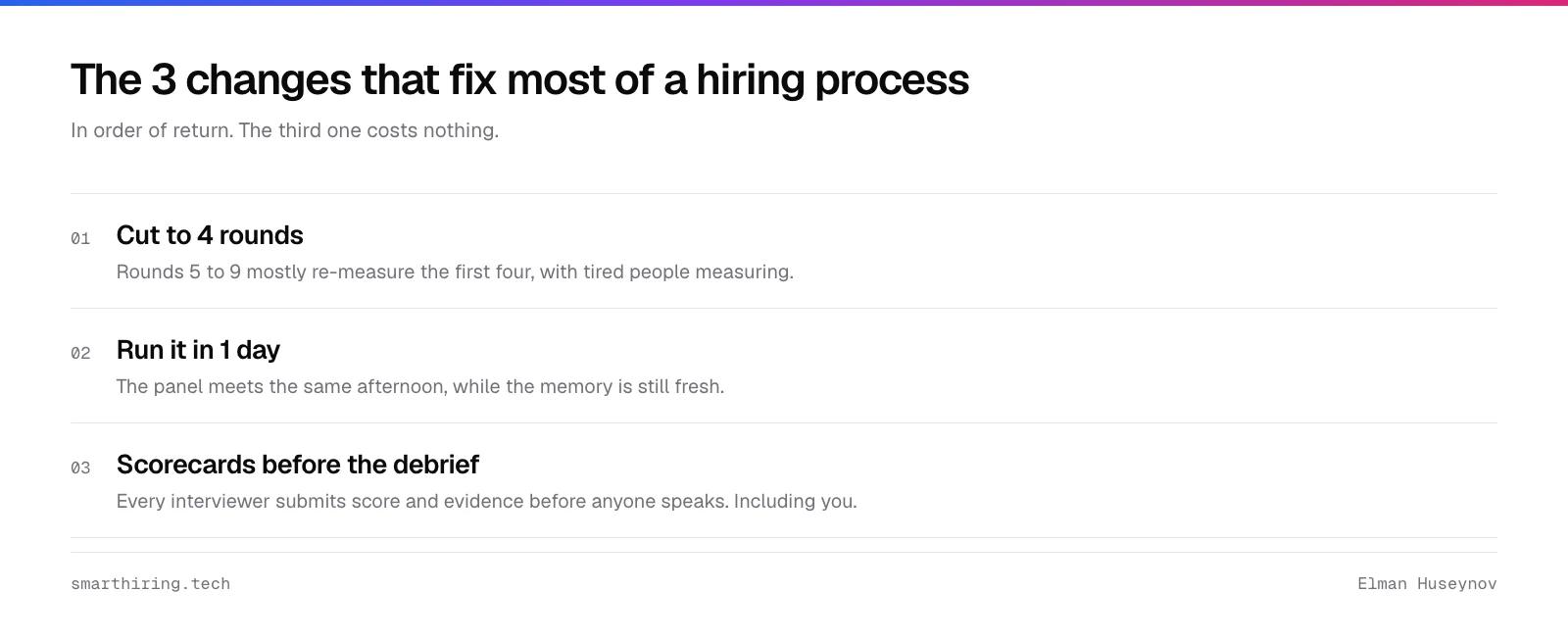
Change 1: why cut the hiring process to 4 rounds?
Seven rounds mostly re-measure the same signal, with tired people doing the measuring.
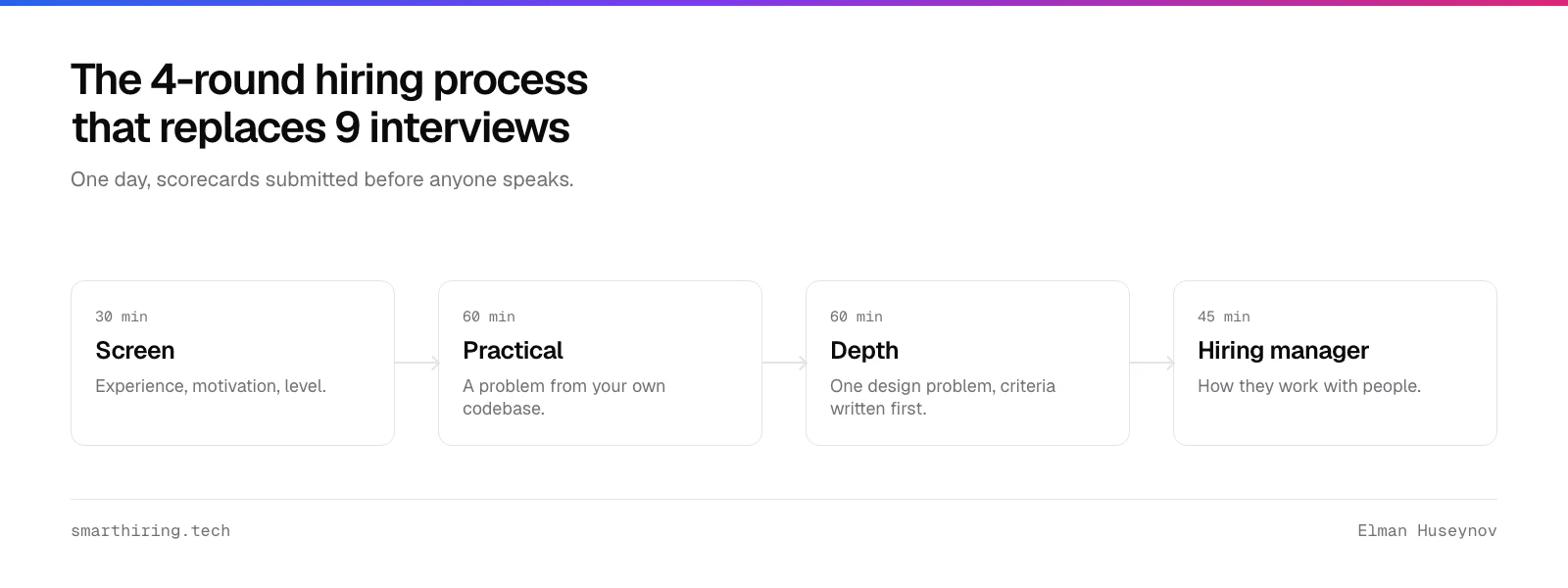
Four cover it. A 30-minute screen. A 60-minute practical round from your own codebase.
A 60-minute depth or design round. A 45-minute hiring manager conversation.
A fifth round adds noise.
Screen, 30 minutes. Experience, motivation, level. Does this person want this job or any job.
Practical coding, 60 minutes. A problem from the actual codebase, stripped down.
Let the candidate use AI, documentation, whatever they use at work. You are hiring the person who will work that way on Monday.
System or technical depth, 60 minutes. One design problem with clear constraints, scored against criteria written in advance.
Hiring manager and team fit, 45 minutes. How they work with people, how they handle disagreement, what they need from a manager.
Change 2: why run it in 1 day?
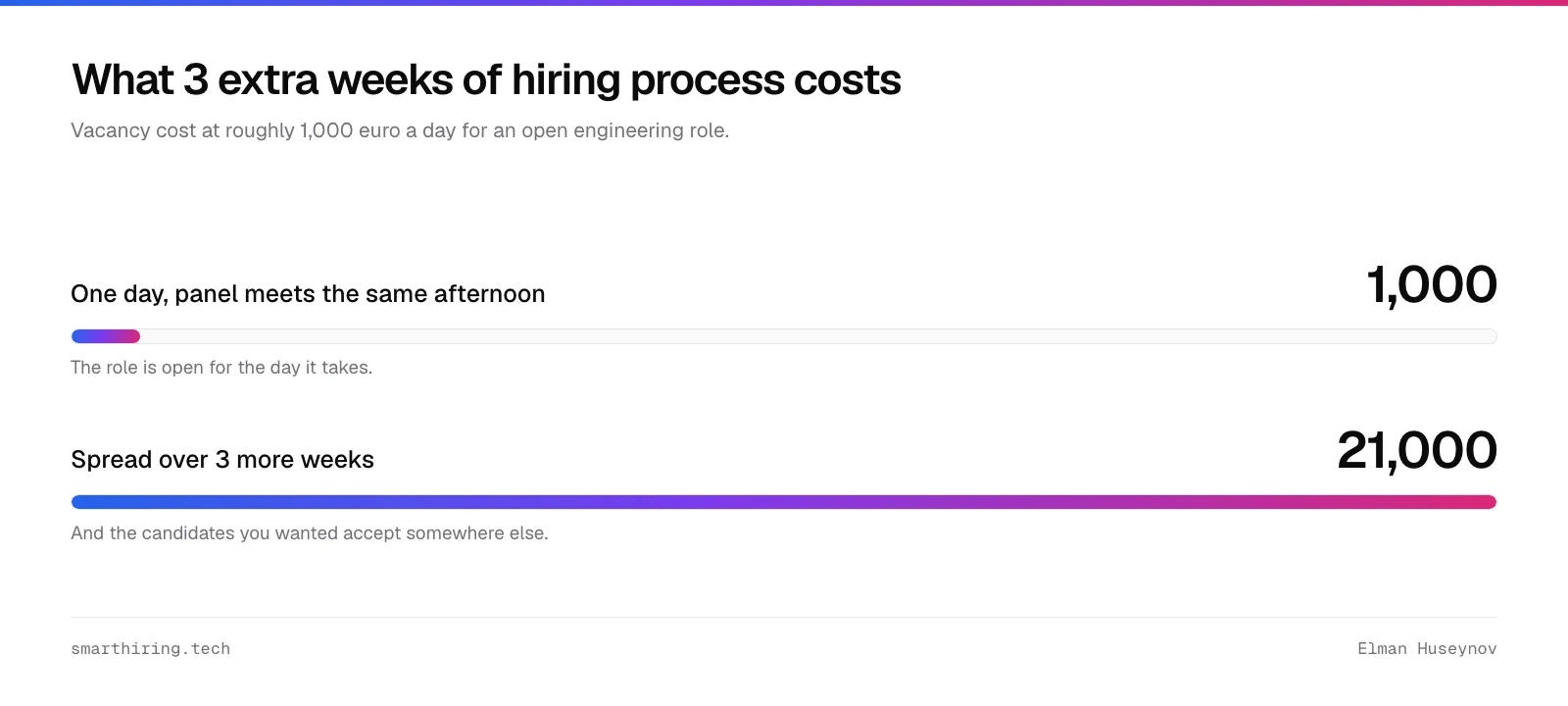
A hiring process spread over 3 weeks loses candidates to companies that decided faster.
One day, on site or remote, with breaks, and the panel meets the same afternoon.
Vacancy cost runs around 1,000 euro a day for an open engineering role.
3 extra weeks of hiring process is not free.
The cost is coordination.
You stop losing the people you wanted. Your engineers spend fewer hours in total.
Nobody re-reads notes from 12 days ago.
Change 3: why do scorecards have to come before the debrief?
Opinions contaminate each other within seconds.
Whoever speaks first sets an anchor. The rest of the panel drifts toward it.
Every interviewer submits score and evidence before anyone speaks.
Including the most senior person in the room.
The debrief then examines disagreement rather than averaging it away.
The scorecard rule is the change with the highest return and the lowest cost.
What this does to the numbers
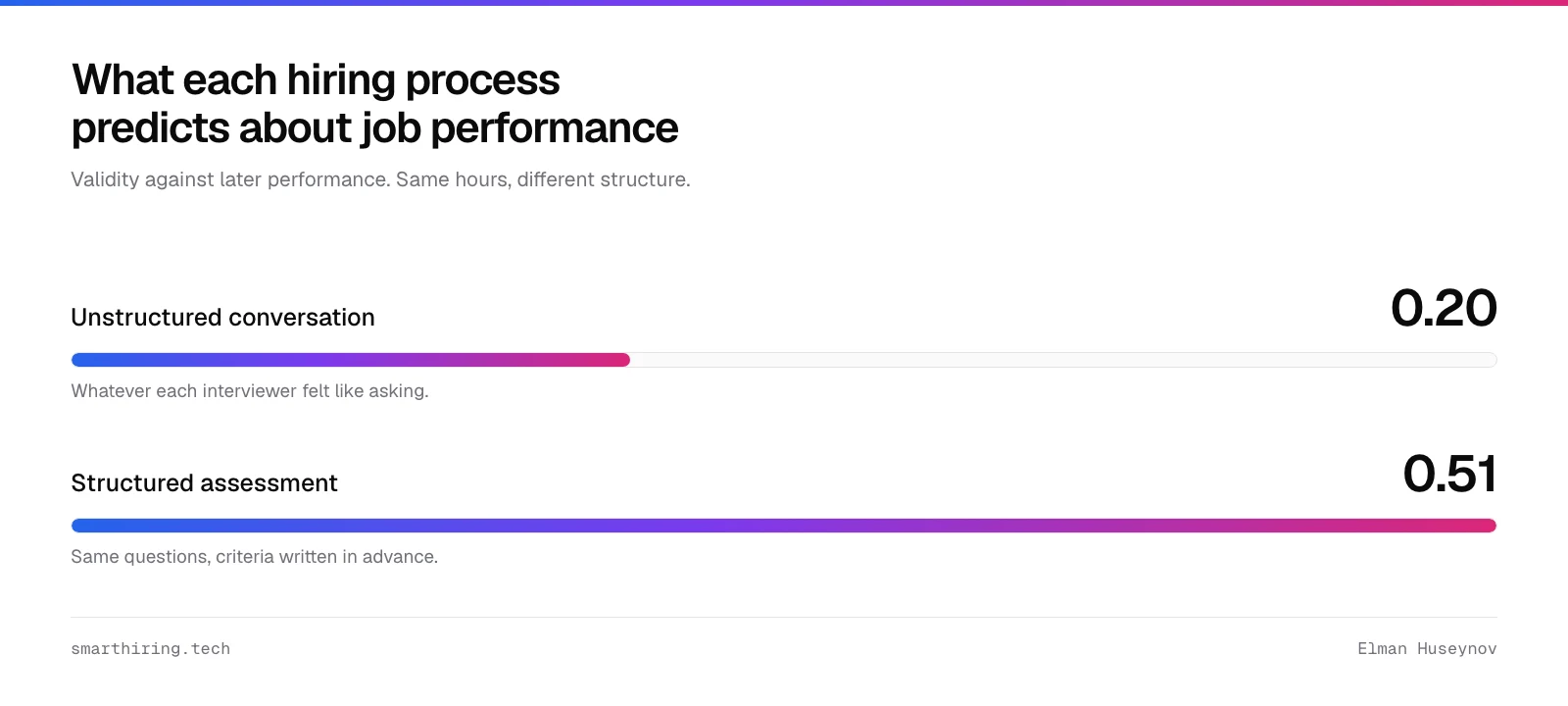
Structured assessment has about 0.51 validity against job performance. Unstructured conversation has about 0.20.
Cutting from 9 interviews to 4 saves roughly 5 to 10 engineering hours per candidate.
Across 5 hires that is close to 288 hours back.
You get better decisions and the saving comes along with it.
What about AI in the coding round?
Give the candidate a task that requires AI. Watch what they ask, what they accept unchecked.
Watch how they validate the output.
An engineer who prompts carelessly and ships the result is a real risk. Now observable.
Watching someone use AI is a far stronger signal than a binary search from memory.
Time spent trying to catch candidates using AI is time not spent designing that task.
What do most teams get wrong when they try this?
Teams change the hiring process without changing the interviewers.
More than 80% of people involved in hiring have had little or no training.
Being a strong engineer does not make someone a strong interviewer.
Shorten the hiring process without calibrating the panel and you have made it faster.
Building systems and evaluating people are different skills.
Where to start
Pick 1 change. The scorecard rule is free and you can apply it to the next debrief.
Look at the length of the hiring process next, then at interviewer training.
Measure one number before you change anything. Days from first contact to offer.
Every change here moves it, and it is the one candidates feel.
Want the whole hiring process rebuilt rather than patched? That is the work I do here.
The process audit is 500 euro and the workshop sprint is 2,500.
Common questions
Can 4 rounds really assess a staff-level candidate?
Yes, with the depth round scoped differently. At staff you use the same 4 slots and change what each looks for. Ambiguity handling, choosing what not to build, influence without authority. Adding a fifth round usually means the panel has not agreed what staff means here.
Is a full day of interviews fair to candidates?
Fairer than 3 weeks of evening calls, in my experience of running both. Give real breaks. Tell them the schedule in advance. Pay for the travel. Candidates who prepare properly handle a single day better than the fragmented version. That one wastes more of their time.
What is a hiring process?
A hiring process is the ordered set of rounds a company runs before an offer. A good one names what each round measures and who decides. Most run 7 to 9 interviews over a month and re-measure the same signal. Four rounds in one day cover it.
Which of the 3 changes should you do first?
Scorecards before the debrief. It is free and needs no scheduling. You can apply it to the next debrief on your calendar. Changing the hiring process length needs coordination, and interviewer training needs budget. Start with the one that costs nothing and shows an effect in one meeting.
What do you do when the panel cannot agree after the debrief?
Go back to the evidence rather than to the room. Ask each interviewer which scorecard line they scored and what the candidate actually said. Disagreement about evidence is resolvable in minutes. Disagreement about a feeling is not. Treat that one as a no.
The short version
4 rounds, 1 day, scorecards submitted before anyone talks.
Train the interviewers or the rest is decoration.
Read next
Why Technical Hiring Is Broken
Most loops measure things nobody agreed on in advance. Here is what that costs, and why I started SmartHiring.
Why Your Interview Loop Rejects Good Engineers
Unstructured interviews explain about 4% of job performance. Structured ones explain 26%. Here is where the signal leaks out, and what to fix first.
The Scorecard Template, Written First
Most hiring problems start before anyone interviews. If you cannot describe a strong answer in advance, the loop will produce noise.
Want this fixed in your loop?
Book a free 20-minute audit call. I’ll show you where your interview quality breaks and what to fix first.